

What size inch bike for 6 year old
For most 6-year-olds, start by trying a 16-inch bike. Choose by measured height and fit, however: 14, 16 or 18 inches may be appropriate depending on the child.
Which wheel size should you check?
The XBikes starting points place a 16-inch bike at ages 4–7 and heights of 40–48 inches (102–122 cm), so it is the usual first comparison for a 6-year-old. Age is only a starting point, not proof that the bike fits.
| Wheel size | XBikes age starting point | Rider height | When to compare it |
|---|---|---|---|
| 14 Inch | Ages 3–6 | 37–45 in / 94–114 cm | For a shorter 6-year-old who can comfortably control it |
| 16 Inch | Ages 4–7 | 40–48 in / 102–122 cm | The normal first size to try at age six |
| 18 Inch | Ages 5–9 | 43–52 in / 109–132 cm | For a taller child, but only after a successful fit check |
| 20 Inch | Ages 7–12 | 48–60 in / 122–152 cm | Usually a later step; consider only when height and control support it |
The height ranges overlap deliberately. A child in an overlap should try both relevant sizes rather than automatically taking the larger one.
Measure height and inseam first
Measure the child without shoes while they stand straight against a wall. Mark the top of the head and measure from the floor for total height. Compare that result with the table before choosing bikes to try.
Then measure inseam. Have the child stand naturally with feet slightly apart. Place a firm, thin book between the legs, level with the floor and raised to simulate the bicycle saddle. Measure from the floor to the top edge of the book. Record the result, but do not convert it directly into a wheel size: frame shapes and stand-over clearance vary.
Confirm the fit on the actual bicycle
Have the child try the exact bike. With both feet on the floor and the bicycle upright, check that they can stand over it without the frame pressing into them. Follow the product manual for the required stand-over setup and adjustments.
Next, seat the child and watch their riding position. They should be able to reach the handlebar without stretching, turn it without losing balance, and look ahead comfortably. Ask them to operate every brake control fitted to that bicycle. They must be able to reach and use it reliably without shifting their hands into an unstable position.
Finally, consider current confidence. A new or hesitant rider may control a smaller suitable bike more easily than a larger bike that merely falls within a height band. Do not buy an oversized bicycle for future growth. If the child cannot start, steer, stop or place their feet as the manual requires, try another size or frame.
How the supplied 14-inch and 16-inch bikes help
The Purple XJD Girls' Bike with Doll Seat & Basket and the Black XJD Kids' BMX Bicycle with Training Wheels each have 12 Inch, 14 Inch and 16 Inch SKU labels. Their 16-inch versions therefore provide direct comparison options for the usual starting size, while their 14-inch versions let a shorter child compare the adjacent size. Neither supplied product offers an 18-inch or 20-inch label, so these products are not substitutes when the fit check indicates either of those sizes.
 Purple XJD Girls' Bike with Doll Seat & Basket
Available in 12 Inch, 14 Inch and 16 Inch labels. Its 16-inch option matches the usual first size to try for a 6-year-old, while 14 inches offers an adjacent comparison for a shorter rider.
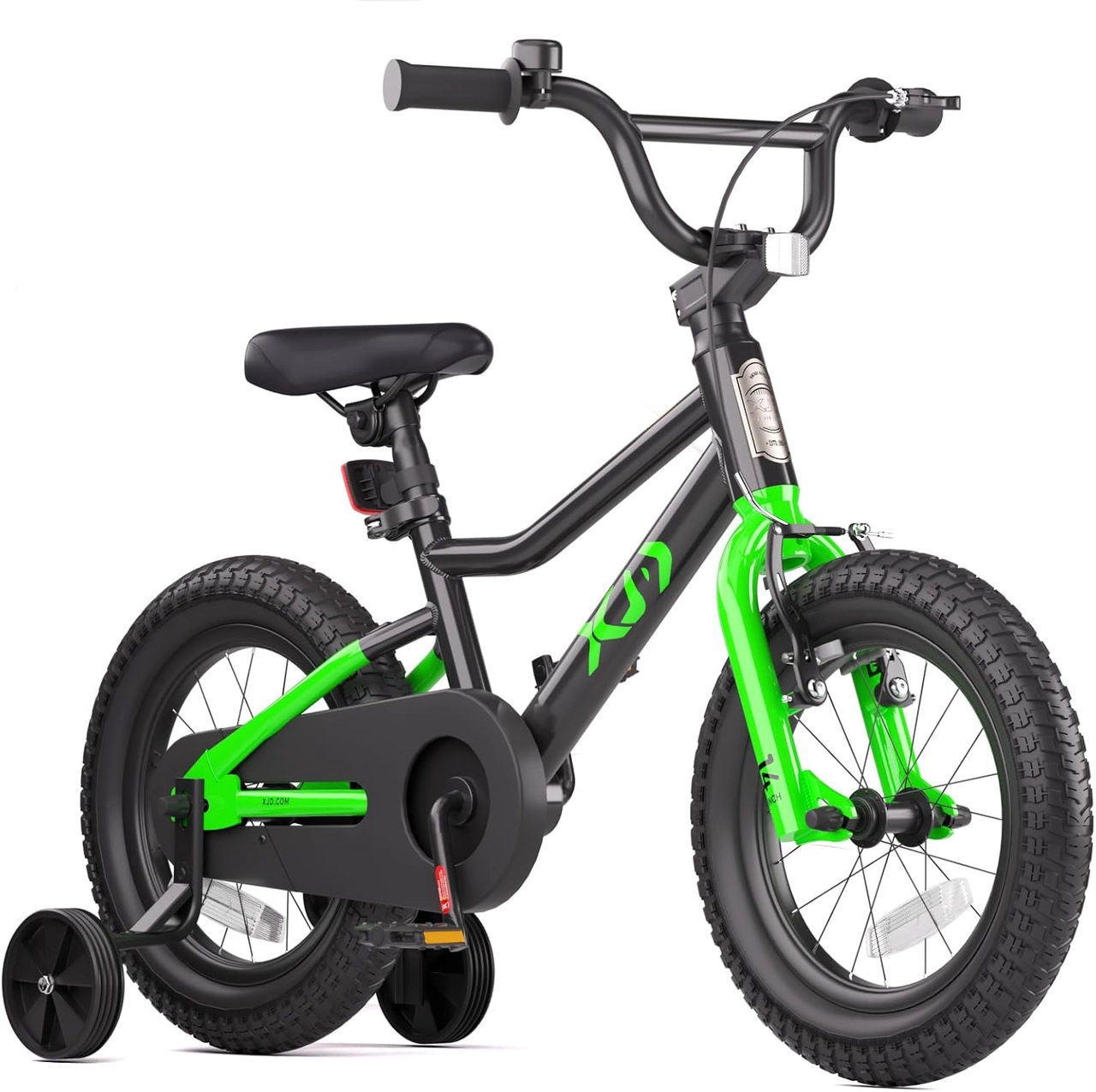 Black XJD Kids' BMX Bicycle with Training Wheels
This kids' BMX bike has 12 Inch, 14 Inch and 16 Inch labels. Compare its 16-inch version first for many 6-year-olds, but use the 14-inch version when measurements and an individual fit check support the smaller size.
The catalog classifies the Purple XJD Girls' Bike with Doll Seat & Basket as a training-wheel bike and the Black XJD Kids' BMX Bicycle with Training Wheels as a kids' BMX bike. Those labels help distinguish the options, but they do not establish fit. Compare the exact SKU label and the child's control on the assembled bicycle.
What to do after choosing a likely size
- Shortlist by height: begin with the wheel-size bands above.
- Try the exact bicycle: verify stand-over space, reach, steering and access to its brake controls.
- Reject excess size: move down when the child stretches, struggles to stop or appears less confident.
- Follow the manual: use the exact product instructions for assembly, adjustment, maintenance, load limits, compatibility and torque. When uncertain, use a qualified bicycle mechanic.
- Fit a helmet: use a bicycle helmet that fits properly, sits level and has straps adjusted according to its manufacturer's instructions.
The decision for a 6-year-old
Measure height and inseam, then arrange a 16-inch test ride first when the child is 40–48 inches (102–122 cm) tall. Compare 14 inches for a shorter rider or 18 inches for a taller rider within the stated bands. Buy only the size on which this particular 6-year-old can stand over, reach, steer and brake with confident control.
Bikes for your next adventure
-

XJD Girls Bike for Kids Ages 3-8, 12/14/16 Inch with Training Wheels – Purple
The XJD Girls Bike in Purple is a training-wheel bicycle for kids ages 3 to 8, f…$149
$169 -

Pink Girls' 12/14/16" Bike by XJD – Basket & Doll Seat
The XJD Pink Girls' Bike with Basket & Doll Seat is made for riders 71–122 cm ta…$75.99
$99.99 -
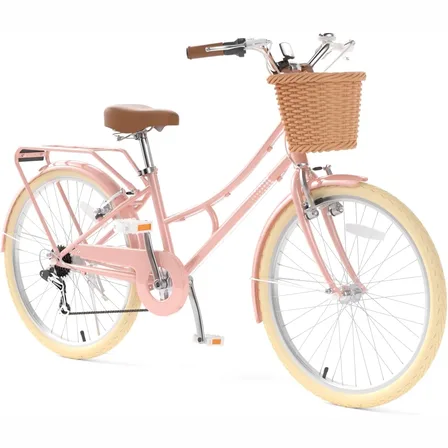
XJD Pink Beach Cruiser for Girls – Rear Rack & V-Brake
The XJD Pink Beach Cruiser for girls is the step-up bike for riders who've outgr…$179.99
$209.99