

What size would a 20 in bike fit
A 20-inch bike generally fits a child 48–60 inches (122–152 cm) tall, often around ages 7–12, but only an individual fit check can confirm it.
Start with height, then measure inseam
Measure the child without shoes, standing straight against a wall. Record total height from the floor to the top of the head. For inseam, have the child stand with feet slightly apart and measure from the floor to the crotch. Use the height range as the first screening check and the inseam when assessing stand-over clearance.
The XBikes starting point for a 20-inch wheel is 48–60 inches (122–152 cm) in rider height. The age range of 7–12 is only a rough guide. A shorter, taller, less confident or more experienced child may need a different size despite being within that age range.
What a correct 20-inch fit should look like
Have the child try the assembled bicycle rather than choosing from age or wheel diameter alone. With the child standing over the frame, there should be usable clearance instead of contact or an awkward tiptoe stance. The exact clearance depends on the bicycle’s frame shape, so check the product manual if it specifies a method.
Next, place the child in the riding position and check these points:
- The child can get on and off without struggling or leaning the bicycle sharply.
- The handlebars are reachable without locking the elbows, stretching the torso or losing steering control.
- The child can operate the brakes comfortably and reliably with the controls supplied on that exact bicycle.
- Starting, stopping and turning feel controlled at the child’s current confidence level.
If any of these checks fail, the nominal 20-inch size is not a suitable fit yet. Do not buy an oversized bicycle merely to leave room for growth.
Compare 20 inches with the adjacent sizes
Wheel size is a category, not a complete geometry measurement. Use this compact comparison to decide which bicycles are worth trying:
| Wheel size | Starting age | Rider height | When to consider it |
|---|---|---|---|
| 16 Inch | 4–7 | 40–48 in / 102–122 cm | Compare when the rider is below the 20-inch height range or cannot control a 20-inch bicycle. |
| 18 Inch | 5–9 | 43–52 in / 109–132 cm | Compare near the lower end of the 20-inch range when reach or confidence makes the larger bicycle difficult. |
| 20 Inch | 7–12 | 48–60 in / 122–152 cm | Try when measured height is in range, then confirm stand-over, reach and brake control. |
| 24 Inch | 10–14 | 54–64 in / 137–163 cm | Compare near the upper end only if the child can pass every individual fit and control check. |
These ranges overlap because children with the same height can have different inseams, arm lengths and riding confidence. A wheel-size chart narrows the search; it does not settle the purchase.
How the supplied XBikes options relate
The XJD Kids Bike for Girls – Pink, 12/14/16/20 Inch with Training Wheels includes a supplied 20 Inch SKU label, so it is directly relevant for a child who meets the starting range and passes an individual fit check. Its other listed sizes—12, 14 and 16 Inch—also make it useful when comparing a smaller wheel category.
The XJD Light Purple Girls Bike with Basket, Training Wheels, 12/14/16/20 Inch has 12, 14 and 16 Inch among the supplied available SKU labels, but no available 20 Inch label is supplied. Although “20 Inch” appears in its exact catalog title, treat it only as a smaller-size comparison option unless a 20-inch selection is separately verified; the title itself is not proof of current size availability or fit. These catalog choices help clarify the requested size by showing one listed 20-inch option and one nearby smaller-size comparison.
 XJD Kids Bike for Girls – Pink, 12/14/16/20 Inch with Training Wheels
Directly relevant because the supplied SKU labels include 20 Inch, alongside 12, 14 and 16 Inch comparison sizes. Confirm the child’s measured height, stand-over, reach, brake control and confidence on the actual bicycle.
 XJD Light Purple Girls Bike with Basket, Training Wheels, 12/14/16/20 Inch
Its supplied available SKU labels are 12, 14 and 16 Inch, despite 20 Inch appearing in the exact catalog title. Use it as a smaller-size comparison unless a 20-inch selection is separately verified.
Both products are categorized as Training Wheel Bikes. Training wheels do not make an incorrectly sized frame fit, and their presence does not replace checks for reach, braking and control. Follow the exact product manual for assembly, adjustment, compatibility, maintenance and limits not stated here, or use a qualified bicycle mechanic.
Run a final check before deciding
- Confirm that measured height is within or reasonably near the 48–60 inch (122–152 cm) starting range.
- Compare the child’s inseam with the actual frame by checking stand-over clearance.
- Watch the child mount, reach the bars, operate the brakes, start, stop and turn.
- Choose a smaller comparison size if the 20-inch bicycle causes stretching, unstable starts or poor brake control.
- Fit a bicycle helmet properly: it should sit level, with its straps adjusted according to the helmet manufacturer’s instructions.
A 20-inch bike is the right size only when the child falls around the stated height range and can control that specific bicycle now. Measure first, arrange a real fit check, and reject the 20-inch option if stand-over, reach, braking or confidence is not satisfactory.
Bikes for your next adventure
-
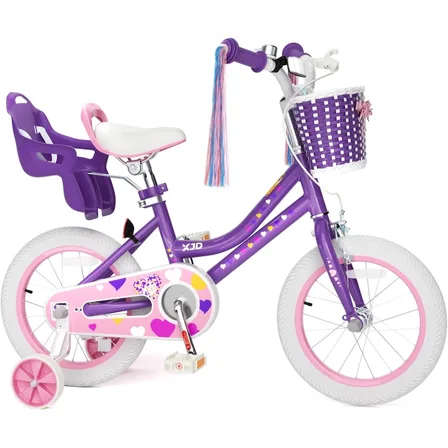
Purple XJD Girls' Bike with Doll Seat & Basket
For girls 71–122 cm tall (about ages 3–7), this XJD girls' bike in Purple pairs …$75.99
$99.99 -

XJD 24-Inch Green Beach Cruiser Bike with U-Brake
This XJD 24-inch beach cruiser in green is made for riders about 4'8" to 5'4" ta…$159.99
$199.99 -

Kids Bike Helmet by XJD for Boys & Girls – Black, Blue, Green, Pink, Purple
The XJD Kids Bike Helmet covers a wide 2-to-8-year age range thanks to two head-…$59.99