

When can child ride a bike
A child can ride a bike when they can balance, steer, stop and follow simple directions on a bicycle that fits their body and confidence.
Readiness matters more than a birthday
Age gives only a rough starting point. Before moving ahead, look for practical readiness: the child willingly sits on the bike, keeps attention on the path, turns the handlebar without losing control and understands when to stop. They should also be able to reach and operate the bicycle’s braking controls without stretching or changing their grip dangerously.
Confidence matters, but it should not be confused with speed. A cautious child who can control a correctly fitted bike may be ready, while an eager child who cannot stop reliably needs more preparation. Begin in a flat area away from traffic, obstacles and steep slopes, with close adult supervision.
Measure the child before choosing a bike
Measure the child’s height without shoes, standing straight against a wall. Also measure inseam from the floor to the crotch. Height helps identify possible wheel sizes; inseam helps determine whether the child can stand over the bicycle comfortably.
Then have the child try the actual bike. Check that they can stand over it with stable footing, sit without feeling stretched, reach the handlebar while keeping comfortable control and turn it in both directions. Confirm that their hands can reach and operate the braking controls. The American Academy of Pediatrics advises trying the bicycle rather than buying an oversized model for future growth.
A child who cannot mount, stand over, steer or brake comfortably is not ready for that particular bike, even if their age appears in its suggested range. Do not treat tiptoes, an extreme reach or difficulty squeezing the controls as problems the child will simply grow into.
Compare the measurement with these starting points
Use the child’s measured height first and age only as supporting context. Overlapping ranges are intentional: two wheel sizes may deserve a trial, but neither is confirmed until reach, stand-over clearance, brake control and confidence are checked on the individual bicycle.
| Wheel size | Age starting point | Rider-height starting point |
|---|---|---|
| 12 Inch | 3–4 | 34–40 in / 86–102 cm |
| 14 Inch | 3–6 | 37–45 in / 94–114 cm |
| 16 Inch | 4–7 | 40–48 in / 102–122 cm |
| 18 Inch | 5–9 | 43–52 in / 109–132 cm |
| 20 Inch | 7–12 | 48–60 in / 122–152 cm |
| 24 Inch | 10–14 | 54–64 in / 137–163 cm |
| 26 Inch | Youth and adults | Over 60 in / 153 cm |
If the child falls within an overlap, compare both candidate sizes in person. Choose according to actual control rather than the larger number. If neither candidate permits comfortable footing, steering and braking, pause and seek help from a qualified bicycle mechanic.
Where the supplied bike is relevant
The Black XJD Kids Bike for Boys – 12, 14 & 16 Inch Sizes is a Training Wheel Bikes option with 12 Inch, 14 Inch and 16 Inch SKU labels. Those three sizes provide catalog options across the smaller starting ranges in the table, so parents can compare the child’s measured height with a potentially relevant label before carrying out the required hands-on fit check. Its category does not establish readiness, fit or riding ability by itself.

This product is relevant only when the measured child falls near the supplied starting range for one of its available wheel sizes and can control that exact bicycle. It does not provide an 18, 20, 24 or 26 Inch option, so families whose measurements point toward those sizes should treat its 16 Inch version only as a nearest-size comparison point, not an equal or substitute.
Complete a short control check
- Let the child mount and dismount without being lifted into position.
- Check stable footing and comfortable stand-over clearance.
- Watch for a relaxed reach to the handlebar and controlled steering.
- Confirm that the child can reach and operate the braking controls reliably.
- Ask the child to start, travel slowly, turn and stop in a flat, traffic-free practice area.
Stop the check if the child appears frightened, cannot follow directions or repeatedly loses control. Readiness can change with practice; there is no benefit in forcing the transition on a particular date.
Prepare for the first rides
Use a bicycle helmet that fits properly, sits level and has its straps adjusted according to the helmet manufacturer’s instructions, consistent with U.S. Consumer Product Safety Commission guidance. Choose a controlled practice space and supervise closely while the child develops reliable starting, steering and stopping habits.
For assembly, maintenance, adjustments, load limits, compatibility and torque, follow the exact bicycle’s product manual or use a qualified bicycle mechanic. Before deciding that your child can ride, measure height and inseam today, compare the appropriate wheel-size range, and approve the bike only after the child passes the hands-on fit and control check.
Bikes for your next adventure
-

Black XJD Kids Bike for Boys – 12, 14 & 16 Inch Sizes
For a son between roughly 3 and 8 years old, the XJD Kids Bike in Black covers t…$169
$199 -

Blue XJD Girls Bike with Training Wheels – 12/14/16 Inch
If you're shopping for a first pedal bike for a daughter roughly 3 to 8 years ol…$149
$169 -
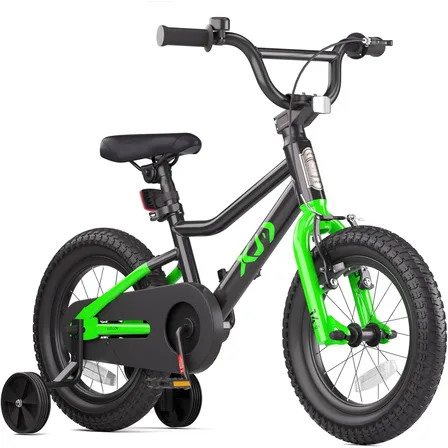
Black XJD Kids' BMX Bicycle with Training Wheels
The XJD Kids' BMX Bicycle with Training Wheels is built for children roughly 3 t…$99.99
$119.99