

When do kids start learning to ride a bike
Children often start learning between ages 3 and 6, but readiness matters more than a birthday. Measure the child, check control and confidence, then choose a bike they can handle now—not one sized for future growth.
What “ready to learn” looks like
A child is ready to begin when they want to try, can follow simple directions and can stay engaged without becoming overwhelmed. Learning may start with mounting, steering and stopping rather than immediately riding independently.
Confidence also affects the right starting setup. A cautious beginner may benefit from extra stability while learning to pedal and steer. A child who already balances comfortably may be ready to practise without that support. Avoid treating siblings of the same age as though they need identical bikes.
Measure before comparing wheel sizes
Measure the child’s standing height and inseam while they wear the shoes they will normally use for riding. Height narrows the wheel-size range; inseam helps determine whether the individual bicycle offers comfortable stand-over clearance.
The child must try the actual bike. Check that they can stand over it, get on and off without struggling, reach the handlebar without stretching, turn it with control and operate the brakes comfortably. Do not buy an oversized bicycle merely to allow room for growth.
XBikes wheel-size starting points
| Wheel size | Starting age | Rider height |
|---|---|---|
| 12 Inch | 3–4 | 34–40 in / 86–102 cm |
| 14 Inch | 3–6 | 37–45 in / 94–114 cm |
| 16 Inch | 4–7 | 40–48 in / 102–122 cm |
| 18 Inch | 5–9 | 43–52 in / 109–132 cm |
| 20 Inch | 7–12 | 48–60 in / 122–152 cm |
| 24 Inch | 10–14 | 54–64 in / 137–163 cm |
| 26 Inch | Youth and adults | Over 60 in / 153 cm |
These ranges are starting points, not guarantees. Where sizes overlap, compare the child’s inseam, reach, brake control and confidence on each candidate. The smaller manageable option is generally more appropriate than a larger bike the child cannot confidently control.
When the supplied training-wheel bikes are relevant
The two catalog options help answer when children can start because both are training-wheel bikes offered in 12 Inch, 14 Inch and 16 Inch choices. Those sizes cover XBikes starting ranges from ages 3–4 through 4–7, subject to measured height and an individual fit check.
 Blue XJD Girls Bike with Training Wheels – 12/14/16 Inch
Relevant for beginners who fit an individually checked 12, 14 or 16 Inch bicycle and may benefit from training wheels; available size labels are the only supplied basis for comparison.
 XJD Boys 12/14/16" Training Wheel Bike – Blue
A blue training-wheel bicycle offered in 12, 14 and 16 Inch labels. Consider it only after measured height, inseam, reach, brake control and confidence confirm a suitable current fit.
Blue XJD Girls Bike with Training Wheels – 12/14/16 Inch is available with 12 Inch, 14 Inch and 16 Inch labels. XJD Boys 12/14/16" Training Wheel Bike – Blue has the same three available size labels. Based on the supplied facts, wheel-size label and title are the meaningful comparison points; no difference in components, materials, weight or braking system has been established.
These products are relevant when the child fits one of those three wheel-size ranges and training wheels suit their present confidence. They are not relevant when the child’s measurements and control indicate an 18 Inch or larger bicycle, or when a fit check shows that none of the available versions can be handled comfortably. A 16 Inch model is not a substitute for an indicated 18 Inch size.
What to do during the first sessions
- Choose a level area away from traffic and obstacles.
- Fit a bicycle helmet so it sits level, fits properly and uses its straps according to the helmet manufacturer’s instructions.
- Let the child practise mounting, looking ahead, steering and stopping before expecting continuous riding.
- Keep the experience calm and stop before fatigue or frustration erodes control.
- Recheck fit and brake reach as confidence develops and the child grows.
Training wheels can support early pedaling and steering practice, but readiness to remove or adjust them depends on the child and the bicycle. Follow the exact product manual for assembly, adjustment, maintenance, compatibility and load limits. If instructions are missing or the setup is uncertain, use a qualified bicycle mechanic rather than inventing an adjustment procedure.
Make the decision from today’s fit
Start with the child’s measured height and inseam, identify the matching wheel-size range, and then have them try the bicycle. Proceed only if stand-over clearance, reach, braking and steering are manageable now. For the supplied products, compare the 12, 14 and 16 Inch versions only when the child falls within those starting ranges and benefits from training-wheel support; otherwise, continue the fit search in the size their measurements indicate.
Bikes for your next adventure
-

XJD Girls Bike for Kids Ages 3-8, 12/14/16 Inch with Training Wheels – Purple
The XJD Girls Bike in Purple is a training-wheel bicycle for kids ages 3 to 8, f…$149
$169 -
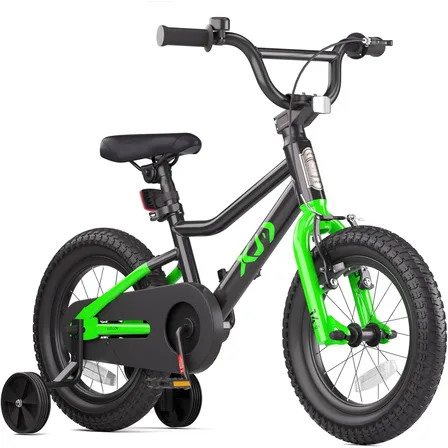
Black XJD Kids' BMX Bicycle with Training Wheels
The XJD Kids' BMX Bicycle with Training Wheels is built for children roughly 3 t…$99.99
$119.99 -

XJD Kids Bike for Girls – Pink, 12/14/16/20 Inch with Training Wheels
The XJD Kids Bike for Girls in Pink is a training-wheel bike built to carry your…$139
$159