

When do most kids learn to ride a bike
Most kids learn to ride a bike between ages 3 and 8, but readiness matters more than a birthday. Measure height and inseam, then check control and confidence on the actual bicycle.
What is the usual learning age?
There is no single correct age. Some children begin balancing and pedaling around 3 or 4, while others learn comfortably at 7, 8 or later. A child is more likely to progress when they want to try, can follow simple directions and feel secure enough to practice.
Do not treat the broad 3-to-8 range as a fit standard. Age can suggest where to start looking, but measured height, inseam, reach, brake control and current confidence should decide whether a particular bicycle works.
Measure before choosing a wheel size
Measure the child without shoes, standing straight against a wall. Record total height. For inseam, place a book firmly between the legs to approximate the saddle contact point, then measure from the floor to the top edge of the book.
Use the measurements to narrow the options below. Overlapping ranges are intentional: two wheel sizes may appear plausible, but only an individual fit check can resolve the choice.
| Wheel size | Starting age | Rider height |
|---|---|---|
| 12 Inch | 3–4 | 34–40 in / 86–102 cm |
| 14 Inch | 3–6 | 37–45 in / 94–114 cm |
| 16 Inch | 4–7 | 40–48 in / 102–122 cm |
| 18 Inch | 5–9 | 43–52 in / 109–132 cm |
| 20 Inch | 7–12 | 48–60 in / 122–152 cm |
| 24 Inch | 10–14 | 54–64 in / 137–163 cm |
| 26 Inch | Youth and adults | Over 60 in / 153 cm |
These are starting points, not permission to buy a bicycle the child cannot yet control. Never choose an oversized model simply to allow room for growth.
Check readiness on the actual bicycle
Have the child try the bicycle before committing to it. The fit should let them manage the bike rather than merely occupy the seat. Check these points together:
- Stand-over: the child can straddle the bicycle without the frame preventing a stable stance.
- Ground contact: they can stop and support themselves with confidence during learning.
- Reach: they can hold the handlebar without stretching, locking their arms or losing a comfortable posture.
- Brake control: they can reach and operate the controls reliably with their hands in a normal riding position.
- Handling: they can start, steer, stop and move the bicycle without appearing overwhelmed by its size.
If one of these checks fails, compare another size or configuration. A larger bicycle is not equivalent merely because the child falls within an overlapping age range.
What to do during the first practice sessions
Choose a flat, open area away from traffic and obstacles. Begin with short sessions focused on looking ahead, balancing, steering and stopping. Let the child set the pace; fatigue or frustration usually makes control worse.
- Practice mounting, standing over the frame and stopping before adding speed.
- Work on balance and steering in a straight, predictable space.
- Add pedaling only when the child can remain composed and control direction.
- Finish while confidence is still intact, then repeat another day.
A bicycle helmet should fit properly, sit level and have its straps adjusted according to the helmet manufacturer’s instructions. Recheck the fit whenever the helmet is adjusted or replaced.
How the supplied catalog option fits this decision
The 26-Inch XJD Beach Cruiser Bike for Girls – Purple, V-Brake is offered under the supplied catalog facts in 20 Inch, 24 Inch and 26 Inch SKU labels, with color choices varying by size. Those sizes are most relevant when comparing options for taller or older children who are learning later, or riders moving beyond smaller learning bikes.
These particular catalog options help answer the title by showing where later-learning riders may begin their comparison: 20 Inch starts at 48–60 in / 122–152 cm, 24 Inch at 54–64 in / 137–163 cm, and 26 Inch only for youth and adults over 60 in / 153 cm. They are not substitutes for the smaller 12-, 14-, 16- or 18-inch sizes that may suit many children learning earlier.

Use the exact SKU label only after matching the child’s measurements and completing the stand-over, reach, brake-control and confidence checks. For assembly, adjustment, maintenance, load limits, compatibility or torque requirements, follow the exact product manual or use a qualified bicycle mechanic.
The decision to make today
If your child is interested and can control a correctly fitted bicycle, it is a reasonable time to begin—whether that is at 3, 6, 8 or later. Measure height and inseam now, shortlist the corresponding wheel sizes, and let the child try them. Choose the size they can confidently straddle, reach, steer and stop, not the size you hope they will grow into.
Bikes for your next adventure
-

Black XJD Kids Bike for Boys – 12, 14 & 16 Inch Sizes
For a son between roughly 3 and 8 years old, the XJD Kids Bike in Black covers t…$169
$199 -

Blue XJD Girls Bike with Training Wheels – 12/14/16 Inch
If you're shopping for a first pedal bike for a daughter roughly 3 to 8 years ol…$149
$169 -
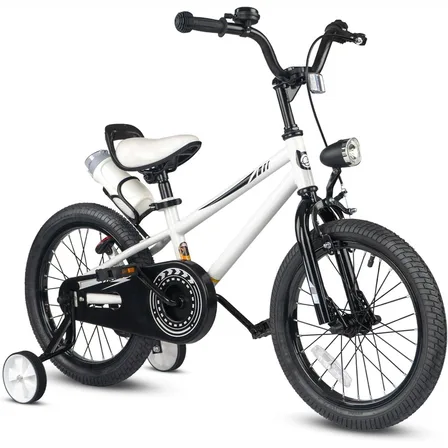
XJD Kids' Training Wheel Bike for Boys & Girls, 12/14/16 Inch – White
The XJD kids' training wheel bike in White is made for riders ages 3–8 (roughly …$169
$199