

When do you teach a kid to ride a bike
Teach a child to ride when they can balance, steer, stop, follow simple directions and want to practise—not at a fixed birthday.
Use readiness, not age, as the deciding test
Many children become interested in cycling during the preschool or early school years, but age alone cannot tell you when to begin. Start when your child willingly sits on a correctly fitted bicycle, keeps their attention on a short task and understands instructions such as “stop,” “slow down” and “look ahead.”
Watch what happens during a calm trial. A ready learner can hold the handlebar without fighting the bicycle, place their feet down promptly, steer around a gentle turn and operate the available brakes with control. Hesitation is normal; distress, repeated freezing or an inability to stop means it is better to pause, adjust the fit or return another day.
Measure before choosing a bicycle
Measure the child’s height without shoes. Check inseam as well, because two children of equal height can have different leg lengths. Then have the child try the actual bicycle. They need comfortable stand-over clearance, an easy reach to the handlebar and reliable access to the brake controls. Do not buy an oversized bicycle for future growth.
| Wheel size | XBikes age starting point | Rider-height starting point |
|---|---|---|
| 12 Inch | 3–4 | 34–40 in / 86–102 cm |
| 14 Inch | 3–6 | 37–45 in / 94–114 cm |
| 16 Inch | 4–7 | 40–48 in / 102–122 cm |
| 18 Inch | 5–9 | 43–52 in / 109–132 cm |
| 20 Inch | 7–12 | 48–60 in / 122–152 cm |
| 24 Inch | 10–14 | 54–64 in / 137–163 cm |
| 26 Inch | Youth and adults | Over 60 in / 153 cm |
These ranges are starting points, not fit guarantees. Where sizes overlap, compare the child’s measured height, inseam, reach, brake control and present confidence on each bicycle. The correct choice is the one they can control now.
Choose the learning setup that matches current confidence
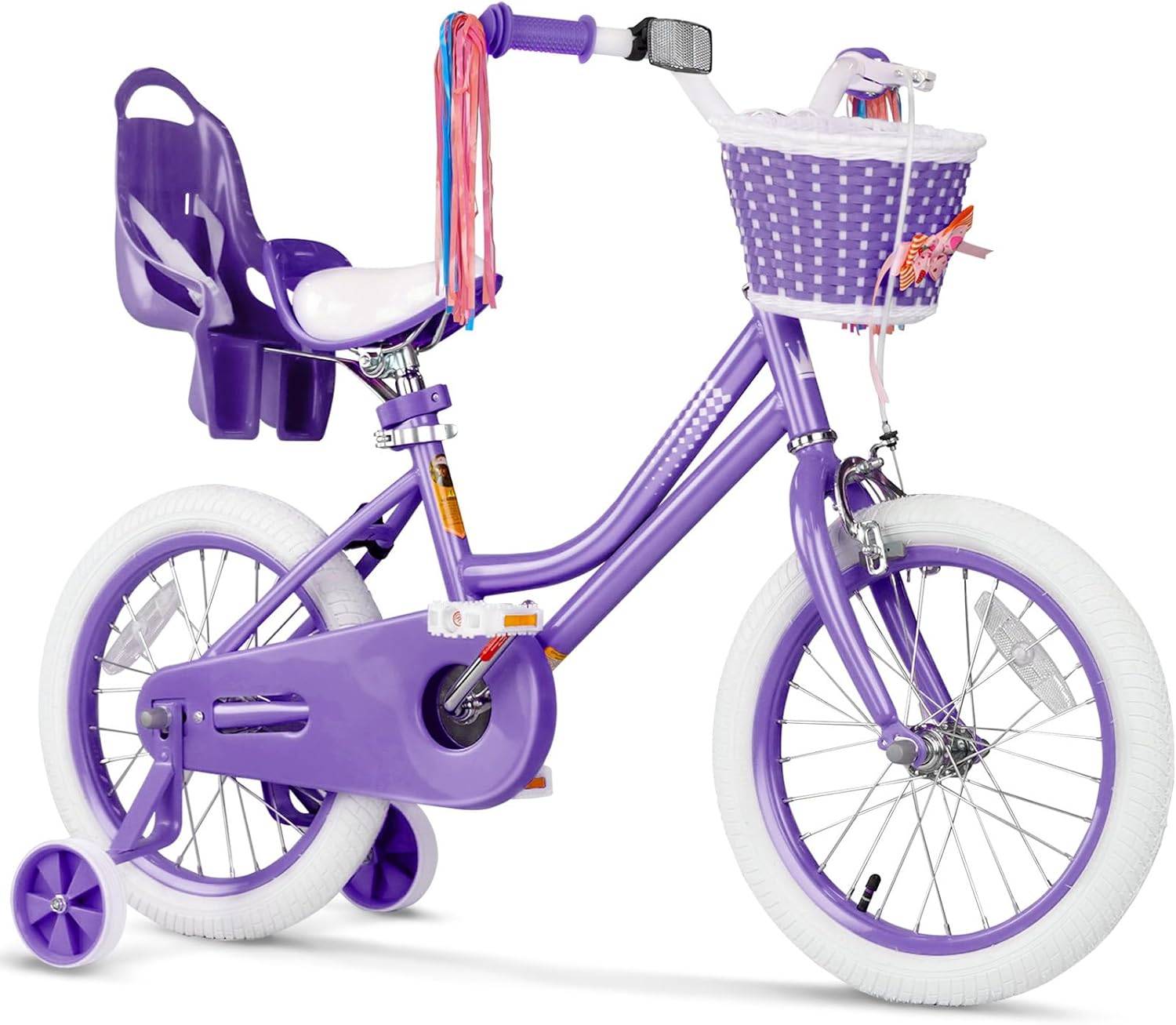
A child who can already glide and balance may be ready to learn on two wheels. One who is still developing balance may begin with a more supported setup. Training wheels can provide lateral support while a child practises pedalling and steering, but they do not remove the need to learn independent balance.
The supplied catalog option helps with this decision because it is specifically categorized as a training-wheel bike and offers three wheel-size labels that cover several common early-learning starting points. The XJD Girls Bike for Kids Ages 3-8, 12/14/16 Inch with Training Wheels – Purple is available in 12 Inch, 14 Inch and 16 Inch choices. The “Ages 3-8” wording is part of its catalog title, not evidence that it fits every child in that span; compare the selected size with the XBikes measurements above and perform an individual fit check.
Run a short first lesson
- Choose a flat, open area away from traffic, slopes and obstacles.
- Fit the helmet before riding. It should sit level, fit properly and have its straps adjusted according to the helmet manufacturer’s instructions.
- Let the child practise getting on, getting off and stopping before adding speed.
- Work on looking ahead and steering toward a nearby marker.
- Keep the session brief enough that attention and confidence remain intact.
Stand close enough to help, but avoid pulling the handlebar, which can interfere with steering. Give one instruction at a time. End after a small success—such as a controlled stop—rather than waiting for fatigue or frustration.
Know whether to continue, adjust or wait
Continue when the child remains interested, can repeat controlled starts and stops, and recovers calmly from a wobble. Adjust the bicycle or compare another size if they stretch for the handlebar, cannot reach or operate the brakes reliably, struggle to put a foot down, or appear cramped.
Wait if the child consistently refuses, cannot follow stop instructions or becomes increasingly frightened. Readiness can change quickly, so a pause is not failure. Try another low-pressure fit check later rather than pushing through fear.
Before riding, follow the exact bicycle manual for assembly, adjustments, maintenance and load limits; use a qualified bicycle mechanic when anything is uncertain. Your next decision is simple: measure height and inseam, try the correctly sized bicycle, confirm reach and stopping control, then teach only if the child is willing and in command of the bike.
Bikes for your next adventure
-

Kids Bike Helmet by XJD for Boys & Girls – Black, Blue, Green, Pink, Purple
The XJD Kids Bike Helmet covers a wide 2-to-8-year age range thanks to two head-…$59.99
-

Kids Bike Helmet by XJD for Girls – Pink
The XJD Kids Bike Helmet in Pink is a lightweight multi-sport helmet for girls r…$59.99
$99 -

XJD Kids Bike for Girls – Pink, 12/14/16/20 Inch with Training Wheels
The XJD Kids Bike for Girls in Pink is a training-wheel bike built to carry your…$139
$159