

When does a child start riding a bike
A child starts riding a bike when they can balance, steer, stop and follow simple directions on a bicycle that fits—not at one universal age.
Use readiness, not a birthday, as the deciding point
Age is only a starting point because children of the same age can differ greatly in height, reach, coordination and confidence. A willing child who can walk or run steadily, look ahead while moving and respond to instructions may be ready to practise. A child who is frightened, cannot control the bicycle or cannot reach its controls needs more time or a different fit.
Do not buy an oversized bicycle for the child to grow into. The child should try the actual bike whenever possible. Check whether they can mount and dismount without struggling, stand over it comfortably, hold the handlebar without stretching, turn it through a useful range and operate the brakes with control.
Measure before comparing wheel sizes
Measure the child without shoes against a wall for total height. Then measure the inseam from the floor to the crotch while the child stands upright with feet slightly apart. Height narrows the wheel-size range; inseam helps you judge stand-over clearance and how manageable mounting will be.
Use the following XBikes figures only as starting points. Overlapping ranges are intentional, so a measured fit check must decide between adjacent sizes.
| Wheel size | Starting age | Rider height |
|---|---|---|
| 12 Inch | 3–4 | 34–40 in / 86–102 cm |
| 14 Inch | 3–6 | 37–45 in / 94–114 cm |
| 16 Inch | 4–7 | 40–48 in / 102–122 cm |
| 18 Inch | 5–9 | 43–52 in / 109–132 cm |
| 20 Inch | 7–12 | 48–60 in / 122–152 cm |
| 24 Inch | 10–14 | 54–64 in / 137–163 cm |
| 26 Inch | Youth and adults | Over 60 in / 153 cm |
If height points to two sizes, compare both in person. Prefer the bicycle the child can control now: they should not need to lean, lunge or release their grip to reach a brake control. Confidence on the smaller option matters more than theoretical growing room.
What to check during the bike trial
- Stand-over: Ask the child to straddle the bicycle and confirm that the frame does not obstruct a comfortable stance.
- Reach: Watch for relaxed arms and secure hands on the grips rather than a stretched upper body.
- Steering: Have the child turn the handlebar both ways while remaining balanced and in control.
- Braking: Confirm that the child can reach and operate the available brake controls without losing grip or position.
- Confidence: Start in a flat, open area away from traffic. Stop if fear or poor control increases.
A correctly sized bicycle can still be unsuitable on that day if the child cannot coordinate starting, steering and stopping. Short practice sessions are more useful than pressure to ride independently by a particular age.
How the supplied bicycles help with comparison
These catalog options cover several XBikes starting points and let a parent compare training-wheel, BMX and beach-cruiser categories across 12, 14, 16, 20, 24 and 26 Inch labels. They help narrow the trial size, but their labels cannot replace measured height, inseam, reach, brake control and confidence.
 XJD Boys & Girls BMX Bike with Training Wheels, 12/14/16" – Blue
A 12, 14 or 16 Inch BMX-category option with training wheels, relevant for comparing early starting sizes after measuring the child's height and checking individual fit.
 XJD Pink Beach Cruiser for Girls – Rear Rack & V-Brake
A beach-cruiser category comparison in 20, 24 and 26 Inch labels, relevant for taller children or youth whose measured height reaches the corresponding XBikes ranges.
 Girls' Training Wheel Bike by XJD with Basket – Purple
A training-wheel category bicycle offered in 14, 16 and 20 Inch labels, useful for comparing overlapping starting ranges while still checking inseam, reach, braking and confidence.
XJD Boys & Girls BMX Bike with Training Wheels, 12/14/16" – Blue offers 12, 14 and 16 Inch labels. Those sizes span the earliest XBikes starting ranges, making it relevant when a beginning rider measures between 34 and 48 inches, subject to an individual trial.
Girls' Training Wheel Bike by XJD with Basket – Purple is available in 14, 16 and 20 Inch labels. It provides comparison points for children within the corresponding 37–60 inch height ranges. Because those ranges overlap, do not choose solely from age or the presence of training wheels.
XJD Pink Beach Cruiser for Girls – Rear Rack & V-Brake comes in 20, 24 and 26 Inch labels. It becomes relevant for taller riders beginning at the 20 Inch range: 48–60 inches for 20 Inch, 54–64 inches for 24 Inch, and over 60 inches for 26 Inch. Verify actual reach and control.
No supplied product has an 18 Inch option. If the child measures within the 18 Inch starting range of 43–52 inches, the listed products are nearest-size comparison points only, not substitutes for an 18 Inch bicycle.
Prepare for the first ride
Use a bicycle helmet that fits properly, sits level and has its straps adjusted according to the helmet manufacturer's instructions. Choose a flat practice space separated from traffic and obstacles, provide close adult supervision and establish a clear stopping point before the child starts moving.
Before riding, follow the exact bicycle manual for assembly, adjustments, maintenance, compatibility, load limits and torque requirements. If anything is unclear, loose or difficult to adjust, use a qualified bicycle mechanic rather than improvising a procedure.
Make the decision
Measure height and inseam today, shortlist only the matching wheel-size range, and have the child try the bicycle. Start riding when they can stand over it, reach and control it, brake reliably and practise willingly; otherwise, change the fit or wait and try again later.
Bikes for your next adventure
-

Kids Bike Helmet by XJD for Boys & Girls – Black, Blue, Green, Pink, Purple
The XJD Kids Bike Helmet covers a wide 2-to-8-year age range thanks to two head-…$59.99
-
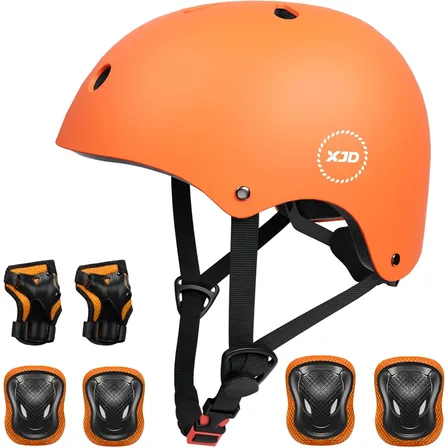
Orange Kids Helmet & Pad Set by XJD – Sizes S & M
The Orange XJD Kids Helmet & Pad Set is built for children around 3 to 8 years o…$24.64
-

XJD Boys 12/14/16" Training Wheel Bike – Blue
The XJD Boys Bike in Blue is a training wheel bike for riders 71–122 cm tall—rou…$169
$199