

When is my kid ready for a 24 bike
A child is ready for a 24-inch bike when they are about 54–64 inches (137–163 cm) tall and can comfortably stand over, reach, steer and brake it.
Start with measured height, not age
XBikes lists a 24-inch bike as a starting point for riders ages 10–14 and 54–64 inches (137–163 cm) tall. Height is the more useful first screen; age alone cannot show whether the frame, controls and riding position fit an individual child.
Measure your child barefoot, standing straight against a wall. Then measure inseam from the floor to the crotch while they stand with feet slightly apart. The inseam does not select a wheel size by itself, but it helps you check stand-over clearance on the actual bicycle.
If your child is below 54 inches (137 cm), begin the comparison with a 20-inch bike instead. XBikes places that size at 48–60 inches (122–152 cm) and ages 7–12. The overlapping ranges are intentional starting points: a rider near the boundary must try both sizes rather than automatically moving up.
Use this five-part readiness check
Have the child try the fully assembled bicycle in a controlled area, with an adult stabilizing it as needed. A 24-inch wheel label is not proof of fit. Check all five points:
- Stand-over: The child can straddle the bicycle with both feet planted and without the frame pressing uncomfortably into the body.
- Starting and stopping: They can mount, push off and stop without the bicycle pulling them off balance.
- Reach: They can hold the handlebar with relaxed arms and steer through a turn without stretching or shifting far forward.
- Brake control: Their hands comfortably reach and operate the brake controls while they maintain a secure grip and straight-line control.
- Confidence: They can look ahead, turn, slow and stop without freezing, wobbling excessively or relying on an adult to hold the bicycle.
If any point fails, adjust only within the bicycle manufacturer’s instructions and repeat the check. For assembly, component compatibility, adjustment limits or torque, follow the exact product manual or ask a qualified bicycle mechanic.
Compare 20, 24 and 26 inches carefully
| Wheel size | XBikes starting point | What it means here |
|---|---|---|
| 20 Inch | Ages 7–12; 48–60 in / 122–152 cm | Compare it with 24 inches for a child near the lower boundary or one who lacks control on the larger bike. |
| 24 Inch | Ages 10–14; 54–64 in / 137–163 cm | This is the target size, subject to the complete hands-on fit and control check. |
| 26 Inch | Youth and adults over 60 in / 153 cm | Consider it only as a separate larger-size comparison for a sufficiently tall rider; it is not equivalent to 24 inches. |
Do not choose a 24-inch or 26-inch bike merely to leave room for growth. An oversized bicycle can make mounting, steering and braking harder now. The correct next bike is the one the child can control today.
How the supplied catalog option helps
The supplied catalog product, 26-Inch XJD Beach Cruiser Bike for Girls – Purple, V-Brake, includes available SKU labels for Mint Green / 20 Inch, Mint Green / 24 Inch, Mint Green / 26 Inch, Pink / 20 Inch, Pink / 24 Inch, Pink / 26 Inch and Purple / 26 Inch. Its 24-inch SKU labels make it directly relevant to this decision, while its 20- and 26-inch labels provide neighboring-size comparison points. The exact product title describes the Purple / 26 Inch configuration, so do not assume that title applies identically to every labeled size.

Use the 24-inch Mint Green or Pink SKU label only as a reason to inspect that exact configuration and conduct the fit check. The 20-inch versions may be more relevant if the child cannot confidently control 24 inches. The 26-inch versions are larger alternatives for riders who meet the separate over-60-inch starting point and can pass the same individual checks; they are not substitutes for a needed 24-inch fit.
Check safety before the first ride
A properly fitting bicycle helmet is essential. It should sit level on the child’s head, fit securely and use its straps according to the helmet manufacturer’s instructions. Recheck the fit rather than assuming a helmet still fits because the child wore it last season.
Before riding, confirm that the bicycle has been assembled and adjusted according to its exact manual. If you are uncertain about brakes, fasteners, controls or assembly, have a qualified bicycle mechanic inspect it. Practice starts, straight-line stops and gentle turns in a traffic-free area before moving to a more demanding setting.
Make the 24-inch decision
Choose a 24-inch bike only if your child is within the 54–64-inch starting range and passes the stand-over, reach, steering, braking and confidence checks on the actual bike. If they stretch, tiptoe, struggle with the brakes or lose confidence, compare a 20-inch bike now. If they are over 60 inches, also compare 26 inches—but buy for present control, not future growth.
Bikes for your next adventure
-
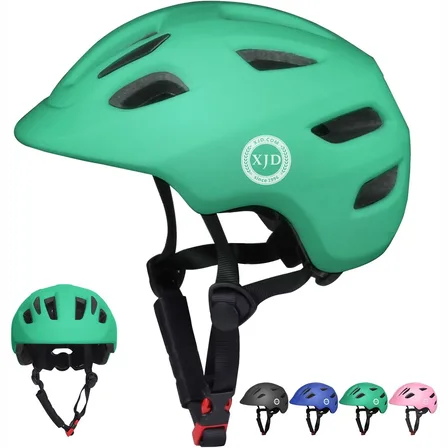
Green XJD Toddler Bike Helmet with Adjustable Fit, XS (46–51 cm)
The XJD toddler bike helmet in Green is built for the youngest riders — the size…$20.39
$23.99 -

Kids Bike Helmet by XJD for Boys & Girls – Black, Blue, Green, Pink, Purple
The XJD Kids Bike Helmet covers a wide 2-to-8-year age range thanks to two head-…$59.99
-

Kids Bike Helmet by XJD for Girls – Pink
The XJD Kids Bike Helmet in Pink is a lightweight multi-sport helmet for girls r…$59.99
$99