

When should i buy child first bike
Buy your child’s first bike when they want to ride and can fit, balance and control an available size now—not at a particular birthday or for future growth.
Check readiness before shopping
Interest matters. A child who willingly sits on a bike, follows simple directions and practices stopping is more ready than one who is frightened or being pressured. Confidence may develop gradually, so the right buying date can be later than the age chart suggests.
Look for basic physical control: the child should be able to hold the bike upright, steer without fighting the handlebar and operate the intended braking system. They also need enough attention to stop when told and remain within a supervised practice area.
Measure height and inseam
Measure the child without shoes, standing straight against a wall. Record total height from floor to head. For inseam, place a thin book firmly between the legs to represent a saddle, keep it level, and measure from the floor to its top edge.
Use height to identify a starting wheel size, then use inseam, reach and an in-person fit check to make the decision. Age overlaps substantially and should never override the child’s measurements or control.
| Wheel size | Starting age | Rider height |
|---|---|---|
| 12 Inch | 3–4 | 34–40 in / 86–102 cm |
| 14 Inch | 3–6 | 37–45 in / 94–114 cm |
| 16 Inch | 4–7 | 40–48 in / 102–122 cm |
| 18 Inch | 5–9 | 43–52 in / 109–132 cm |
| 20 Inch | 7–12 | 48–60 in / 122–152 cm |
| 24 Inch | 10–14 | 54–64 in / 137–163 cm |
| 26 Inch | Youth and adults | Over 60 in / 153 cm |
These XBikes ranges are starting points, not proof of fit. Where ranges overlap, compare the actual bicycles and choose according to current ability rather than assuming the larger wheel is better.
Have your child try the bike
The American Academy of Pediatrics advises having the child try the bicycle and avoiding an oversized bike bought for growth. During the trial, check four things:
- Stand-over: the child must be able to straddle the bicycle with practical clearance and without being forced onto tiptoes.
- Reach: seated riding posture should allow comfortable steering without stretching, locking the elbows or leaning excessively.
- Brakes: the child must reach and operate the controls reliably with their hands in a normal riding position.
- Control: ask the child to start, steer, slow and stop in a quiet, supervised area.
If any of these checks fail, do not buy that bike simply because the chart or age band appears to match. Try a different model or size. Frame shape, saddle adjustment and control layout can make bikes with the same wheel label fit differently.
Compare the available XBikes option
The catalog includes the XJD Pink Beach Cruiser for Girls – Rear Rack & V-Brake in 20 Inch, 24 Inch and 26 Inch labels. Those sizes make it relevant only when the child’s measured height points toward those starting ranges and the individual fit test succeeds. It is not a substitute for a 12, 14, 16 or 18 Inch first bike; for a smaller child, its listed versions are comparison points showing that a later purchase may be more appropriate.
This particular catalog option helps answer the timing question by providing three larger wheel-size labels to compare against the child’s measured height. Its exact title also identifies a rear rack and V-brake, but those details do not establish fit or readiness.

If considering this model, compare the 20, 24 and 26 Inch versions only within their distinct XBikes starting ranges. Do not treat adjacent sizes as equivalent, and do not infer suitability from the word “Girls” in the catalog title. Fit depends on the individual rider.
Prepare before the first ride
A properly fitting helmet is part of the purchase decision. The U.S. Consumer Product Safety Commission advises that the helmet should fit properly, sit level and have its straps used according to the manufacturer’s instructions. Replace guesswork with a fitting check while the child is present.
Confirm that the bicycle has been assembled and adjusted as its exact product manual specifies. For assembly, maintenance, compatibility, load limits or torque information not stated in the catalog, follow that manual or use a qualified bicycle mechanic.
Choose a flat, traffic-free practice area with close adult supervision. The first sessions should focus on starting, looking ahead, steering and stopping—not distance or speed.
Make the buy-now decision
Buy now if the child is interested, falls within a relevant height starting range, fits the actual bike, reaches its controls and can practice stopping with confidence. Wait if the available bike is oversized, stand-over or reach is awkward, braking is unreliable, or the child does not yet want to ride.
Your next step is simple: measure height and inseam today, shortlist the matching starting size, then take the child for a real fit and control check before purchasing their first bike.
Bikes for your next adventure
-
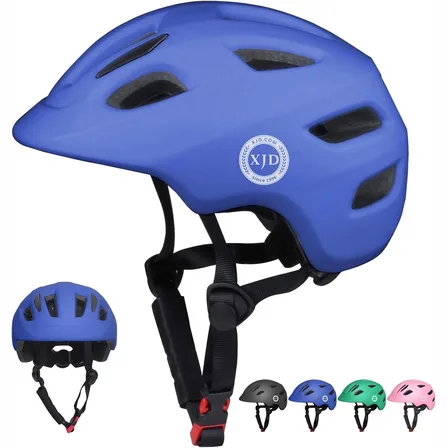
Blue XJD Kids' Bike Helmet, Adjustable Fit – Sizes XS & S
The Blue XJD Kids' Bike Helmet is a lightweight, adjustable helmet for toddlers …$20.39
-

Kids Bike Helmet by XJD for Boys & Girls – Black, Blue, Green, Pink, Purple
The XJD Kids Bike Helmet covers a wide 2-to-8-year age range thanks to two head-…$59.99
-
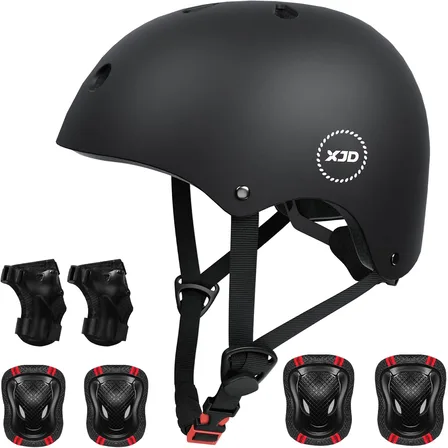
XJD Kids Helmet & Pad Set – Black, S/M/L
This XJD Kids Helmet & Pad Set in Black is designed for kids aged 3 to 8, pairin…$23.79
$27.99