

Why are 14 inch bikes hard to find
14-inch bikes are hard to find because they occupy a short transition between common 12-inch beginner bikes and longer-lasting 16-inch models. Brands and shops may concentrate on those neighboring sizes, but neither is automatically an appropriate substitute. Fit the child who will ride, not the gap in the catalog.
Why the 14-inch category is limited
A 14-inch bike serves riders whose size and confidence fall between two heavily used categories. Some children move from a 12-inch bike directly to a 16-inch bike, while others need the intermediate proportions of a 14-inch model. That makes demand less predictable and can lead to fewer designs or listings.
Search results can also be confusing because wheel sizes may appear as selectable variants within one product rather than as separate product pages. Check the available size label instead of relying only on the photograph or the main product name.
Start with the measured rider
Age is only a starting point. Measure the child's current height without shoes, then measure inseam from the floor to the crotch while the child stands upright. Compare those measurements with the bike, and have the child try the actual bicycle whenever possible.
| Wheel size | XBikes starting age | XBikes rider-height range |
|---|---|---|
| 12 Inch | Ages 3–4 | 34–40 in / 86–102 cm |
| 14 Inch | Ages 3–6 | 37–45 in / 94–114 cm |
| 16 Inch | Ages 4–7 | 40–48 in / 102–122 cm |
These overlapping ranges explain why age alone cannot settle the choice. A child within the 14-inch starting range might also appear in a neighboring range, but that does not make both bikes equally suitable. Body proportions, frame shape and skill can change how each one feels.
What to check on the bike
With an adult stabilizing the bicycle, check four practical points:
- Stand-over: The child should be able to straddle the bicycle without the frame preventing a stable stance.
- Reach: The handlebars should be reachable without an awkward stretch or loss of steering control.
- Brake control: If the bicycle has hand controls, the child must be able to reach and operate them confidently.
- Current confidence: Starting, stopping, turning and putting a foot down should feel manageable rather than intimidating.
Do not buy an oversized bike merely for extra growing time. If the child cannot control it now, the nominal future value does not solve the present fit problem.
How the available catalog option helps
The XJD Boys 12/14/16" Training Wheel Bike – Blue is relevant because its available SKU labels include 12 Inch, 14 Inch and 16 Inch. That makes it useful for comparing the requested 14-inch option with both adjacent sizes within a training-wheel-bike listing. The labels establish size availability only; they do not prove which variant fits an individual child.

When reviewing this product, verify that the selected SKU explicitly says 14 Inch. Do not assume the displayed image, title alone or a neighboring 12 Inch or 16 Inch selection represents the same fit. If the child falls near an overlap in the height ranges, compare the actual variants through a supervised fit check rather than choosing by age.
What to do if 14 inches is unavailable
First, ask whether the store lists 14 Inch as a variant under a multi-size product. If it is genuinely unavailable, do not automatically size up or down. Recheck the child's height and inseam, then try the nearest sizes separately.
A 12-inch bike is a comparison point for riders around its 34–40 in / 86–102 cm starting range; a 16-inch bike is a comparison point around 40–48 in / 102–122 cm. Those ranges overlap the 14-inch range, but a neighboring size is not equivalent to a 14-inch bike. Choose it only if stand-over, reach, brake operation and riding control all work for that specific child.
Before the first ride
Follow the exact product manual for assembly, adjustment, maintenance, load limits, compatibility and any torque requirements. If the instructions are missing, unclear or beyond your tools, use a qualified bicycle mechanic rather than guessing.
Add a properly fitting bicycle helmet. It should sit level and its straps should be adjusted according to the helmet manufacturer's instructions. Supervise the initial ride in a suitable low-traffic area so the child can demonstrate stopping and steering control.
The practical decision is simple: seek the 14 Inch SKU when the child's measurements and trial fit point there; choose 12 or 16 inches only when a separate hands-on check shows that neighboring size fits and can be controlled now.
Bikes for your next adventure
-
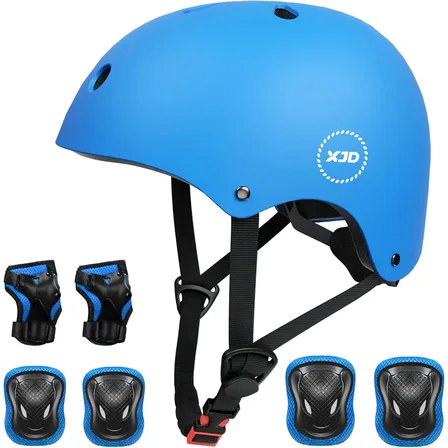
Blue XJD Helmet & Protective Gear Set for Kids, Sizes S/M
The Blue XJD Helmet & Protective Gear Set is made for kids roughly 3 to 8 years …$23.79
-

Kids Bike Helmet by XJD for Boys & Girls – Black, Blue, Green, Pink, Purple
The XJD Kids Bike Helmet covers a wide 2-to-8-year age range thanks to two head-…$59.99
-

Kids Bike Helmet by XJD for Girls – Pink
The XJD Kids Bike Helmet in Pink is a lightweight multi-sport helmet for girls r…$59.99
$99