

Will a 24 inch bike fit me
A 24 inch bike is a likely fit if you are 54–64 inches (137–163 cm) tall, can stand over it comfortably, reach the controls, and ride with confidence. Age 10–14 is only a starting point, so measure and try the bike before deciding.
Start with height, then measure inseam
Measure the rider without shoes, standing straight against a wall. Record total height from the floor to the top of the head. For inseam, place a book firmly between the legs as if it were a bicycle saddle, keep it level, and measure from the floor to the book’s top edge.
Compare total height with the XBikes starting point below. Keep the inseam measurement for the actual stand-over check; wheel size alone does not reveal the frame’s clearance or geometry.
| Wheel size | Starting age | Rider height |
|---|---|---|
| 20 Inch | 7–12 | 48–60 in / 122–152 cm |
| 24 Inch | 10–14 | 54–64 in / 137–163 cm |
| 26 Inch | Youth and adults | Over 60 in / 153 cm |
The overlapping ranges are intentional starting points, not proof that either neighboring size fits. Prioritize measured height and the checks below over age.
Check stand-over clearance on the exact bike
Have the rider straddle the bicycle’s top tube with both feet flat on the ground. There should be comfortable clearance rather than pressure from the frame. The rider must be able to mount and dismount without leaning the bicycle so far that control is lost.
Do not choose an oversized bicycle merely to allow room for growth. If the rider cannot stand over the exact 24 inch bike comfortably today, it does not fit today, even if the age or height range appears suitable. Because frame shapes differ, an inseam that works on one bicycle may not work on another.
Test reach, steering and brake control
With the saddle adjusted according to the exact product manual, ask the rider to sit in a normal riding position. They should reach the handlebar without locking their elbows, stretching their torso, or sliding forward unnaturally. They should also turn the handlebar through a useful range without knees or body position interfering.
Next, confirm that the rider can operate each brake control securely while maintaining a steady grip. A bicycle is too large or otherwise unsuitable if the rider cannot reach and use the controls reliably. Follow the bicycle’s manual for adjustment limits and assembly instructions; ask a qualified bicycle mechanic when the setup or fit remains uncertain.
Use a short ride as the final fit check
In a quiet, traffic-free area, have the rider start, pedal, steer, brake and stop. Watch for confident control rather than merely asking whether the bike feels comfortable. A suitable rider should be able to:
- start without needing someone to hold the bicycle upright;
- steer smoothly at a manageable speed;
- use the brakes without releasing control of the handlebar;
- stop and place a foot down predictably; and
- dismount without struggling against the frame.
If hesitation comes from unfamiliarity, allow a calm second attempt. If stretching, poor brake reach, difficult mounting or loss of control persists, do not treat practice as a cure for incorrect sizing. Compare the rider with a smaller size and repeat the same checks.
How the supplied 24 inch options are relevant
The catalog includes two beach cruiser models with a 24 inch option, so they are directly relevant for checking the requested wheel size. Their 26 inch variants can help riders above 60 inches compare the next starting size, but a 26 inch bicycle is not equivalent to, or a substitute for, a 24 inch fit.
XJD 24-Inch Green Beach Cruiser Bike with U-Brake is listed with Green / 24 Inch and Pink / 24 Inch choices, plus Pink / 26 Inch. Pink XJD Beach Cruiser Bike, 24"/26", U-Brake is listed with 24 Inch and 26 Inch choices. Those facts identify available size labels and colors only; they do not prove fit for an individual rider. These particular options help because each permits an exact 24 inch fit check, while their listed 26 inch choices provide a clearly different comparison size.
 XJD 24-Inch Green Beach Cruiser Bike with U-Brake
A beach cruiser with Green / 24 Inch and Pink / 24 Inch choices for an exact 24 inch fit check; its Pink / 26 Inch option is a distinct comparison size, not an equivalent fit.
 Pink XJD Beach Cruiser Bike, 24"/26", U-Brake
This beach cruiser offers both 24 Inch and 26 Inch choices, making it relevant for trying the requested size and comparing the next starting size where appropriate; individual stand-over, reach and control still decide fit.
Use the exact product manual for assembly, maintenance, adjustment limits, compatibility, load limits and torque information not given here. If any control or component cannot be set correctly within the manual’s limits, use a qualified bicycle mechanic rather than improvising.
Make the decision
Choose the 24 inch bike only when the rider falls near the 54–64 inch starting range and passes every individual check: comfortable stand-over, natural reach, dependable brake use, controlled starting and stopping, and present confidence. If any check fails, compare another wheel size on the rider instead of buying extra growth room.
Before riding, add a properly fitting bicycle helmet. It should sit level, and its straps should be used exactly as the helmet manufacturer instructs. The practical answer is simple: measure first, try the exact 24 inch bicycle, and buy it only if the rider can control it now.
Bikes for your next adventure
-

XJD Pink Beach Cruiser for Girls – Rear Rack & V-Brake
The XJD Pink Beach Cruiser for girls is the step-up bike for riders who've outgr…$179.99
$209.99 -
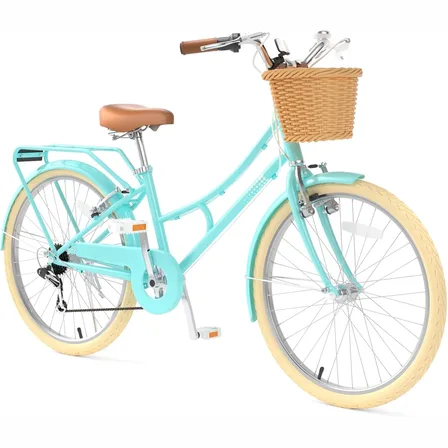
XJD 24-Inch Green Beach Cruiser Bike with U-Brake
This XJD 24-inch beach cruiser in green is made for riders about 4'8" to 5'4" ta…$159.99
$199.99 -
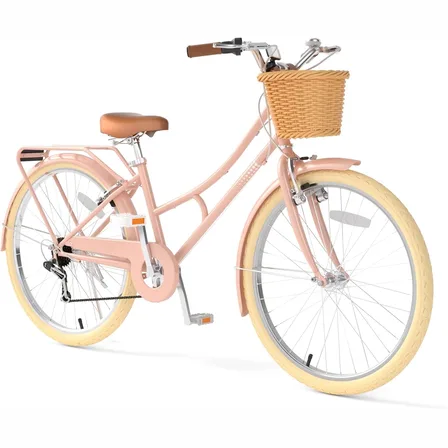
Pink XJD Beach Cruiser Bike, 24"/26", U-Brake
The XJD Pink Beach Cruiser Bike is a single-speed cruiser built for older kids a…$159.99