

Will you teach my child to bike
Yes—you can teach your child to bike by choosing a bike they can control, practising in small steps, and stopping whenever fit or confidence is wrong.
Start by measuring, not guessing
Measure your child’s standing height and inseam before choosing a wheel size. Age is only a starting point because children of the same age can have different proportions, reach and confidence.
Use the XBikes wheel-size ranges to identify sizes worth trying: 12 Inch for 34–40 in / 86–102 cm and ages 3–4; 14 Inch for 37–45 in / 94–114 cm and ages 3–6; 16 Inch for 40–48 in / 102–122 cm and ages 4–7; 18 Inch for 43–52 in / 109–132 cm and ages 5–9; 20 Inch for 48–60 in / 122–152 cm and ages 7–12; 24 Inch for 54–64 in / 137–163 cm and ages 10–14; and 26 Inch for youth and adults over 60 in / 153 cm.
Overlapping ranges are normal. When two sizes appear possible, compare both in person rather than choosing the larger one for future growth.
Check whether the bike actually fits
Have your child try the bicycle. They need comfortable stand-over clearance, a manageable reach to the handlebar, and the ability to operate the brakes without stretching or shifting their hands into an unstable position. They should be able to start, stop and steer while remaining composed.
Do not buy an oversized bicycle merely because your child may grow into it. A size chart narrows the search, but measured height, inseam, reach, brake control and current confidence decide whether a particular bike works now.
Teach one skill at a time
- Prepare: Choose a flat, open area away from traffic and obstacles. Fit a bicycle helmet so it sits level, fits properly and has its straps adjusted according to the helmet manufacturer’s instructions.
- Learn the controls: While stationary, show your child where to hold, how to steer and how the brakes respond. Confirm that the controls are within easy reach.
- Practise stopping: Before seeking speed or distance, have the child rehearse controlled stops. Stay close enough to assist without pulling the handlebar.
- Add starts and short runs: Use a clear start point and an obvious stopping point. Keep attempts brief, repeat what worked and reduce assistance gradually.
- Introduce turns: Once straight starts and stops are controlled, add broad turns before tighter steering tasks.
End a session if your child repeatedly cannot reach the controls, appears frightened, or loses control because of the bike’s dimensions. Those are reasons to reassess fit, not reasons to push harder.
How the supplied bikes relate
The two catalog options help with this question because both are Kids’ BMX Bikes offered in 12 Inch, 14 Inch and 16 Inch variants, and both include training wheels. The XJD Girls BMX Bike 12/14/16 Inch with Training Wheels – Pink Blue differs in its supplied color wording from the XJD Boys & Girls BMX Bike with Training Wheels, 12/14/16" – Blue. No other performance or fit difference is established by the supplied facts.
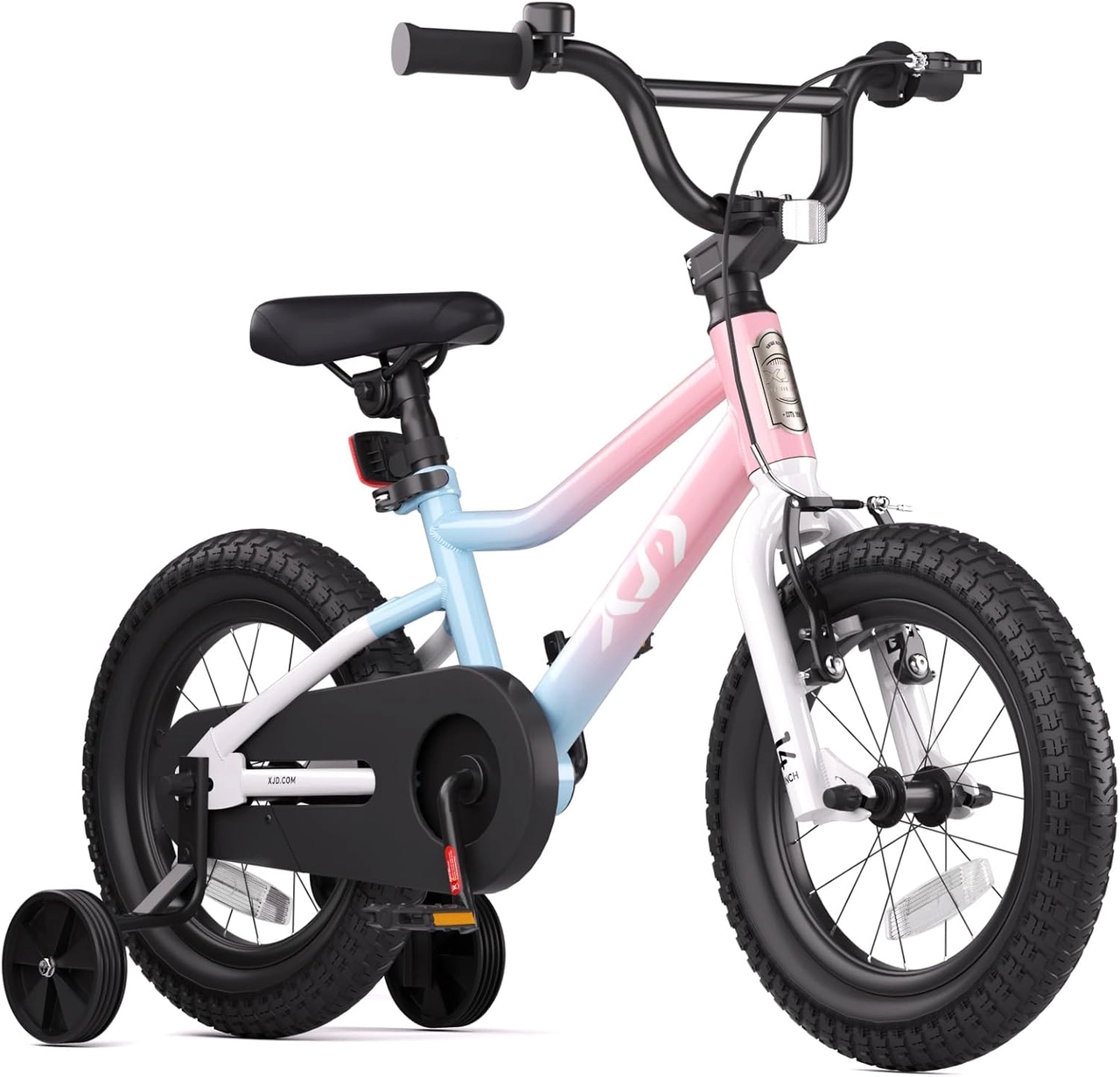 XJD Girls BMX Bike 12/14/16 Inch with Training Wheels – Pink Blue
A Kids’ BMX Bike offered in 12 Inch, 14 Inch and 16 Inch variants with training wheels. Consider it only after the selected size passes the child’s individual fit and control checks.
 XJD Boys & Girls BMX Bike with Training Wheels, 12/14/16" – Blue
A blue Kids’ BMX Bike offered in 12 Inch, 14 Inch and 16 Inch variants with training wheels. Its relevance depends on measured height, inseam, reach, brake control and confidence.
These products are relevant only when your child’s measurements and individual fit check point toward a 12, 14 or 16 Inch bike. If the fit check indicates 18, 20, 24 or 26 Inch, these catalog products are smaller-size comparison points, not substitutes for the indicated size.
Training wheels may support an early stage of practice, but their presence does not establish correct fit or guarantee that a child will learn without instruction and supervision. Follow the exact product manual for assembly, adjustment, maintenance, compatibility, load limits and torque. If anything is unclear or the bicycle cannot be set up correctly, use a qualified bicycle mechanic.
Compare before deciding
- Does measured height place the rider within the starting range for the selected wheel size?
- Can the child stand over the bicycle comfortably?
- Can they reach the handlebar without being pulled too far forward?
- Can they operate the brakes confidently with their hands in a stable position?
- Can they start, steer and stop without the bike’s size overwhelming them?
- Does the selected catalog variant say 12 Inch, 14 Inch or 16 Inch rather than relying on a product name or appearance?
Your next step
Measure height and inseam today, shortlist the corresponding wheel size, and have your child try it under close adult supervision. Choose one of the supplied bikes only if its 12, 14 or 16 Inch variant passes the stand-over, reach, brake-control and confidence checks; otherwise, pause the lesson and find the size that does.
Bikes for your next adventure
-

Kids Bike Helmet by XJD for Boys & Girls – Black, Blue, Green, Pink, Purple
The XJD Kids Bike Helmet covers a wide 2-to-8-year age range thanks to two head-…$59.99
-

Kids Bike Helmet by XJD for Girls – Pink
The XJD Kids Bike Helmet in Pink is a lightweight multi-sport helmet for girls r…$59.99
$99 -

XJD Kids Bike for Girls – Pink, 12/14/16/20 Inch with Training Wheels
The XJD Kids Bike for Girls in Pink is a training-wheel bike built to carry your…$139
$159