

A girl bike
A girl bike should fit the individual rider now: measure her height and inseam, then check stand-over clearance, reach, brake control and confidence.
What makes a bike suitable for a girl?
The word “girl” may describe a bike’s color or catalog styling, but it does not determine fit. The useful choice is a bicycle that matches the child’s body, skills and intended riding. Start with measured height rather than age, because children of the same age can need different wheel sizes.
Have the rider try the bicycle whenever possible. She should be able to stand over it comfortably, reach the handlebar without stretching, steer with control and operate the brakes reliably. Do not choose an oversized bicycle merely to allow room for growth; a bike that is difficult to mount, balance or stop is not a good current fit.
Measure before comparing sizes
- Measure standing height: With shoes off, have the child stand straight against a wall and record the measurement from floor to head.
- Measure inseam: With feet slightly apart, measure from the floor to the crotch. This helps assess stand-over clearance, but it does not by itself select a wheel size.
- Check reach: On the actual bicycle, confirm that the child can hold the handlebar and turn it without leaning excessively or locking her arms.
- Check stopping control: Confirm that she can reach and operate the bicycle’s brakes as designed. Brake type and adjustment are product-specific, so follow the exact manual or ask a qualified bicycle mechanic.
- Notice confidence: A rider who is still learning may need a more manageable setup than a similarly sized, experienced child.
Wheel-size starting points
Use the XBikes ranges below to narrow the search, not to replace an individual fit check. Where ranges overlap, compare both candidate sizes on the rider and favor present control over extra growing room.
| Wheel size | Age starting point | Rider-height starting point |
|---|---|---|
| 12 Inch | Ages 3–4 | 34–40 in / 86–102 cm |
| 14 Inch | Ages 3–6 | 37–45 in / 94–114 cm |
| 16 Inch | Ages 4–7 | 40–48 in / 102–122 cm |
| 18 Inch | Ages 5–9 | 43–52 in / 109–132 cm |
| 20 Inch | Ages 7–12 | 48–60 in / 122–152 cm |
| 24 Inch | Ages 10–14 | 54–64 in / 137–163 cm |
| 26 Inch | Youth and adults over 60 in / 153 cm | Over 60 in / 153 cm |
Age is only an orientation point. Measured height, inseam, usable reach, brake control and the rider’s current confidence take priority.
How the two catalog options compare
The supplied choices help answer “A girl bike” by offering girls’ training-wheel bikes in several common starting sizes. Both let a parent compare 12, 14, 16 and 20 Inch catalog options after measuring the rider.
 Girls' Training Wheel Bike by XJD, 12–20 Inch Wheels – Blue
A blue girls’ training-wheel bike offered with 12 Inch, 14 Inch, 16 Inch and 20 Inch SKU labels, making it relevant when one of those sizes passes the rider’s individual fit check.
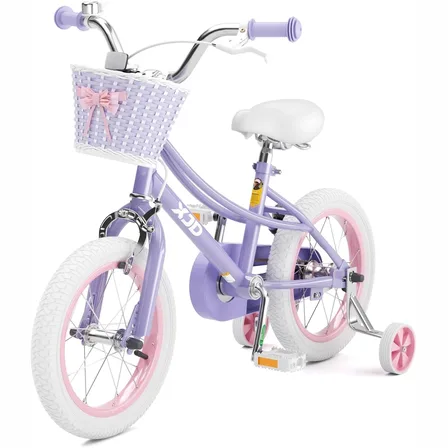
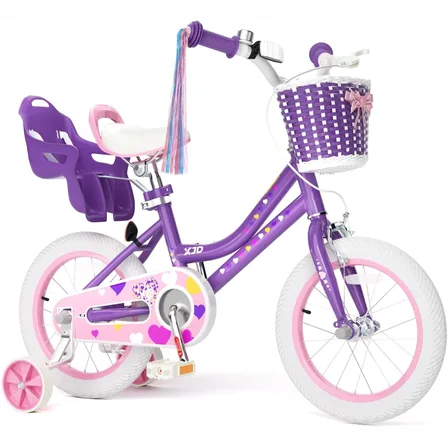
 XJD Girls' Bike with Training Wheels, 12/14/16/20 Inch – Purple
A purple girls’ training-wheel bike with available 12 Inch, 14 Inch, 16 Inch and 20 Inch SKU labels; compare it only after measuring the rider and confirming hands-on control.
Girls' Training Wheel Bike by XJD, 12–20 Inch Wheels – Blue is categorized as a training wheel bike and has available SKU labels of 12 Inch, 14 Inch, 16 Inch and 20 Inch. Its distinguishing supplied catalog detail is the blue designation.
XJD Girls' Bike with Training Wheels, 12/14/16/20 Inch – Purple is also categorized as a training wheel bike, with the same four available SKU labels: 12 Inch, 14 Inch, 16 Inch and 20 Inch. Its distinguishing supplied catalog detail is the purple designation.
On the facts provided, wheel-size labels and color are the available comparison points; no difference in brakes, weight, materials or equipment has been established. If the fit check points to an 18, 24 or 26 Inch bike, neither supplied product lists that exact size. They are comparison points, not substitutes for the required size, and another wheel size should not be treated as equivalent.
Decide whether training wheels fit the rider’s stage
Both supplied bicycles are training-wheel models, so they are relevant when that format matches the child’s current learning needs. They may be less relevant for a rider who already balances confidently and is specifically seeking a different setup.
Do not assume compatibility, adjustment range, load limit or assembly procedure beyond the supplied catalog facts. Review the manual for the exact product and SKU before use. If assembly, brake operation or fit adjustment is unclear, use a qualified bicycle mechanic rather than inventing a procedure or torque setting.
Complete the try-out and safety check
- Confirm that the selected SKU label matches the wheel size being evaluated.
- Have the child mount, stand over, steer and stop the actual bicycle in a controlled setting.
- Reject a size that requires stretching, awkward control or buying ahead for growth.
- Use a bicycle helmet that fits properly, sits level and has its straps positioned according to the helmet manufacturer’s instructions.
- Recheck fit as the child grows and whenever control or confidence changes.
Your next decision is specific: record the girl’s height and inseam, shortlist the matching wheel-size range, and choose one of these girls’ training-wheel bikes only if its listed size and the hands-on control check both fit her now.
Bikes for your next adventure
-
Girls' Training Wheel Bike by XJD with Basket – Purple
If you're shopping for a first bike for a girl roughly 3 to 12 years old (91–152…$75.99
-
XJD Light Purple Girls Bike with Basket, Training Wheels, 12/14/16/20 Inch
The XJD Girls Bike with Basket in Light Purple is a single-speed training-wheel …$99.99
$119.99 -

Pink 12/14/16/20" XJD Girls Bike with Training Wheels & Basket
The Pink XJD Girls Bike with Training Wheels & Basket is a first-bike pick f…$65.99
$75.99