

A girl on a bicycle trailer
A girl can use a bicycle trailer only when the exact trailer manual permits her size and riding position, and the towing bicycle, hitch and helmet all fit correctly. If she is ready for her own bike, measure her rather than choosing by age or buying extra room for growth.
First identify what “bicycle trailer” means
A passenger trailer carries a child behind an adult’s bicycle. A trailer cycle, sometimes called a tag-along, gives the child a saddle and pedals while remaining attached to the adult bicycle. These are different products with different fit, attachment and use requirements.
Before riding, find the precise make and model and read its manual. Confirm that the child’s measurements and riding position are permitted, then follow the stated instructions for the hitch, harness or restraint, seating, load limit, assembly and maintenance. If the manual is missing or compatibility is uncertain, stop and ask the manufacturer or a qualified bicycle mechanic.
What a parent should measure
For a trailer, record the girl’s current height and any other measurement required by its manual. Check her seated position exactly as directed, including whether her helmeted head and body fit within the permitted space. Do not assume that age, a comfortable-looking seat or an apparently secure connection proves suitability.
For a move to an independent bicycle, measure standing height and inseam. Then have her try the actual bike and check four things:
- Stand-over: she can occupy the required position without the frame obstructing her.
- Reach: she can hold and steer the handlebars without stretching or losing control.
- Brake control: she can reach and operate the fitted brakes reliably.
- Confidence: starts, stops and turns remain controlled at her present skill level.
This follows the practical fit approach recommended by the American Academy of Pediatrics through HealthyChildren: try the bicycle, check control and brake reach, and do not buy an oversized bike merely for future growth.
Wheel-size starting points for her own bike
Use measured height before age. These XBikes ranges are starting points, not a substitute for trying the bicycle:
| Wheel size | Age guide | Rider height |
|---|---|---|
| 12 Inch | 3–4 | 34–40 in / 86–102 cm |
| 14 Inch | 3–6 | 37–45 in / 94–114 cm |
| 16 Inch | 4–7 | 40–48 in / 102–122 cm |
| 18 Inch | 5–9 | 43–52 in / 109–132 cm |
| 20 Inch | 7–12 | 48–60 in / 122–152 cm |
| 24 Inch | 10–14 | 54–64 in / 137–163 cm |
| 26 Inch | Youth and adults | Over 60 in / 153 cm |
Overlapping ranges are normal. Inseam, reach, brake control and confidence determine whether a particular bicycle works for the individual rider.
How the supplied bicycles help with the decision
The catalog options are independent girls’ bicycles, not bicycle trailers. They help compare possible next bikes after trailer use: the Light Pink XJD Girls' Bicycle with Basket & Training Wheels offers 12, 14, 16 and 20 Inch labels, while the 26-Inch XJD Beach Cruiser Bike for Girls – Purple, V-Brake has 20, 24 and 26 Inch size labels in its listed color variants. Neither establishes compatibility with a trailer or replaces an individual fit check.
 26-Inch XJD Beach Cruiser Bike for Girls – Purple, V-Brake
A beach cruiser with listed 20, 24 and 26 Inch variants; the exact titled configuration is Purple / 26 Inch with V-brake. It is an independent-bike comparison, not a bicycle trailer.
 Light Pink XJD Girls' Bicycle with Basket & Training Wheels
An independent training-wheel bicycle with a basket, offered in 12, 14, 16 and 20 Inch labels; relevant when those measured size starting points fit, not as a trailer or trailer-compatibility claim.
Compare the two catalog options accurately
The Light Pink XJD Girls' Bicycle with Basket & Training Wheels is relevant when the measured starting point is 12, 14, 16 or 20 Inch and the family specifically wants to consider a training-wheel bicycle with a basket. Training wheels do not remove the need to confirm stand-over, reach, braking and control on the actual bicycle.
The 26-Inch XJD Beach Cruiser Bike for Girls – Purple, V-Brake provides listed variants at 20, 24 and 26 Inch, although the exact titled configuration is Purple / 26 Inch. A 26 Inch starting point applies only above 60 in / 153 cm, followed by a real fit check. Its listed V-brake matters only if the rider can reach and operate it confidently.
If her measured starting point is 18 Inch, neither supplied product lists that exact wheel size. In that case, these products are nearest-size comparison points only, not substitutes; do not treat 16 or 20 Inch as equivalent to 18 Inch.
Checks before the next ride
- Identify whether she will use a passenger trailer, trailer cycle or independent bicycle.
- Measure her now and compare the result with the applicable manual or wheel-size starting point.
- Have her try the equipment and observe posture, reach, control and braking.
- Fit a bicycle helmet so it sits level, fits properly and uses its straps according to the helmet manufacturer’s instructions, as advised by the U.S. Consumer Product Safety Commission.
- Follow the exact product manual for assembly, attachment, compatibility, load limits, maintenance and torque. Use a qualified bicycle mechanic when anything is unclear.
The next decision is specific: keep her in the trailer only if its manual and her present fit permit it; otherwise measure and test the correctly sized independent bike rather than moving her into an oversized one.
Bikes for your next adventure
-
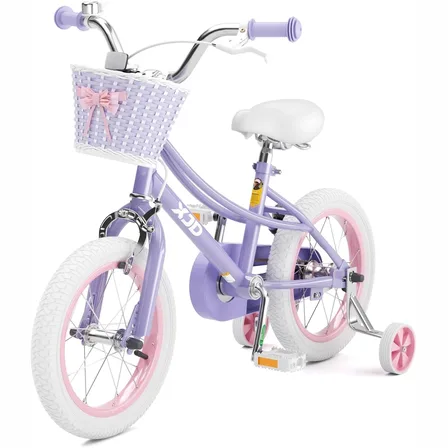
Girls' Training Wheel Bike by XJD with Basket – Purple
If you're shopping for a first bike for a girl roughly 3 to 12 years old (91–152…$75.99
-
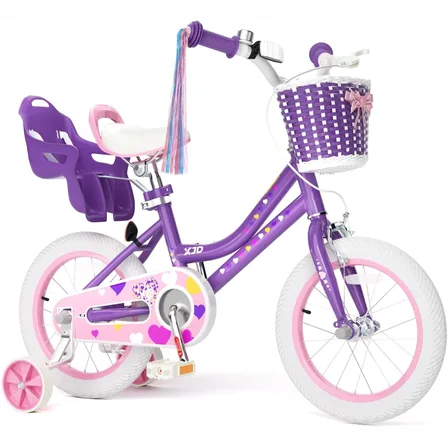
XJD Light Purple Girls Bike with Basket, Training Wheels, 12/14/16/20 Inch
The XJD Girls Bike with Basket in Light Purple is a single-speed training-wheel …$99.99
$119.99 -
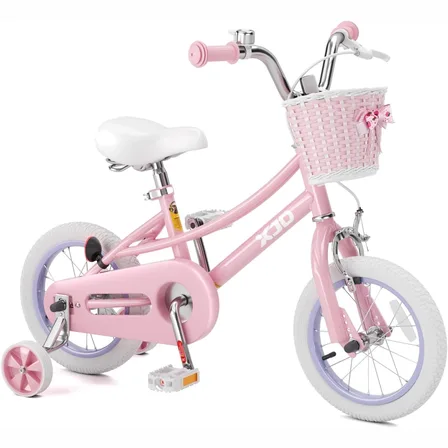
Pink 12/14/16/20" XJD Girls Bike with Training Wheels & Basket
The Pink XJD Girls Bike with Training Wheels & Basket is a first-bike pick f…$65.99
$75.99