

Can girls ride boys bikes
Yes, girls can ride boys’ bikes. The label does not determine fit: choose a bike she can stand over, steer, brake and control confidently.
What matters more than the boys’ label
Many children’s bikes are marketed by gender because of their color, graphics or product naming. Those labels do not tell you whether a particular child can ride the bicycle comfortably. The practical questions are whether its dimensions suit her body and whether she can operate it without stretching, wobbling or struggling.
Do not buy an oversized bicycle just to allow room for growth. A child should try the bike whenever possible. Height gives you a useful wheel-size starting point, but inseam, reach, brake access and confidence determine whether the individual fit works.
Measure and check the fit
Measure the child’s height without shoes and her inseam from the floor to the crotch. Use her measured height to select a likely wheel size, then check the actual bicycle rather than relying on age or a boys’ or girls’ description.
- Stand-over: Have her straddle the bicycle with both feet on the ground. She should be able to stand comfortably without the frame pressing into her.
- Seat position: Confirm that she can get on and off securely and place her feet as needed for her current skill level.
- Reach: Her hands should reach the handlebar without locking her elbows, leaning excessively or losing a stable riding position.
- Steering: Ask her to turn the handlebar in both directions while remaining balanced and in control.
- Brake control: She must be able to reach and operate the bicycle’s brakes confidently. Check the exact controls fitted to the bike she tries.
If any of these checks fail, adjust the bicycle only as permitted by its manual or compare another size or model. Use a qualified bicycle mechanic if the correct setup is uncertain.
Use wheel size as a starting point
| Wheel size | Starting age | Rider height |
|---|---|---|
| 12 Inch | 3–4 | 34–40 in / 86–102 cm |
| 14 Inch | 3–6 | 37–45 in / 94–114 cm |
| 16 Inch | 4–7 | 40–48 in / 102–122 cm |
| 18 Inch | 5–9 | 43–52 in / 109–132 cm |
| 20 Inch | 7–12 | 48–60 in / 122–152 cm |
| 24 Inch | 10–14 | 54–64 in / 137–163 cm |
| 26 Inch | Youth and adults | Over 60 in / 153 cm |
Where ranges overlap, do not assume either size will fit equally well. Compare both through an individual fit check, prioritizing measured height, inseam, reach, brake control and present confidence over age alone.
When the supplied XBikes options are relevant
The supplied catalog options help because both are explicitly listed for boys and girls, directly showing that a child’s gender does not restrict the intended rider label. Both offer 12 Inch, 14 Inch and 16 Inch size labels, so they are relevant comparison points when the child falls near those height ranges and needs a training-wheel bike or a kids’ BMX bike with training wheels.
 XJD Kids' Training Wheel Bike for Boys & Girls, 12/14/16 Inch – White
A boys-and-girls Training Wheel Bike offered in 12 Inch, 14 Inch and 16 Inch labels; relevant when measurements indicate one of those starting points and an individual fit check succeeds.
 XJD Boys & Girls BMX Bike with Training Wheels, 12/14/16" – Blue
A boys-and-girls Kids’ BMX Bike with training wheels, offered in 12 Inch, 14 Inch and 16 Inch labels for measurement-led comparison and a hands-on fit check.
XJD Kids' Training Wheel Bike for Boys & Girls, 12/14/16 Inch – White is categorized as a Training Wheel Bike and is available with 12 Inch, 14 Inch and 16 Inch labels. Compare the appropriate labeled size with the child’s measurements and complete the hands-on checks before deciding.
XJD Boys & Girls BMX Bike with Training Wheels, 12/14/16" – Blue is categorized as a Kids’ BMX Bike and likewise has 12 Inch, 14 Inch and 16 Inch labels. Its boys-and-girls wording supports gender-neutral consideration, but it does not replace an individual fit check.
These two products are not suitable comparison choices when the child needs an 18 Inch, 20 Inch, 24 Inch or 26 Inch starting point: none of those wheel-size labels is supplied for either product. A nearby catalog size is not an equal substitute for the size indicated by measurement and hands-on control.
Separate appearance from function
Let the rider decide whether she likes the bike’s appearance, but evaluate function separately. A preferred color cannot compensate for poor reach, difficult braking or an oversized frame. Conversely, a bicycle sold or informally described as a boys’ bike can be entirely relevant if its actual fit and controls work for her.
Training wheels may also be relevant to current confidence, but the catalog facts do not establish setup procedures or compatibility beyond the supplied product titles and categories. Follow the exact product manual for assembly, adjustment, maintenance, load limits and torque requirements, or ask a qualified bicycle mechanic.
Make the final riding decision
Before riding, provide a properly fitting bicycle helmet. It should sit level and its straps should be used according to the helmet manufacturer’s instructions. Recheck the bicycle’s fit and control after adjustments and as the child grows.
The decision is simple: ignore the boys’ label, measure her height and inseam, choose a wheel-size starting point, and have her demonstrate comfortable stand-over, reach, steering and braking. If she cannot do all of those confidently, choose a different size or bicycle.
Bikes for your next adventure
-
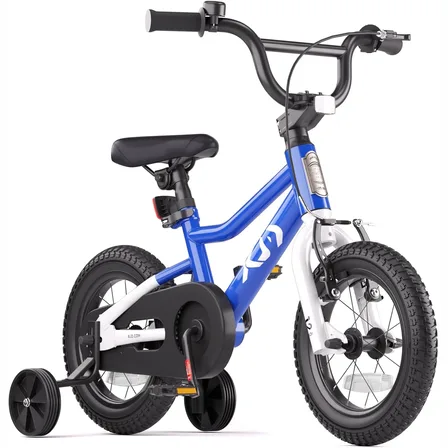
XJD Boys & Girls BMX Bike with Training Wheels, 12/14/16" – Blue
The XJD Boys & Girls BMX Bike in Blue is a first pedal bike for kids roughly age…$99.99
$119.99 -
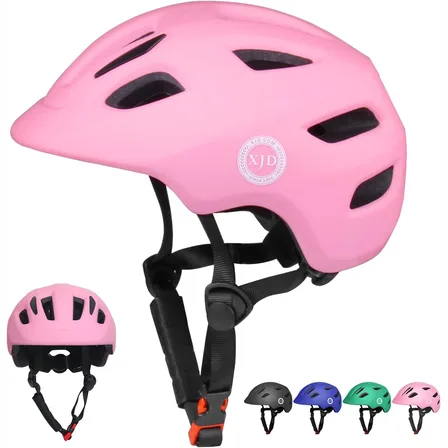
Pink Adjustable Kids Helmet by XJD – Toddler Bike Helmet, XS & S
This Pink XJD Adjustable Kids Helmet is built for toddlers and kids who ride bik…$21.24
-
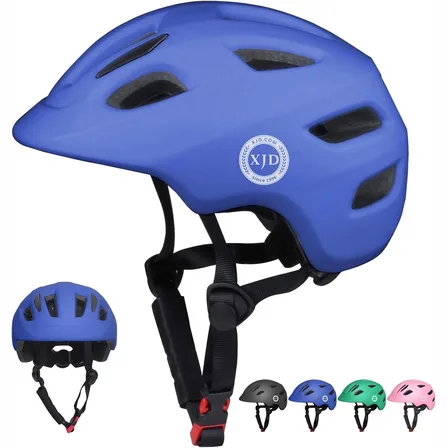
Blue XJD Kids' Bike Helmet, Adjustable Fit – Sizes XS & S
The Blue XJD Kids' Bike Helmet is a lightweight, adjustable helmet for toddlers …$20.39