

Do lower bars on bikes mean its a girl bike
No. Lower bars do not make a bicycle a “girl bike.” They describe frame or handlebar geometry; fit, control and the child’s preference matter more.
What “lower bars” may mean
Parents often use “bar” to mean either the top tube of the frame or the handlebars. A lower or sloping top tube can make it easier to step over the bicycle, but it does not determine who can ride it. Colors, decorations and catalog labels may market a bicycle toward girls, yet they are not evidence that its dimensions fit a particular child.
If you mean low handlebars, that is also a fit question rather than a gender marker. Their position affects posture and reach. The rider should be able to steer comfortably and operate the brakes without stretching, shifting awkwardly or losing control.
Measure the rider before comparing bikes
Measure the child’s height without shoes. Also measure inseam from the floor to the crotch while the child stands upright. Height provides a wheel-size starting point; inseam helps you assess clearance when the actual bicycle is present.
- Use measured height to identify likely wheel sizes in the XBikes ranges below.
- Have the child try each plausible bicycle rather than relying on its gender label or age alone.
- Check that the child can stand over the frame with practical clearance and get on and off confidently.
- Confirm a comfortable reach to the handlebars and full, reliable access to the brake controls.
- Watch the child start, steer, stop and place a foot down while remaining in control.
Do not choose an oversized bicycle merely to leave room for growth. The American Academy of Pediatrics advises trying the bicycle and checking stand-over clearance, control and brake reach.
Use wheel size only as a starting point
| Wheel size | XBikes age starting point | Rider-height starting point |
|---|---|---|
| 12 Inch | 3–4 | 34–40 in / 86–102 cm |
| 14 Inch | 3–6 | 37–45 in / 94–114 cm |
| 16 Inch | 4–7 | 40–48 in / 102–122 cm |
| 18 Inch | 5–9 | 43–52 in / 109–132 cm |
| 20 Inch | 7–12 | 48–60 in / 122–152 cm |
| 24 Inch | 10–14 | 54–64 in / 137–163 cm |
| 26 Inch | Youth and adults over 60 in | Over 60 in / 153 cm |
Overlapping ranges are intentional starting points, not guarantees. When two sizes appear possible, compare both in person. Prioritize measured height, inseam, reach, brake control and current confidence over age.
How the supplied girls’ bikes are relevant
The Flower Pink XJD Girls Bike with Doll Seat & Basket and the Purple XJD Girls' Bike with Doll Seat & Basket are cataloged as Training Wheel Bikes and are offered with 12 Inch, 14 Inch and 16 Inch SKU labels. They help show that “girls’ bike” is a catalog description across several wheel sizes—not a conclusion you can draw simply from a lower bar. Compare the child’s measurements and actual control with the labeled wheel size.
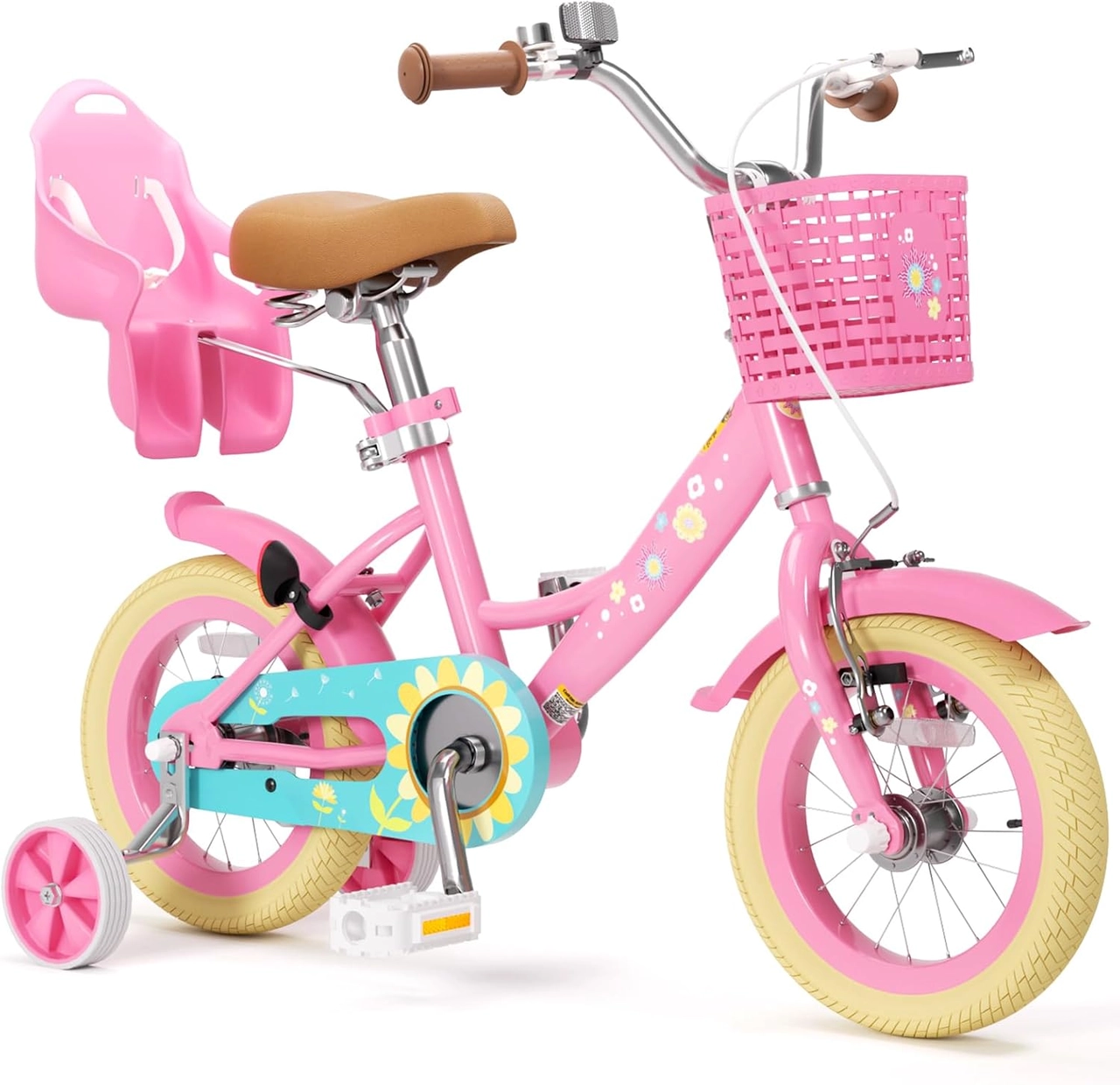 Flower Pink XJD Girls Bike with Doll Seat & Basket
A Training Wheel Bike offered in 12 Inch, 14 Inch and 16 Inch SKU labels; relevant for comparing measured fit with a pink girls’ catalog style featuring a doll seat and basket.
 Purple XJD Girls' Bike with Doll Seat & Basket
A Training Wheel Bike offered in 12 Inch, 14 Inch and 16 Inch SKU labels; useful for comparing measured fit with a purple girls’ catalog style featuring a doll seat and basket.
These two options are relevant only when a 12, 14 or 16 Inch starting point matches the rider’s height and an individual fit check succeeds. They are not substitutes when the rider needs an 18, 20, 24 or 26 Inch bicycle. Their supplied catalog facts do not establish frame measurements, handlebar position, brake type, stock status or compatibility.
Separate preference from fit
A child may genuinely prefer a pink or purple bicycle, a basket or a doll seat. That preference can help the child feel enthusiastic about riding, but it should be considered after the basic fit checks pass. Equally, any child may choose or reject those features; the words “girls’ bike” do not impose a riding rule.
For assembly, adjustment, maintenance, load limits, compatibility and torque, follow the exact product manual or ask a qualified bicycle mechanic. Do not guess at settings. Pair the bicycle with a properly fitting helmet that sits level and has straps adjusted according to the helmet manufacturer’s instructions, consistent with U.S. Consumer Product Safety Commission guidance.
Make the decision
Ignore the lower-bar stereotype. Measure height and inseam, shortlist the corresponding wheel sizes, and have the child test stand-over clearance, reach, braking and control. Choose one of the supplied 12, 14 or 16 Inch catalog options only if its actual fit works and the child wants its features; otherwise, compare a more suitable size or geometry.
Bikes for your next adventure
-

Kids Bike Helmet by XJD for Girls – Pink
The XJD Kids Bike Helmet in Pink is a lightweight multi-sport helmet for girls r…$59.99
$99 -

Kids Bike Helmet by XJD for Boys & Girls – Black, Blue, Green, Pink, Purple
The XJD Kids Bike Helmet covers a wide 2-to-8-year age range thanks to two head-…$59.99
-

XJD Kids Bike for Girls – Pink, 12/14/16/20 Inch with Training Wheels
The XJD Kids Bike for Girls in Pink is a training-wheel bike built to carry your…$139
$159