

How large of a bicycle for young girl
Choose a bicycle by the girl's measured height first, then confirm inseam clearance, comfortable reach, brake control and confidence during a real fit check.
Measure before choosing a wheel size
Measure her standing height without shoes against a wall. Also measure her inseam from the floor to the crotch while she stands naturally. Height gives you a useful starting range; inseam helps you judge whether she can stand over the bicycle without the frame interfering.
Do not select a larger bicycle simply so she can grow into it. Age can narrow the search, but it cannot confirm fit. Two girls of the same age may differ substantially in height, proportions, reach and riding ability.
Compare her height with these starting points
| Wheel size | Starting age | Rider height |
|---|---|---|
| 12 Inch | 3–4 | 34–40 in / 86–102 cm |
| 14 Inch | 3–6 | 37–45 in / 94–114 cm |
| 16 Inch | 4–7 | 40–48 in / 102–122 cm |
| 18 Inch | 5–9 | 43–52 in / 109–132 cm |
| 20 Inch | 7–12 | 48–60 in / 122–152 cm |
| 24 Inch | 10–14 | 54–64 in / 137–163 cm |
| 26 Inch | Youth and adults | Over 60 in / 153 cm |
These ranges overlap because wheel diameter alone does not determine how a bicycle fits. When her height falls into two rows, compare both sizes in person rather than automatically choosing the larger one. Favor the bicycle she can mount, balance, steer and stop with controlled movements.
Perform the fit check
Have her try the complete bicycle in a safe, level area with adult supervision. Check each of these points before deciding:
- Stand-over: She should be able to straddle the bicycle with useful clearance and stable footing rather than leaning precariously.
- Seat position: With the seat adjusted within the limits identified by the product manual, she should be able to start and stop confidently.
- Reach: She should hold the handlebar without stretching, locking her elbows or losing a balanced riding posture.
- Brake control: She must be able to reach and operate the bicycle's brakes reliably with her hands in a controlled position.
- Handling: Ask her to start, steer, turn and stop. A size is unsuitable if the bicycle controls her movements instead of responding to them.
If a promising wheel size fails any of these checks, try another bicycle or size. Frame shape and adjustment can affect fit even when the height chart points to the same wheel diameter.
Where the supplied girls' bicycle fits
The XJD Pink Girls' Bike – Kids 12/14/16 Inch Training Wheel Bicycle is relevant when her measured height points toward a 12-, 14- or 16-inch starting size and a training-wheel bicycle suits her current confidence. Its listed size labels let you compare three adjacent wheel sizes, but they do not replace the individual stand-over, reach and brake checks.
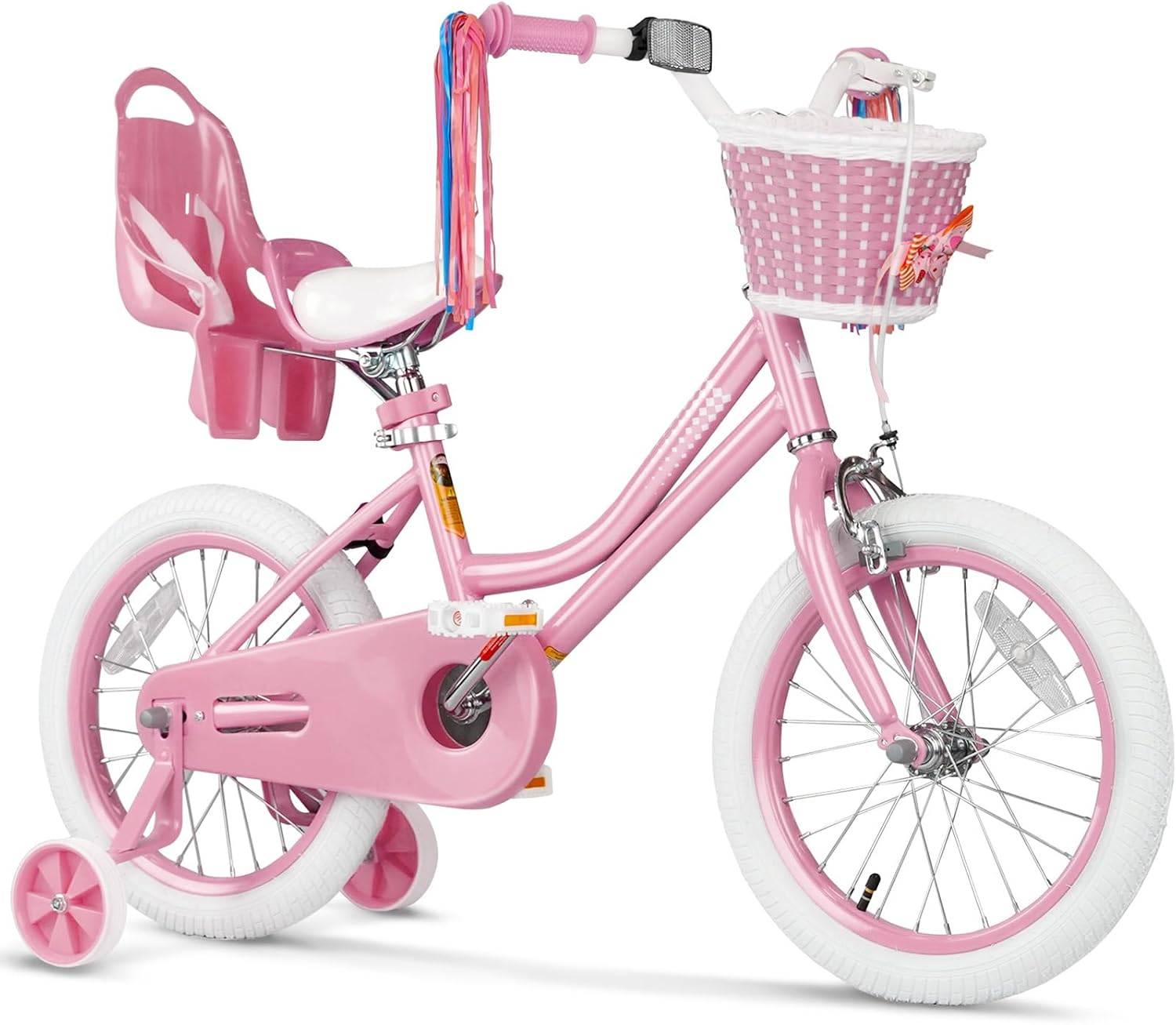
The supplied catalog option does not include 18-, 20-, 24- or 26-inch labels. If her measured height points to one of those sizes, this product is not an equal substitute; use the chart to seek the indicated size and verify its fit in person. Any age-related wording in a product name is a catalog label, not evidence that it fits a particular child.
Match size to current confidence
Physical fit and riding readiness are separate decisions. A girl whose measurements suit a bicycle may still need a setup appropriate to her present balance and control. Conversely, an experienced rider should not be placed on an oversized bicycle merely because she appears confident.
Let her demonstrate calm starts, purposeful steering and repeatable stops. Training wheels may be relevant if that configuration matches her current needs, but their presence does not make an incorrectly sized bicycle suitable. For assembly, adjustments, compatibility, maintenance or torque requirements, follow the exact product manual or ask a qualified bicycle mechanic.
Make the final size decision
- Measure her height and inseam.
- Use her height to identify one or two starting wheel sizes in the table.
- Have her try those sizes and compare stand-over clearance, reach and brake operation.
- Choose the size she can control now, rather than one intended mainly for future growth.
- Fit a bicycle helmet so it sits level and secure, with straps used according to the helmet manufacturer's instructions.
The right size is therefore the chart-supported option that passes her individual fit and control check today. If the 12-, 14- or 16-inch range applies, compare the supplied XJD model's matching label; otherwise, continue with the larger size indicated by her measured height.
Bikes for your next adventure
-

Kids Bike Helmet by XJD for Boys & Girls – Black, Blue, Green, Pink, Purple
The XJD Kids Bike Helmet covers a wide 2-to-8-year age range thanks to two head-…$59.99
-

Kids Bike Helmet by XJD for Girls – Pink
The XJD Kids Bike Helmet in Pink is a lightweight multi-sport helmet for girls r…$59.99
$99 -

XJD Kids Bike for Girls – Pink, 12/14/16/20 Inch with Training Wheels
The XJD Kids Bike for Girls in Pink is a training-wheel bike built to carry your…$139
$159