

How tall of a bike for a 5'1 girl
At 5'1" (61 inches / about 155 cm), start with a 26-inch bike, but also try a 24-inch bike because both XBikes height ranges overlap at this height. Choose by actual stand-over clearance, inseam, reach, brake control and confidence—not by the rider being a girl or by age alone.
The two sizes to compare
Wheel size is only a starting point; it is not the same as frame fit. The relevant XBikes ranges place a 5'1" rider just above the threshold for a 26-inch bike and within the upper portion of the 24-inch range.
| Wheel size | XBikes rider-height starting point | What it means at 5'1" |
|---|---|---|
| 24 Inch | 54–64 in / 137–163 cm | Within the stated range; worth trying, especially when easier mounting and confident control matter. |
| 26 Inch | Over 60 in / 153 cm | Also within the starting point; try it if the rider can stand over, reach and operate it comfortably. |
A 20-inch bike has a stated range of 48–60 inches / 122–152 cm. At a measured 61 inches, the rider is beyond that starting range. Do not move to a larger bike merely to leave room for growth, however; an oversized bicycle can make starting, stopping and steering harder.
Measure height and inseam first
Measure without shoes on a hard, level floor. For height, have the rider stand straight against a wall and measure from the floor to the top of the head. Do not rely on a remembered height, since one inch changes where this rider falls in the XBikes chart.
For inseam, place a firm, thin book between the legs with its spine raised snugly to simulate a saddle. Keep the book level, then measure from the floor to the top edge. Record the result, but compare it with the bicycle’s actual stand-over and adjustment information rather than inventing a universal inseam formula.
If a product page or label does not provide the dimensions needed for that comparison, consult the exact product manual or ask a qualified bicycle mechanic to assess the fit.
Perform the fit check on the actual bike
Have the rider try each candidate rather than deciding from wheel size alone. The American Academy of Pediatrics advises checking the child on the bicycle and avoiding an oversized purchase made only for future growth.
- Stand over it: With both feet flat on the ground, confirm that the rider can straddle the bicycle without being forced onto tiptoes or pressed uncomfortably against the bike.
- Check the reach: While seated in a normal riding position, the rider should reach the handlebar without stretching, locking the elbows or leaning excessively.
- Test the brakes: The rider must be able to reach and operate the brake controls securely while maintaining steering control.
- Start and stop: In a controlled area, confirm that mounting, pushing off, turning, slowing and putting a foot down feel predictable.
- Respect confidence: If the larger option makes the rider hesitant or reduces control, compare the smaller candidate even when the chart permits both.
How the supplied cruiser helps with the comparison
The 26-Inch XJD Beach Cruiser Bike for Girls – Purple, V-Brake is relevant because the supplied catalog includes 24-inch and 26-inch size labels in mint green and pink, plus a purple 26-inch label. Those options let a 5'1" rider compare the two pertinent wheel sizes within one catalog listing. Color and the word “Girls” describe the catalog offering; neither establishes fit.

The exact product title identifies the purple configuration as 26-inch and V-brake. The supplied facts do not establish frame geometry, stand-over height, brake-lever adjustment, weight, load limit or assembly details, so do not infer those features from wheel size. Confirm the selected SKU label, then use the exact product manual or a qualified bicycle mechanic for assembly, adjustment, compatibility, maintenance and torque guidance.
When 24 inches may be the better result
At 5'1", choosing 24 inches is not automatically “too small,” because 61 inches remains inside its supplied 54–64-inch range. It may produce the better individual fit when the rider has a shorter inseam, cannot comfortably clear the 26-inch candidate, feels stretched toward the controls or handles the smaller bicycle more confidently.
Conversely, the 26-inch option may fit when stand-over clearance is adequate and the rider can comfortably reach, steer, brake, start and stop. Do not choose between them by wheel size appearance, color, age assumptions or the expectation that the rider will grow into an uncomfortable bicycle.
Make the final decision
Measure the rider’s current height and inseam, then arrange a real fit check on both 24-inch and 26-inch candidates. Reject any bike that compromises stand-over clearance, reach, braking or controlled stopping. Before riding, use a properly fitting bicycle helmet that sits level and has its straps secured according to the helmet manufacturer’s instructions. For a 5'1" girl, select 26 inches only if that complete check succeeds; otherwise, choose the properly fitting 24-inch option rather than sizing up for growth.
Bikes for your next adventure
-
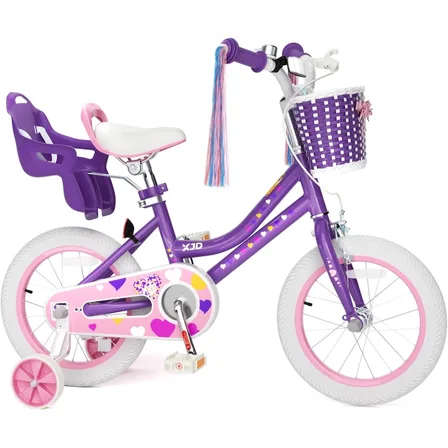
Purple XJD Girls' Bike with Doll Seat & Basket
For girls 71–122 cm tall (about ages 3–7), this XJD girls' bike in Purple pairs …$75.99
$99.99 -

Blue XJD Girls Bike with Training Wheels – 12/14/16 Inch
If you're shopping for a first pedal bike for a daughter roughly 3 to 8 years ol…$149
$169 -

XJD Boys 12/14/16" Training Wheel Bike – Blue
The XJD Boys Bike in Blue is a training wheel bike for riders 71–122 cm tall—rou…$169
$199