

How to pick out a girls bike
To pick out a girls bike, measure the rider’s height and inseam, shortlist the matching wheel size, then check stand-over clearance, reach, braking and confident control on the actual bicycle.
Measure before choosing a wheel size
Have the rider wear the shoes she will normally use. Measure her standing height, then measure her inseam from the floor to the top of the inside leg. Height provides a starting wheel-size range; inseam helps determine whether she can stand over a particular frame comfortably.
Use age only as a rough secondary clue. Children of the same age can differ substantially in height, proportions, strength and confidence. Never move up to an oversized bicycle simply to leave room for growth.
Use the XBikes size ranges as starting points
| Wheel size | Age starting point | Rider height |
|---|---|---|
| 12 Inch | 3–4 | 34–40 in / 86–102 cm |
| 14 Inch | 3–6 | 37–45 in / 94–114 cm |
| 16 Inch | 4–7 | 40–48 in / 102–122 cm |
| 18 Inch | 5–9 | 43–52 in / 109–132 cm |
| 20 Inch | 7–12 | 48–60 in / 122–152 cm |
| 24 Inch | 10–14 | 54–64 in / 137–163 cm |
| 26 Inch | Youth and adults | Over 60 in / 153 cm |
Overlapping ranges are intentional: wheel size alone does not settle the choice. When height falls within two ranges, compare both bicycles in person. Favor the one that gives the rider natural reach, reliable brake control and calm handling now.
Check the actual bike, not just its label
Have the child try each candidate. With her standing over the bicycle, confirm that she has usable clearance rather than contact with the frame. Seated, she should reach the handlebar without stretching, locking her elbows or pulling her shoulders forward.
Ask her to operate every brake control while maintaining a secure grip. She should also be able to start, stop, steer and dismount without panic or obvious strain. A bicycle that matches the height chart can still be unsuitable if the frame shape, control placement or reach does not fit her proportions.
Do not treat “girls” as a sizing standard. Color and styling may matter to the rider, but measurable fit and control determine whether a particular bicycle is appropriate. Let her participate in the visual choice after unsuitable sizes have been removed.
Decide whether training wheels are relevant
Training wheels are relevant when the family specifically wants a training-wheel bicycle and the rider fits and controls it properly. They are not automatically necessary because a bicycle is marketed for girls, nor does their presence correct a frame that is too large or controls that are out of reach.
The supplied catalog option helps compare four common starting sizes within one training-wheel product listing: Girls' Training Wheel Bike by XJD, 12–20 Inch Wheels – Blue is listed in 12 Inch, 14 Inch, 16 Inch and 20 Inch wheel-size labels. It is relevant only if a training-wheel bike is wanted and an individual fit check confirms the selected size.

This product does not provide an 18 Inch or 24 Inch option in the supplied catalog facts. If the rider’s measurements point toward either size, do not treat 16 Inch or 20 Inch as equivalent substitutes; compare a bicycle in the indicated size and verify its fit.
Compare the finalists in a useful order
- Measured range: Remove candidates that do not align with the rider’s current measured height.
- Stand-over: Confirm comfortable clearance on the specific frame.
- Reach: Check for a relaxed upper body and easy steering movement.
- Brake control: Make sure the rider can reach and operate the controls while holding the handlebar securely.
- Current confidence: Observe starting, turning, stopping and getting off.
- Preference: Among bicycles that pass the fit checks, let the rider choose the appearance she enjoys.
If two sizes appear plausible, repeat the riding checks rather than choosing the larger one by default. The correct choice is the bicycle she can control now, not one she may grow into later.
Finish the setup safely
Use a properly fitting bicycle helmet every ride. It should sit level and its straps should be adjusted according to the helmet manufacturer’s instructions. Recheck the fit as the child grows.
Assembly details, adjustments, maintenance, load limits, compatibility and torque values depend on the exact bicycle. Follow its product manual or ask a qualified bicycle mechanic rather than guessing.
Your next step is simple: record her height and inseam, identify one or two wheel-size starting points, and arrange an actual fit check. Choose a girls bike only when she can stand over it, reach and operate its controls, and ride with present-day confidence.
Bikes for your next adventure
-
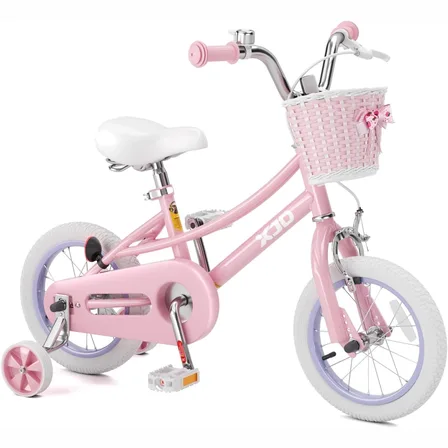
Pink 12/14/16/20" XJD Girls Bike with Training Wheels & Basket
The Pink XJD Girls Bike with Training Wheels & Basket is a first-bike pick f…$65.99
$75.99 -

Light Pink XJD Girls' Bicycle with Basket & Training Wheels
The Light Pink XJD Girls' Bicycle with Basket & Training Wheels is a retro-style…$109.99
$129.99 -

Black XJD Kids Bike for Boys – 12, 14 & 16 Inch Sizes
For a son between roughly 3 and 8 years old, the XJD Kids Bike in Black covers t…$169
$199