

What is a girls bike
A girls bike is a bicycle marketed for girls, often through its colour or accessories. The label does not determine fit: choose by the rider’s measurements, control and confidence.
What the label actually tells you
“Girls bike” is a shopping description, not a separate fit standard. A child does not need a bicycle bearing that label, and any rider may use one if it fits and suits their preferences. In the supplied XBikes range, the description helps identify options with colours such as pink, purple or mint green and features named in the product titles, including baskets or training wheels.
Start by asking whether the child likes the appearance and intended riding style. Then make the decision on wheel size, stand-over clearance, reach, brake access and the child’s ability to control the bicycle. Do not buy an oversized bicycle simply to allow room for growth.
Measure before comparing wheel sizes
Measure the child’s height without shoes. Also measure the inseam from the floor to the crotch while the child stands naturally. Height provides a starting wheel-size range; inseam helps you assess clearance when the actual bicycle is available.
Have the rider try the bicycle. They should be able to stand over it with suitable clearance, reach the handlebar without stretching, steer comfortably and operate the brakes reliably. Check that starting, stopping and putting a foot down feel controlled. Age is only an initial guide, especially near the boundary between sizes.
XBikes wheel-size starting points
| Wheel size | Starting age | Rider height |
|---|---|---|
| 12 Inch | 3–4 | 34–40 in / 86–102 cm |
| 14 Inch | 3–6 | 37–45 in / 94–114 cm |
| 16 Inch | 4–7 | 40–48 in / 102–122 cm |
| 18 Inch | 5–9 | 43–52 in / 109–132 cm |
| 20 Inch | 7–12 | 48–60 in / 122–152 cm |
| 24 Inch | 10–14 | 54–64 in / 137–163 cm |
| 26 Inch | Youth and adults | Over 60 in / 153 cm |
These overlapping ranges are comparison points, not guarantees. Prioritize measured height, inseam, reach, brake control and current confidence over age alone. If two sizes appear plausible, the physical fit check should decide.
How the supplied girls’ bikes compare
These particular catalog options make the meaning of “girls bike” concrete: they cover training-wheel models in several smaller wheel sizes and a beach-cruiser model in larger sizes. They help you compare wheel size, listed features and colour choices after measuring the rider.
 Pink 12/14/16/20" XJD Girls Bike with Training Wheels & Basket
A pink training-wheel bike offered with 12, 14, 16 and 20 Inch SKU labels. Its title also lists a basket, making it relevant for comparing smaller wheel-size choices and named accessories after a fit check.
 26-Inch XJD Beach Cruiser Bike for Girls – Purple, V-Brake
A beach cruiser offered in 20, 24 and 26 Inch labels across listed mint green, pink and purple choices. Its title identifies a V-brake; confirm the rider can reach and control it.
 Light Pink XJD Girls' Bicycle with Basket & Training Wheels
A light pink training-wheel bicycle with a basket and 12, 14, 16 and 20 Inch SKU labels. It is relevant when comparing smaller training-wheel options, provided the selected size passes an individual fit check.
Smaller training-wheel options
The Pink 12/14/16/20" XJD Girls Bike with Training Wheels & Basket is categorized as a training-wheel bike and has 12, 14, 16 and 20 Inch SKU labels. Its title also identifies a basket. Compare only the size that matches the child’s measurements and successful fit check.
The Light Pink XJD Girls' Bicycle with Basket & Training Wheels is another training-wheel option with 12, 14, 16 and 20 Inch SKU labels. Because its listed size choices match the first model’s, the supplied facts distinguish them principally by their exact catalog descriptions rather than by additional fit specifications.
Larger beach-cruiser choices
The 26-Inch XJD Beach Cruiser Bike for Girls – Purple, V-Brake is categorized as a beach cruiser. Its available labels include mint green in 20, 24 and 26 Inch; pink in 20, 24 and 26 Inch; and purple in 26 Inch. Despite “26-Inch” appearing in the title, select from the actual available size labels and perform an individual fit check. The title identifies a V-brake, but brake reach and control still need to be checked by the rider.
None of these supplied products has an 18 Inch SKU label. For a rider whose measurements and fit check point to 18 Inch, the listed models are nearest-size comparison points only; a 16 or 20 Inch bicycle is not an equivalent substitute.
Decide whether training wheels are relevant
Training wheels may be relevant when a child is not yet ready to balance independently and the chosen bicycle fits properly. They do not correct poor fit, excessive reach or difficulty operating the brakes. Base the decision on current confidence and control rather than on whether the product is described as a girls bike.
For assembly, adjustment, removal, compatibility, maintenance, load limits and torque, follow the manual for the exact product or use a qualified bicycle mechanic. Do not transfer procedures or settings between models or sizes.
Complete the safety check
- Let the child try the bicycle rather than choosing from age or colour alone.
- Confirm stand-over clearance, comfortable reach, steering control and reliable brake operation.
- Use a properly fitting bicycle helmet. It should sit level, with straps adjusted according to the helmet manufacturer’s instructions.
- Repeat the fit and control check as the child grows or their riding ability changes.
Make the girls-bike decision
Measure height and inseam now, shortlist the matching wheel-size labels, and arrange a real fit check. Choose a supplied girls bike only when its size, controls and riding format suit the child; treat colour, basket and catalog wording as preferences after fit has been established.
Bikes for your next adventure
-
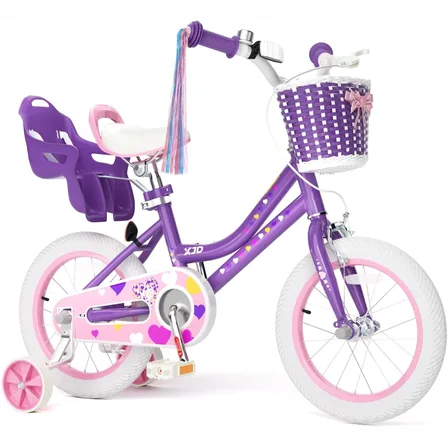
XJD Light Purple Girls Bike with Basket, Training Wheels, 12/14/16/20 Inch
The XJD Girls Bike with Basket in Light Purple is a single-speed training-wheel …$99.99
$119.99 -

XJD Kids Bike for Girls – Pink, 12/14/16/20 Inch with Training Wheels
The XJD Kids Bike for Girls in Pink is a training-wheel bike built to carry your…$139
$159 -
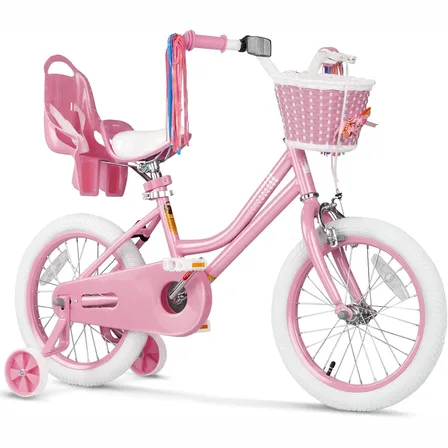
XJD Pink Girls' Bike – Kids 12/14/16 Inch Training Wheel Bicycle
The XJD Pink Girls' Bike is a training-wheel bicycle for girls ages 3 to 8 (ride…$149
$169