

What is the difference between guy and girl bikes
Guy and girl bikes mainly differ in styling, frame shape and accessories—not in who can ride them. Fit, control and confidence matter more than the label.
What the labels usually mean
“Guy” and “girl” are retail descriptions, not separate fit standards. A bike marketed to girls may use particular colors, a lower-looking frame or accessories such as a basket. Another bike may use different styling or frame proportions. None of those features determines which child can ride it.
The practical differences to compare are wheel size, stand-over clearance, reach to the handlebar, access to the brake controls and how confidently the rider can start, steer and stop. Let the child choose the appearance, but choose the size and setup by measurement and an in-person fit check.
Measure the rider before comparing bikes
Measure the child’s height without shoes. Also measure inseam from the floor to the crotch while the child stands naturally. Height provides a wheel-size starting point; inseam helps you evaluate stand-over clearance when the child tries the actual bicycle.
Use these XBikes ranges only to identify sizes worth trying:
| Wheel size | Starting age | Rider height |
|---|---|---|
| 12 Inch | 3–4 | 34–40 in / 86–102 cm |
| 14 Inch | 3–6 | 37–45 in / 94–114 cm |
| 16 Inch | 4–7 | 40–48 in / 102–122 cm |
| 18 Inch | 5–9 | 43–52 in / 109–132 cm |
| 20 Inch | 7–12 | 48–60 in / 122–152 cm |
| 24 Inch | 10–14 | 54–64 in / 137–163 cm |
| 26 Inch | Youth and adults | Over 60 in / 153 cm |
Overlapping ranges are intentional: two children of the same age or height can have different inseams, proportions and skill levels. Prioritize measured height, inseam, reach, brake control and current confidence over age alone.
Check the actual fit and controls
Have the rider try the bike rather than relying on a “boys” or “girls” label. The American Academy of Pediatrics advises against buying an oversized bicycle merely for growth. During the check, confirm that the child can:
- Stand over the bicycle with usable clearance and without being forced onto tiptoes.
- Reach the handlebar without stretching, locking the elbows or losing a stable posture.
- Operate the available brake controls comfortably and with enough confidence to stop.
- Mount, start, steer, turn and stop without the bicycle feeling intimidating or unwieldy.
If the fit sits between two sizes, compare both in person. Do not assume the larger one is a better value or that a lower-looking frame automatically solves a reach or control problem.
How the supplied girls’ bikes help with comparison
The supplied catalog options show that “girls’ bike” covers several wheel sizes and styles rather than one special type of bicycle. The Light Pink XJD Girls' Bicycle with Basket & Training Wheels is listed in 12, 14, 16 and 20 Inch sizes. The 26-Inch XJD Beach Cruiser Bike for Girls – Purple, V-Brake has listed options in 20, 24 and 26 Inch, including the Purple / 26 Inch option named in its title. These are relevant comparison points only where the rider’s measurements and control support the specific size.
 26-Inch XJD Beach Cruiser Bike for Girls – Purple, V-Brake
Listed in 20, 24 and 26 Inch options, this beach cruiser provides larger-wheel comparison points. Its girls’ label and Purple / 26 Inch option describe the catalog offering, not an individual rider’s fit.
 Light Pink XJD Girls' Bicycle with Basket & Training Wheels
This training-wheel bike is listed in 12, 14, 16 and 20 Inch sizes. It is relevant for comparing those wheel-size starting points, but the basket, color and girls’ label do not establish fit.
The first product is useful when comparing smaller listed wheel sizes and a training-wheel-bike category. The second spans larger listed choices in the beach-cruiser category. Their titles and styling do not prove fit for a particular child, and one listed size must never be treated as equivalent to another.
When these products are not relevant
Neither supplied product lists an 18 Inch option. If measurement and an individual fit check point to 18 Inch, these products are nearest-size comparison points, not substitutes; a 16 or 20 Inch bike is not equal to an 18 Inch bike.
They are also not appropriate choices merely because the rider is a girl. Set either aside if the correct SKU does not match the rider’s size range, if stand-over or reach is unsuitable, if the child cannot control the brakes, or if the bicycle’s category does not suit the intended riding. For assembly, maintenance, load limits, compatibility and torque, follow the exact product manual or ask a qualified bicycle mechanic.
Make the decision
Measure height and inseam, identify the wheel sizes worth trying, then compare stand-over, reach, brake access and confident control on the actual bike. After fit is settled, let color, basket, frame styling or the “guy” or “girl” label decide preference—not suitability. Finish by fitting a bicycle helmet level on the head and fastening its straps according to the helmet manufacturer’s instructions.
Bikes for your next adventure
-
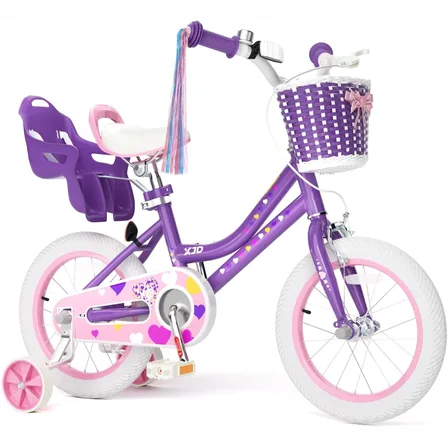
XJD Light Purple Girls Bike with Basket, Training Wheels, 12/14/16/20 Inch
The XJD Girls Bike with Basket in Light Purple is a single-speed training-wheel …$99.99
$119.99 -
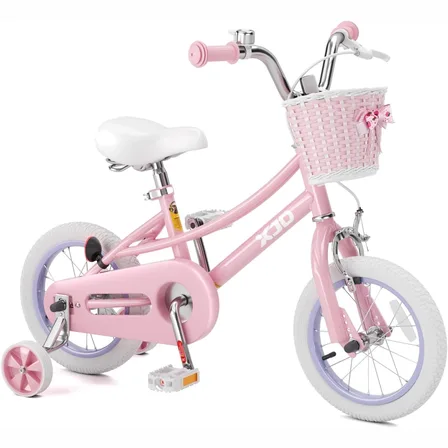
Pink 12/14/16/20" XJD Girls Bike with Training Wheels & Basket
The Pink XJD Girls Bike with Training Wheels & Basket is a first-bike pick f…$65.99
$75.99 -
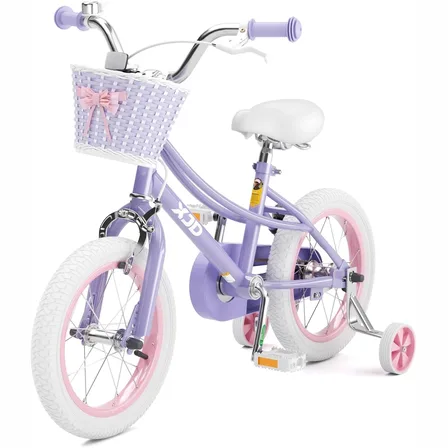
Girls' Training Wheel Bike by XJD with Basket – Purple
If you're shopping for a first bike for a girl roughly 3 to 12 years old (91–152…$75.99