

What Is the Smallest Girls' Mountain Bike?
The smallest XBikes starting point is a 12-inch bike, generally for a rider 34–40 inches (86–102 cm) tall. It is suitable only if the child can stand over, reach, steer and brake comfortably.
What “smallest” means for a girls’ mountain bike
Here, “smallest” refers to the smallest wheel-size starting point in the supplied XBikes fit standard: 12 inches. Whether a bike is marketed for girls does not change the measurements that determine fit. Rider height, inseam, reach, brake control and current confidence matter more than the label or age alone.
A 12-inch model is therefore the first size to investigate, not an automatic recommendation for every small rider. The child should try the complete bicycle. Do not choose an oversized bike merely to leave room for growth; a bike that is too large can make starting, stopping and steering harder to control.
Measure before comparing bikes
- Measure standing height: Have the child stand upright without shoes against a wall. Compare the result with the XBikes height ranges.
- Measure inseam: With feet slightly apart, measure from the floor to the crotch. Use this when checking clearance over the actual frame; wheel diameter alone does not reveal frame height.
- Check reach: On the bike, the child should be able to hold the handlebar and steer without stretching excessively or losing a stable riding position.
- Check brake control: Confirm that the child can comfortably reach and operate the fitted brakes. Follow the exact product manual for adjustment, or ask a qualified bicycle mechanic.
Use the XBikes size ranges as starting points
| Wheel size | Age starting point | Rider height |
|---|---|---|
| 12 Inch | 3–4 | 34–40 in / 86–102 cm |
| 14 Inch | 3–6 | 37–45 in / 94–114 cm |
| 16 Inch | 4–7 | 40–48 in / 102–122 cm |
| 18 Inch | 5–9 | 43–52 in / 109–132 cm |
| 20 Inch | 7–12 | 48–60 in / 122–152 cm |
| 24 Inch | 10–14 | 54–64 in / 137–163 cm |
| 26 Inch | Youth and adults | Over 60 in / 153 cm |
The ranges overlap because children of the same age can have different proportions and abilities. Start with measured height, then resolve an overlap by trying the actual frame and assessing stand-over clearance, reach, braking and confidence. Age is only a secondary clue.
What the supplied catalog product can—and cannot—show
The supplied product, 26-Inch XJD Beach Cruiser Bike for Girls – Purple, V-Brake, is categorized as a beach cruiser rather than a mountain bike. Its available SKU labels include 20-inch, 24-inch and 26-inch choices in listed colors. Those options can help illustrate how much larger the catalog’s available comparison sizes are than the 12-inch starting point.
These particular catalog options help answer the title by providing larger girls’ bike size references, but none is a 12-inch mountain bike. They are comparison points, not substitutes for the smallest requested type or size.

The smallest listed variant is a 20-inch SKU, whose XBikes starting range is 48–60 inches (122–152 cm) and ages 7–12. That is substantially different from the 12-inch range of 34–40 inches (86–102 cm) and ages 3–4. Do not treat the 20-inch option as equivalent merely because it is the smallest supplied catalog choice.
Confirm fit on the actual bicycle
Have the child try the exact bike while wearing normal riding shoes. Check that there is appropriate clearance when standing over the frame, that mounting and dismounting feel manageable, and that the child can turn the handlebar without being pulled forward.
Then confirm that the brake controls are within comfortable reach and can be operated with control. Frame geometry and component position can differ even when two bicycles share a wheel size, so the size printed in a title cannot complete the fit decision.
For assembly, maintenance, component adjustment, compatibility, load limits and torque requirements, follow the manual for the exact product or use a qualified bicycle mechanic. Do not infer those details from wheel size.
Make the smallest-size decision
If the rider measures 34–40 inches (86–102 cm), begin by trying a 12-inch mountain bike and complete every fit check. If the child falls outside that range, move to the corresponding XBikes starting point rather than forcing a 12-inch choice. Whichever size fits, use a properly fitting bicycle helmet that sits level, with straps secured according to the helmet manufacturer’s instructions.
The practical next step is simple: record the child’s height and inseam, then try an actual 12-inch mountain bike. Choose it only if stand-over clearance, reach, brake operation and rider confidence all confirm the fit.
Bikes for your next adventure
-

Light Purple XJD Toddler Bike Helmet, Adjustable, Size XS (46–51 cm)
This Light Purple XJD toddler bike helmet is made for the smallest riders — the …$20.39
-
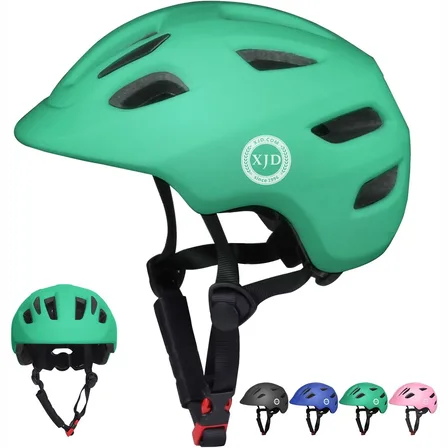
Green XJD Toddler Bike Helmet with Adjustable Fit, XS (46–51 cm)
The XJD toddler bike helmet in Green is built for the youngest riders — the size…$20.39
$23.99 -

Kids Bike Helmet by XJD for Boys & Girls – Black, Blue, Green, Pink, Purple
The XJD Kids Bike Helmet covers a wide 2-to-8-year age range thanks to two head-…$59.99