

What size bike do i need girl
Choose a girls’ bike by her measured height and an in-person fit check, not by gender or age alone. Measure height and inseam, use wheel size as a starting point, then confirm stand-over clearance, comfortable reach, brake control and confidence.
Start with her current height
Have the rider stand barefoot against a wall, looking straight ahead, with her heels on the floor. Mark the top of her head and measure from the floor to the mark. Compare that number with the XBikes starting points below.
| Wheel size | Starting age | Rider height |
|---|---|---|
| 12 Inch | 3–4 | 34–40 in / 86–102 cm |
| 14 Inch | 3–6 | 37–45 in / 94–114 cm |
| 16 Inch | 4–7 | 40–48 in / 102–122 cm |
| 18 Inch | 5–9 | 43–52 in / 109–132 cm |
| 20 Inch | 7–12 | 48–60 in / 122–152 cm |
| 24 Inch | 10–14 | 54–64 in / 137–163 cm |
| 26 Inch | Youth and adults | Over 60 in / 153 cm |
Height ranges overlap, so the table narrows the choice rather than deciding it. Age is only a secondary clue. A taller younger rider may need a different starting size from an older child of shorter stature.
Measure inseam for the stand-over check
With the rider barefoot, place a book firmly between her legs, level with the floor, to represent the saddle area. Measure from the floor to the book’s top edge. Record the result; do not convert it directly into a wheel size because bicycle frame shapes vary.
Next, have her try the complete bicycle. When she straddles it with both feet flat on the ground, she should have usable space between her body and the top tube rather than being pressed against the frame. The American Academy of Pediatrics’ HealthyChildren guidance supports trying the bicycle and checking stand-over instead of buying an oversized bike for future growth.
Confirm reach, braking and control
Ask her to sit in a normal riding position and hold the handlebar. She should not need to lock her elbows, stretch her torso markedly or slide forward just to steer. She must be able to operate the bicycle’s brakes comfortably with the controls provided, without losing a secure grip.
A short supervised trial in a traffic-free area should answer the remaining questions. Look for whether she can:
- start and stop without panic or a large loss of balance;
- turn both ways while looking ahead;
- place a foot down promptly when stopping;
- reach and use the brakes with control;
- handle the bicycle’s size with her current confidence.
If she appears stretched, cannot control the brakes or is intimidated by the bicycle, reject that fit even when her age or height appears in the listed range. Do not size up merely to leave growing room.
How the supplied bike helps with comparison
The XJD Boys & Girls BMX Bike with Training Wheels, 12/14/16" – Blue is listed as a Kids’ BMX Bike and has 12 Inch, 14 Inch and 16 Inch SKU labels. Those three options help families compare the smallest overlapping height ranges directly: 34–40 inches for 12 Inch, 37–45 inches for 14 Inch and 40–48 inches for 16 Inch. The title’s “Boys & Girls” wording indicates catalog positioning; it does not replace measuring or an individual fit check.

This product is relevant only if her measured height points toward one of those three wheel sizes and she passes the physical fit and control checks. It does not provide an 18, 20, 24 or 26 Inch option in the supplied catalog facts. If her measurements point to one of those sizes, treat this product only as a smaller-size comparison point, not as an equal or substitute.
What to do when two sizes overlap
When her height falls in two ranges, arrange a fit check on both sizes if possible. Compare stand-over space, natural handlebar reach, brake access, starting, stopping and turning. Favor the bicycle she can control confidently now. Her inseam and proportions can make one option clearly more manageable even when both wheel sizes match the height table.
Do not infer fit from wheel size alone, and do not adjust or assemble a bicycle using guessed procedures. Follow the exact product manual for assembly, maintenance, compatibility, load limits and torque requirements, or ask a qualified bicycle mechanic.
Make the final size decision
Write down her height and inseam, identify the matching wheel-size range, and have her try that size while you check stand-over, reach, brake operation and confidence. Add a properly fitting bicycle helmet that sits level, with straps used according to the helmet manufacturer’s instructions. Buy only the size she can control today—even if a larger girls’ bike seems likely to last longer.
Bikes for your next adventure
-
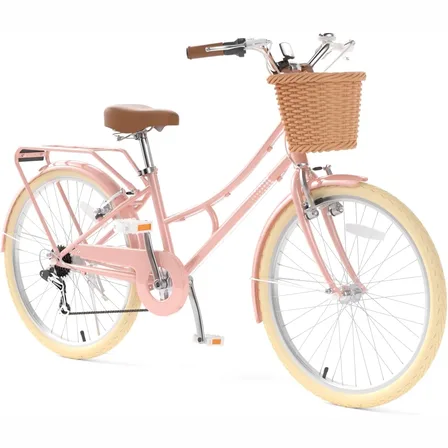
XJD Pink Beach Cruiser for Girls – Rear Rack & V-Brake
The XJD Pink Beach Cruiser for girls is the step-up bike for riders who've outgr…$179.99
$209.99 -
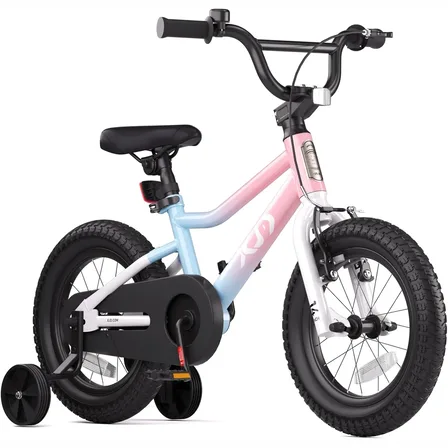
XJD Girls BMX Bike 12/14/16 Inch with Training Wheels – Pink Blue
The XJD Girls BMX Bike in Pink/Blue is built as a first pedal bike for kids roug…$99.99
$119.99 -

Blue XJD Kids Bike Helmet for Boys & Girls
The Blue XJD Kids Bike Helmet is a lightweight, adjustable multi-sport helmet fo…$59.99
$99