

What size bike does a 4 year old girl need
A 4-year-old girl will often fit a 14-inch bike, but her measured height and actual control matter more than age. Compare 12, 14 and 16-inch bikes: XBikes starts 12-inch at 34–40 in (86–102 cm), 14-inch at 37–45 in (94–114 cm), and 16-inch at 40–48 in (102–122 cm). She should try the bike before you choose.
Choose the starting size from her height
Measure her standing height without shoes, with her back straight against a wall. Use that number to identify which wheel sizes deserve a fit check. Overlap is normal, so the chart narrows the choice rather than deciding it automatically.
| Wheel size | XBikes age starting point | Rider height | Relevance at age four |
|---|---|---|---|
| 12 Inch | Ages 3–4 | 34–40 in / 86–102 cm | Check for a shorter rider |
| 14 Inch | Ages 3–6 | 37–45 in / 94–114 cm | Common starting comparison |
| 16 Inch | Ages 4–7 | 40–48 in / 102–122 cm | Check for a taller rider |
For example, a child who is 39 inches tall falls within both the 12-inch and 14-inch ranges. A child who is 41 inches tall falls within both the 14-inch and 16-inch ranges. In either overlap, compare the bikes in person rather than automatically selecting the larger wheel.
Measure inseam before the test ride
Height identifies candidates; inseam helps you assess stand-over room. Have her stand barefoot with her feet slightly apart. Place a straight, firm object between her legs as though it were a bicycle saddle, then measure from its top edge to the floor.
Compare that measurement with the stand-over height of the exact assembled bicycle. She needs comfortable clearance and must be able to get on and off without struggling. Geometry can differ between bicycles with the same wheel label, so wheel diameter alone cannot confirm fit.
What to check when she sits on the bike
Have her try each candidate in a calm, level area with close adult supervision. The American Academy of Pediatrics advises trying the bicycle, checking stand-over and control, and avoiding an oversized bike bought merely for future growth.
- Reach: She should hold the handlebars without stretching, locking her elbows or leaning awkwardly.
- Brake control: If the bicycle has hand controls, confirm that she can reach and operate them confidently. Use the exact product manual for any model-specific instructions.
- Starting and stopping: She should be able to begin, steer, stop and dismount without the bicycle pulling her off balance.
- Confidence: A technically plausible size is still unsuitable if she appears tense or cannot control it predictably.
Do not choose a 16-inch bike simply because it offers more growing room. If she controls a 14-inch bike well but struggles with a 16-inch bike, the larger option has failed the present-day fit check.
How the supplied girls’ bikes compare
The supplied catalog options are useful because all three offer training-wheel bicycles in the 12, 14 and 16-inch comparison sizes relevant to many four-year-olds. Their wheel labels let you shortlist candidates after measuring, but they do not replace an individual fit test.
 XJD Kids Bike for Girls – Pink, 12/14/16/20 Inch with Training Wheels
Offers training-wheel versions in 12, 14 and 16 inches for fitting a four-year-old, plus a 20-inch version that is outside the XBikes age-based starting point for this age.
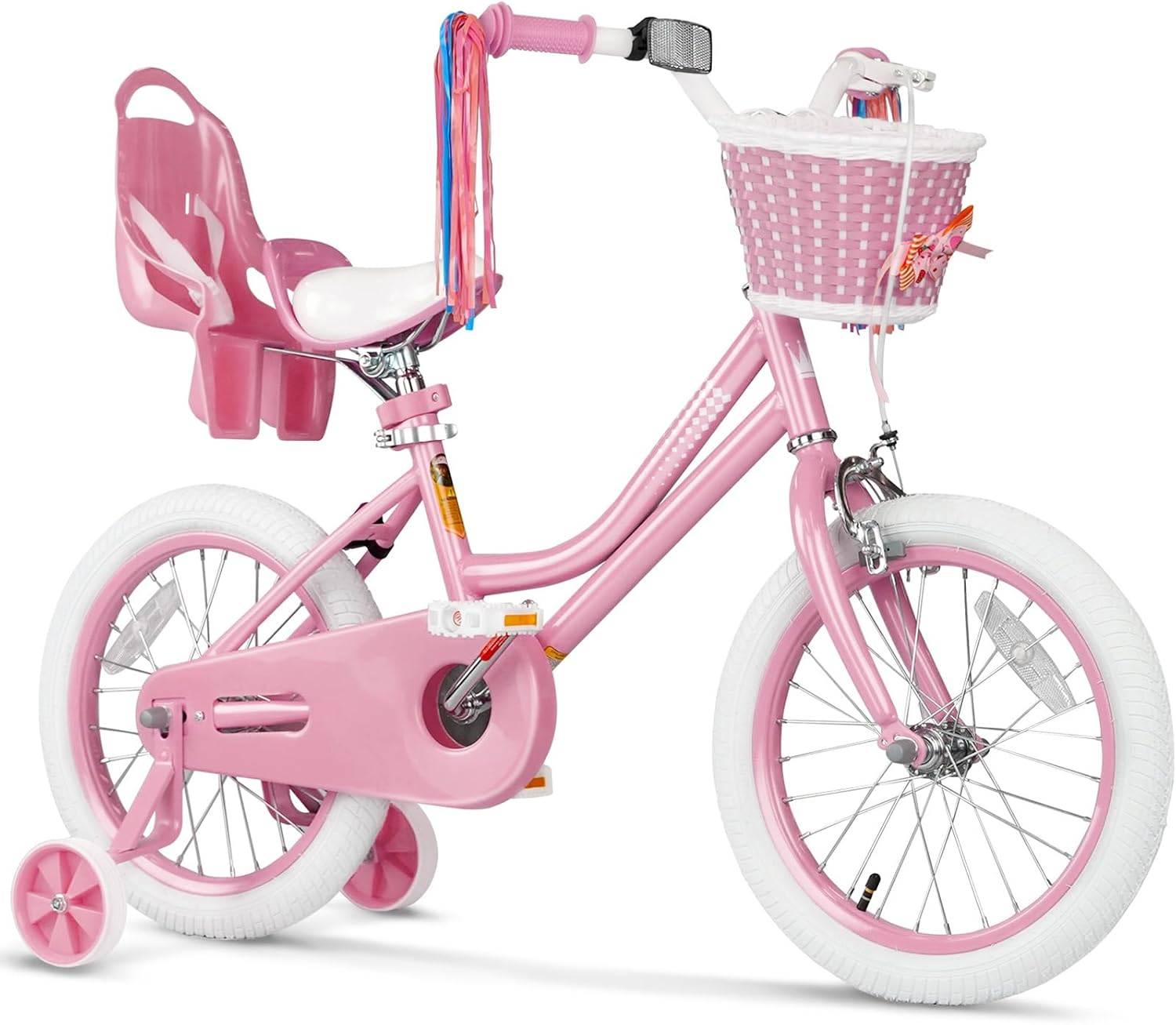 XJD Pink Girls' Bike – Kids 12/14/16 Inch Training Wheel Bicycle
Its 12, 14 and 16-inch training-wheel versions cover the relevant XBikes height-range comparisons; measured height and an individual control check should determine which version to try.
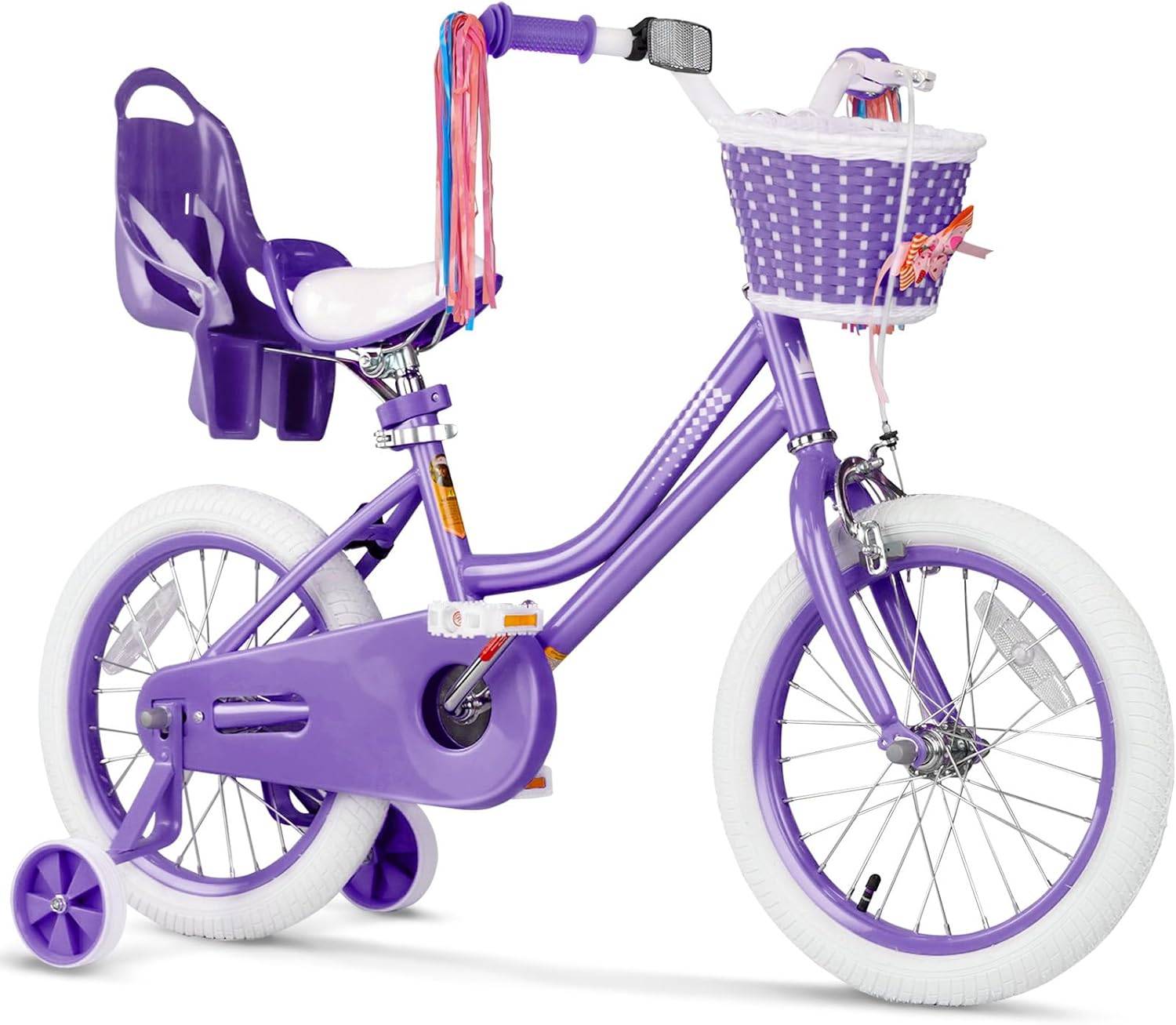 XJD Girls Bike for Kids Ages 3-8, 12/14/16 Inch with Training Wheels – Purple
Provides 12, 14 and 16-inch training-wheel options. The ages in its catalog title are not fit evidence, so choose a candidate using XBikes height ranges and a hands-on check.
XJD Kids Bike for Girls – Pink, 12/14/16/20 Inch with Training Wheels provides 12, 14 and 16-inch options for this decision, plus a 20-inch option. Under the XBikes standard, 20-inch starts at ages 7–12 and heights 48–60 in (122–152 cm), so it is not the age-based starting point for a four-year-old and should never be treated as equivalent to the smaller sizes.
XJD Pink Girls' Bike – Kids 12/14/16 Inch Training Wheel Bicycle offers the three wheel sizes most relevant to the comparison: 12, 14 and 16 inches. Select which version to try from measured height, then verify inseam, reach, braking and control on that exact bicycle.
XJD Girls Bike for Kids Ages 3-8, 12/14/16 Inch with Training Wheels – Purple also comes in 12, 14 and 16-inch versions. “Ages 3-8” is part of its catalog title, not evidence that every version fits every child in that span; use only the XBikes height ranges and a hands-on fit check.
Training wheels do not correct poor sizing
All three supplied products are categorized as training-wheel bikes. Training wheels may match the type of bicycle a family wants, but their presence does not make an oversized frame easier to reach, stand over or brake. Current riding confidence should guide whether these catalog options are relevant at all.
For assembly, adjustment, maintenance, compatibility, load limits and torque, follow the manual for the exact product and size. If anything is unclear or the controls cannot be adjusted to suit the rider, use a qualified bicycle mechanic rather than improvising.
Make the final size decision
- Measure her standing height and inseam.
- Shortlist 12, 14 or 16 inches from the XBikes ranges.
- Have her try every overlapping candidate.
- Choose the size she can stand over, reach, brake, steer, start and stop confidently now.
Before riding, add a properly fitting bicycle helmet. It should sit level and its straps should be used according to the helmet manufacturer’s instructions. For a four-year-old, begin with 14 inches when her height is 37–45 in (94–114 cm), compare 12 or 16 inches where her measurement overlaps, and reject any size she cannot control comfortably today.
Bikes for your next adventure
-
Girls' Training Wheel Bike by XJD with Basket – Purple
If you're shopping for a first bike for a girl roughly 3 to 12 years old (91–152…$75.99
-
XJD Light Purple Girls Bike with Basket, Training Wheels, 12/14/16/20 Inch
The XJD Girls Bike with Basket in Light Purple is a single-speed training-wheel …$99.99
$119.99 -
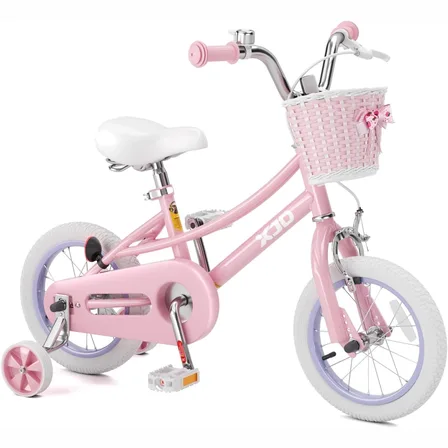
Pink 12/14/16/20" XJD Girls Bike with Training Wheels & Basket
The Pink XJD Girls Bike with Training Wheels & Basket is a first-bike pick f…$65.99
$75.99