

What size bike does a 5-6 year old girl ride
Most 5–6-year-old girls start with a 16-inch bike, but height and fit decide. Measure her height and inseam, then check reach, control and confidence.
Start with her measured height
Age narrows the search, but it does not determine the right bicycle. Have her stand barefoot against a wall and measure from the floor to the top of her head. Then measure her inseam from the floor to the crotch while she stands straight with her feet slightly apart.
Use her height to choose the first wheel size to try. Keep the inseam measurement for the in-person stand-over check, because wheel size alone does not reveal the frame’s exact clearance.
| Wheel size | XBikes starting range | What it means at age 5–6 |
|---|---|---|
| 14 Inch | Ages 3–6; 37–45 in / 94–114 cm | Worth trying for a shorter rider within this height range. |
| 16 Inch | Ages 4–7; 40–48 in / 102–122 cm | The usual starting point when her height falls in this range. |
| 18 Inch | Ages 5–9; 43–52 in / 109–132 cm | Consider when she is tall enough and can control the larger bike. |
| 20 Inch | Ages 7–12; 48–60 in / 122–152 cm | Only consider if she already reaches this height range and passes every fit check. |
If her height appears in two ranges, compare both sizes in person. The better choice is the one she can mount, balance, steer and stop confidently—not automatically the larger one.
Check the bicycle with her on it
Have your child try the actual bicycle. The American Academy of Pediatrics’ HealthyChildren guidance supports checking fit and control instead of buying an oversized bicycle for future growth.
- Stand-over: Ask her to straddle the bicycle with both feet flat on the ground. She needs comfortable clearance rather than contact with the frame.
- Reach: With her seated, confirm that she can hold the handlebars without stretching, locking her elbows or leaning excessively.
- Brake control: She must be able to reach and operate the bicycle’s braking controls as designed. If she cannot, the bike does not fit even when the height chart matches.
- Steering and balance: Let her start, turn and stop in a controlled area. Look for calm control rather than wobbling caused by excessive size or reach.
- Confidence: Ask how the bike feels. A size that makes her tense or reluctant is not a useful growth purchase.
When 14, 16 or 18 inches makes sense
A 14-inch bike may suit a 5–6-year-old who measures 37–45 inches (94–114 cm), especially if she is newer to riding or finds a larger bike difficult to control. Do not reject it merely because she is near the upper end of the age guidance.
A 16-inch bike is the clearest starting point for a rider measuring 40–48 inches (102–122 cm). It spans both ages in the title, but it still needs the same stand-over, reach and brake checks.
An 18-inch bike becomes a relevant comparison at 43–52 inches (109–132 cm). It is not automatically preferable for a tall five- or six-year-old: she must still demonstrate suitable reach, braking and low-speed control.
How the supplied bike helps with comparison
The XJD Light Purple Girls Bike with Basket, Training Wheels, 12/14/16/20 Inch is categorized as a training-wheel bike, and its supplied available SKU labels are 12 Inch, 14 Inch and 16 Inch. That makes its 14-inch and 16-inch options relevant comparison points for many riders in this age group; the 12-inch option starts at ages 3–4 and 34–40 inches (86–102 cm), so it is generally relevant only when her measured height still falls within that range.
These particular catalog options help answer the sizing question because the available 14-inch and 16-inch labels let you compare two adjacent starting sizes against her measurement and actual control. The title also contains “20 Inch,” but 20 Inch is not among the supplied available SKU labels, so do not assume that version is currently selectable.

Training wheels can identify the product category, but they do not correct an oversized frame, excessive handlebar reach or inaccessible braking controls. Use the exact product manual for assembly, adjustment, maintenance, compatibility, load limits and torque information that is not supplied here, or ask a qualified bicycle mechanic.
Avoid sizing up just for growth
Do not move straight to an 18- or 20-inch bicycle merely to make it last longer. An oversized bike may make mounting, steering and stopping harder. A 20-inch bicycle begins at 48 inches (122 cm) in the XBikes starting standard, so it is only a candidate for a 5–6-year-old who reaches that height and can control the exact bicycle comfortably.
If she is between sizes, test both. Favor the bike she can manage now while meeting the measured-height range; future growth should not override present control.
Finish the fit and helmet check
Once a bicycle passes the fit checks, add a properly fitting bicycle helmet. U.S. Consumer Product Safety Commission guidance says the helmet should sit level and its straps should be adjusted according to the helmet manufacturer’s instructions.
Your next move is simple: measure her height and inseam, begin with 16 inches if she is 40–48 inches tall, compare 14 or 18 inches only when her height supports it, and buy only after she demonstrates comfortable stand-over, reach, braking and control on the exact bike.
Bikes for your next adventure
-
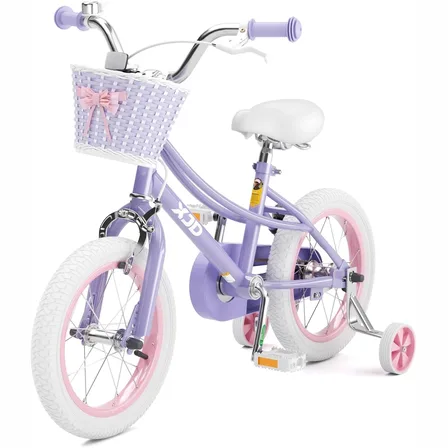
Girls' Training Wheel Bike by XJD with Basket – Purple
If you're shopping for a first bike for a girl roughly 3 to 12 years old (91–152…$75.99
-
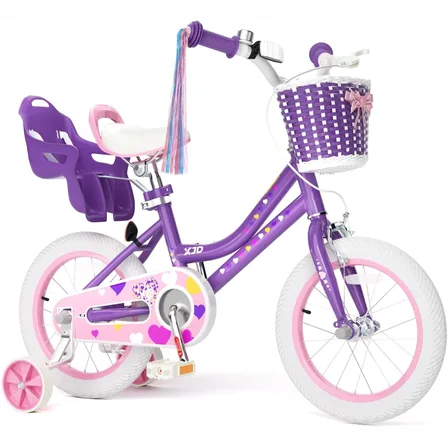
XJD Light Purple Girls Bike with Basket, Training Wheels, 12/14/16/20 Inch
The XJD Girls Bike with Basket in Light Purple is a single-speed training-wheel …$99.99
$119.99 -
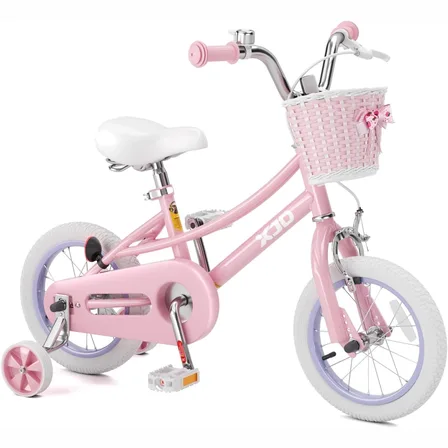
Pink 12/14/16/20" XJD Girls Bike with Training Wheels & Basket
The Pink XJD Girls Bike with Training Wheels & Basket is a first-bike pick f…$65.99
$75.99