

What size bike for 11yr old girl
For an 11-year-old girl, start with a 20-inch or 24-inch bike based on her measured height—not age alone. Check inseam, reach, brakes and confidence before choosing.
Choose the starting wheel size by height
Measure her current height without shoes, standing straight against a wall. Compare that measurement with the XBikes starting points below. These ranges narrow the search, but they do not confirm that a particular frame fits.
| Wheel size | XBikes age starting point | Rider height |
|---|---|---|
| 20 Inch | Ages 7–12 | 48–60 in / 122–152 cm |
| 24 Inch | Ages 10–14 | 54–64 in / 137–163 cm |
| 26 Inch | Youth and adults | Over 60 in / 153 cm |
An 11-year-old measuring 48–54 inches will generally begin the comparison with 20-inch bikes. From 54–60 inches, the 20-inch and 24-inch ranges overlap, so she should try both and choose by actual control. From 60–64 inches, begin with 24-inch bikes; above 60 inches, 26-inch models also become a starting point. Overlapping ranges do not mean the sizes fit identically.
Measure inseam as well as total height
For inseam, have her stand without shoes with her feet naturally spaced. Place a firm, thin book between her legs and raise it gently to simulate a saddle. Measure from the floor to the top edge of the book. Keep this measurement available when checking the bicycle manufacturer’s sizing information.
Then have her straddle the actual bike with both feet on the floor. She needs usable clearance rather than contact with the frame. Frame shapes differ even when wheel labels match, so neither height nor a wheel-size label can replace this stand-over check.
Confirm reach, braking and control
Seat her on the bicycle in a normal riding position and check whether she can hold the handlebar without stretching, locking her elbows or leaning awkwardly. She should be able to steer smoothly and look ahead while remaining balanced.
She must also be able to reach and operate the brake controls confidently. Avoid assuming that she will grow into a difficult reach. HealthyChildren guidance recommends having the child try the bicycle, checking stand-over and control, and not buying an oversized bike merely to allow room for growth.
Use a short, supervised test in a clear area. Watch whether she can:
- start and stop without panic or excessive wobbling;
- turn in both directions while staying in control;
- reach and use the brakes from her normal hand position;
- place a foot down predictably when stopping.
If she cannot do these things comfortably, try a different frame or wheel size rather than treating discomfort as something she must learn around.
How the supplied XBikes product is relevant
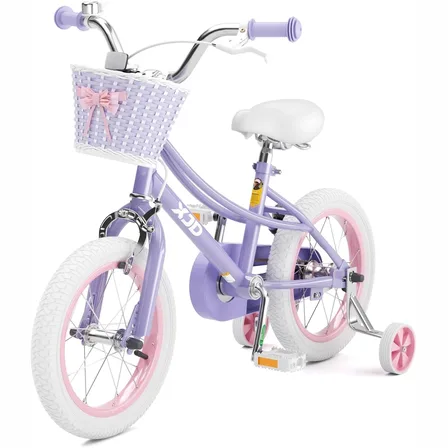
The Light Pink XJD Girls' Bicycle with Basket & Training Wheels is listed in 12 Inch, 14 Inch, 16 Inch and 20 Inch sizes. For this question, only its 20-inch catalog option is a plausible comparison, and only when her measured height falls within the 48–60 inch / 122–152 cm starting range and an individual fit check confirms control. The smaller listed sizes are outside the XBikes age and height starting points for a typical 11-year-old comparison.
This product helps show the available 20-inch catalog choice, including its supplied basket and training-wheel description. It does not provide a 24-inch or 26-inch option, so it is not a substitute if her measurements and test ride point to either larger size.

When training wheels may or may not suit her
Training wheels can be relevant if she currently needs that type of support, but age alone does not establish the need. Ask how confidently she starts, balances, turns and stops. A confident rider seeking a conventional two-wheel setup may find this product category irrelevant even if the 20-inch size range matches her height.
Do not assume how the training wheels should be installed, adjusted or removed. Follow the exact product manual, including its assembly, compatibility, maintenance and load instructions. If the documentation is unavailable or the setup is uncertain, use a qualified bicycle mechanic.
Complete the fit and safety check
Before deciding, repeat the stand-over, reach, brake-control and low-speed handling checks with the bike adjusted according to its manual. Recheck fit after any permitted saddle or handlebar adjustment; do not improvise beyond the manufacturer’s instructions.
Add a properly fitting bicycle helmet. U.S. Consumer Product Safety Commission guidance says the helmet should fit properly, sit level on the head and have its straps used according to the helmet manufacturer’s instructions. A helmet does not correct an oversized or poorly controlled bicycle.
The decision for an 11-year-old girl
Measure her height and inseam first. Compare 20-inch bikes at 48–60 inches, 24-inch bikes at 54–64 inches, and consider the 26-inch starting point above 60 inches. In an overlap, let comfortable stand-over, natural reach, reliable braking and present confidence decide. Consider the supplied 20-inch product only if those checks support 20 inches and training wheels suit her current riding needs; otherwise, continue the search in the size and configuration she can control now.
Bikes for your next adventure
-

XJD Girls Bike for Kids Ages 3-8, 12/14/16 Inch with Training Wheels – Purple
The XJD Girls Bike in Purple is a training-wheel bicycle for kids ages 3 to 8, f…$149
$169 -

Blue XJD Girls Bike with Training Wheels – 12/14/16 Inch
If you're shopping for a first pedal bike for a daughter roughly 3 to 8 years ol…$149
$169 -
Girls' Training Wheel Bike by XJD with Basket – Purple
If you're shopping for a first bike for a girl roughly 3 to 12 years old (91–152…$75.99