

What size bike for 4 foot tall girl
A 4-foot-tall girl (48 in / 122 cm) should usually start with a 16-inch or 20-inch bike, then choose only after checking inseam, reach, brakes and confidence.
Which wheel size matches 4 feet?
At exactly 48 inches, the rider sits on the boundary of two XBikes starting ranges: a 16-inch bike covers heights of 40–48 inches (102–122 cm), while a 20-inch bike covers 48–60 inches (122–152 cm). That means height alone does not settle the choice.
A 16-inch bike is the more relevant comparison when the rider has a shorter inseam, limited reach or less confidence. A 20-inch bike may fit when she can stand over it comfortably, reach the controls without stretching and handle the bicycle confidently. Do not buy the larger option merely to leave room for growth.
Measure her before comparing bikes
Measure without shoes and keep the tape straight. Record her current standing height rather than relying on an old measurement. Then measure inseam from the floor to the crotch while she stands upright with her feet slightly apart.
- Height: Confirm whether she is exactly 48 inches or slightly below or above it.
- Inseam: Use this to compare her leg length with the bicycle’s stand-over clearance and usable seat adjustment.
- Reach: During a trial, check that she can hold the handlebars without locking her elbows, leaning excessively or losing a stable seated position.
- Brake control: She must be able to reach and operate the bike’s actual brakes comfortably. Do not assume that being tall enough guarantees adequate hand reach.
Because geometry differs between bicycles with the same wheel size, compare these measurements with the exact model manual or fit information. If that information is unclear, use a qualified bicycle mechanic.
Use a real fit check to decide
Have her try the bicycle whenever possible. With the bike upright, check that she can stand over it with useful clearance rather than being pressed against the frame. She should also be able to get on and off without struggling.
Next, watch her start, stop, steer and use the brakes in a controlled area. A suitable bike lets her look ahead and steer smoothly while maintaining control. If she must stretch for the bars or brakes, cannot stop reliably, or appears intimidated by the bike’s size, it is too large for her current fit and ability—even if its wheel-size range begins at her height.
At the 48-inch boundary, choose according to present control and fit, not anticipated growth.
How the supplied girls’ bikes compare
The catalog options are useful because both offer 16-inch versions, while one also offers a 20-inch version—the two sizes that meet at a rider height of 48 inches in the XBikes starting ranges.
 XJD Kids Bike for Girls – Pink, 12/14/16/20 Inch with Training Wheels
Available in 12-, 14-, 16- and 20-inch labels, this training-wheel bike allows comparison of both wheel sizes that meet at the 48-inch rider-height boundary.
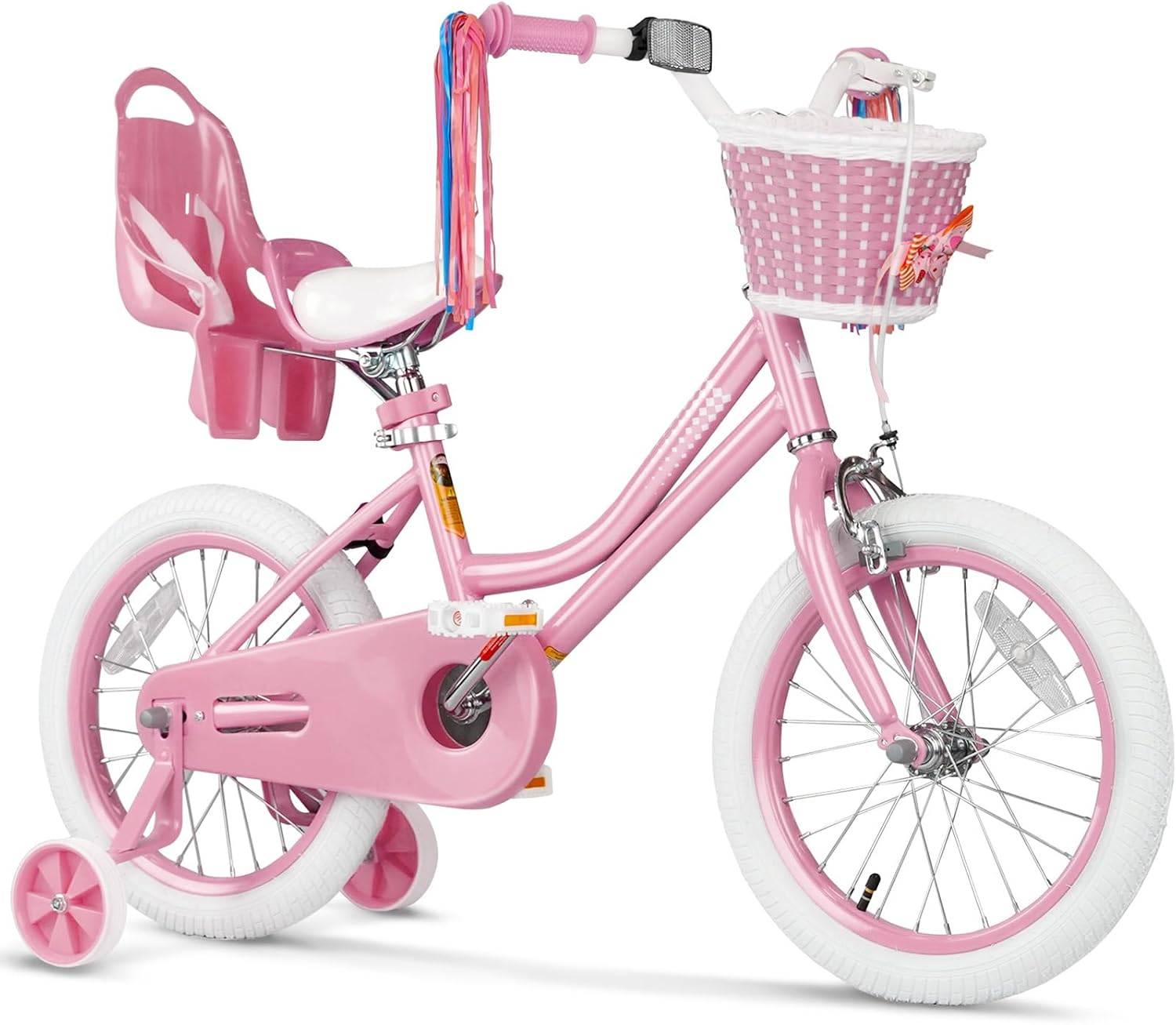 XJD Pink Girls' Bike – Kids 12/14/16 Inch Training Wheel Bicycle
Available in 12-, 14- and 16-inch labels, this training-wheel bike offers a 16-inch option relevant to a 4-foot rider, but no 20-inch version for comparison.
XJD Kids Bike for Girls – Pink, 12/14/16/20 Inch with Training Wheels is listed in 12-, 14-, 16- and 20-inch SKU labels. For a girl measuring exactly 4 feet, compare its 16- and 20-inch versions through an individual fit check; the shared product name does not mean those sizes fit identically.
XJD Pink Girls' Bike – Kids 12/14/16 Inch Training Wheel Bicycle is listed in 12-, 14- and 16-inch SKU labels. Its 16-inch version is relevant to a rider at the upper edge of the 16-inch height range. This product does not supply a 20-inch option, so it cannot provide the larger boundary-size comparison.
Both are cataloged as Training Wheel Bikes. Training wheels do not correct poor stand-over clearance, excessive reach or inaccessible brakes. For assembly, adjustment, compatibility, load limits, maintenance and torque requirements, follow the exact product manual or consult a qualified bicycle mechanic.
Why age cannot make the decision
The XBikes starting points associate a 16-inch bike with ages 4–7 and a 20-inch bike with ages 7–12, but age is secondary here. Children of the same age can have different heights, inseams, arm reach and riding confidence.
Likewise, wording such as “Kids” or “Girls” in a catalog title describes how the product is presented; it is not proof of individual fit. Use her measured body dimensions and her ability to control the exact bicycle.
Make the final choice
Start by trying a 16-inch bike if she is below 48 inches, has a shorter inseam, struggles with reach or is still building confidence. At exactly 48 inches, also compare a 20-inch bike only if she can stand over it, mount it, steer it and operate its brakes comfortably. If neither passes every check, choose neither and seek a better-fitting model rather than sizing up.
Before riding, provide a bicycle helmet that fits properly, sits level and has straps adjusted according to its manufacturer’s instructions. For this 4-foot-tall rider, the decision is simple: measure now, trial both boundary sizes where appropriate, and buy only the bike she can control today.
Bikes for your next adventure
-

Light Pink XJD Girls' Bicycle with Basket & Training Wheels
The Light Pink XJD Girls' Bicycle with Basket & Training Wheels is a retro-style…$109.99
$129.99 -

XJD Girls Bike for Kids Ages 3-8, 12/14/16 Inch with Training Wheels – Purple
The XJD Girls Bike in Purple is a training-wheel bicycle for kids ages 3 to 8, f…$149
$169 -

Blue XJD Girls Bike with Training Wheels – 12/14/16 Inch
If you're shopping for a first pedal bike for a daughter roughly 3 to 8 years ol…$149
$169