

What size bike for 48 inch girl
A 48-inch girl usually starts with a 16-inch or 20-inch bike comparison. At 48 inches tall, she is at the top of the 16-inch range and the bottom of the 20-inch range, so measurements and an in-person fit check should decide.
What size should you try first?
XBikes lists a 16-inch bike for rider heights of 40–48 inches (102–122 cm) and a 20-inch bike for heights of 48–60 inches (122–152 cm). Because 48 inches is the shared boundary, height alone does not produce one automatic answer.
Try both sizes when possible. A 16-inch bike may suit a rider who needs an easier reach, more immediate control or extra confidence. A 20-inch bike may fit if she can stand over it comfortably, reach the controls without stretching and handle it confidently. Do not choose the larger bike simply to leave room for growth.
Measure height and inseam
Measure the child rather than relying on clothing size, an old measurement or age. Have her stand without shoes, upright against a wall, and measure from the floor to the top of her head. Confirm whether she is exactly 48 inches rather than rounding up.
Next, measure inseam. With feet slightly apart, place a firm, thin book between the legs and raise it gently to simulate the bicycle saddle. Measure vertically from the floor to the top edge of the book. Record both height and inseam, then compare them with the bicycle maker’s fit information for the exact model.
The XBikes height ranges are starting points, not promises that every frame with the same wheel size will fit identically. Frame shape, saddle adjustment and handlebar position can change how a bike feels.
Perform the fit check
Have the child try the complete bicycle before deciding. Use these checks to separate a genuinely manageable bike from one that is merely within a chart range:
- Stand-over: She should be able to straddle the bicycle without the frame preventing a stable stance.
- Starting and stopping: She should get on, start, stop and put a foot down without panic or excessive leaning.
- Reach: She should hold the handlebars while keeping comfortable control, not stretching or locking her arms.
- Brakes: If the bicycle has hand controls, she must be able to reach and operate them reliably.
- Steering: She should turn the handlebars and ride a controlled line at a slow speed.
- Confidence: Choose the size she can manage now, especially if she is learning or hesitant.
If either bicycle fails one of these checks, do not treat its wheel-size label as proof of fit. Follow the exact product manual for adjustment, assembly, compatibility and limits, or ask a qualified bicycle mechanic for help.
How the supplied girls’ bikes compare
The Flower Pink XJD Girls Bike with Doll Seat & Basket and the Purple XJD Girls' Bike with Doll Seat & Basket are both training-wheel bikes offered in 12-inch, 14-inch and 16-inch SKU labels. For a 48-inch rider, only their 16-inch versions reach the upper edge of the XBikes 16-inch height range. They are useful 16-inch comparison options, but neither supplied product has a 20-inch SKU.
 Flower Pink XJD Girls Bike with Doll Seat & Basket
A 16-inch comparison option for a 48-inch rider, at the upper edge of that XBikes height range. This training-wheel bike is also offered in 12-inch and 14-inch labels, but no supplied 20-inch SKU.
 Purple XJD Girls' Bike with Doll Seat & Basket
Its 16-inch version is relevant for an individual fit check at 48 inches tall. The supplied catalog also lists 12-inch and 14-inch versions and identifies it as a training-wheel bike; no 20-inch SKU is supplied.
Color distinguishes the two exact catalog titles, while the supplied facts give them the same category, topic and available size labels. No supplied information establishes a difference in geometry, controls, materials or performance, so do not infer one. Compare the 16-inch versions by actual fit and consult each exact product manual before use.
The 12-inch versions correspond to 34–40 inches (86–102 cm), while the 14-inch versions correspond to 37–45 inches (94–114 cm). Those starting ranges end below a measured height of 48 inches, so they should not be presented as equivalent choices for this rider.
Do age and training wheels change the answer?
Age can provide context, but it should not overrule measured height, inseam, reach, brake control or confidence. XBikes associates 16-inch bikes with ages 4–7 and 20-inch bikes with ages 7–12, yet an individual child at the 48-inch boundary may fit one size more comfortably than the other.
Training wheels also do not correct a frame that is too large or controls that are out of reach. Because both supplied products are categorized as training-wheel bikes, consider them only if that format suits the rider’s present needs and the 16-inch model passes the complete fit check.
Helmet and final decision
Use a bicycle helmet that fits properly, sits level and has its straps adjusted according to the helmet manufacturer’s instructions. A helmet does not compensate for an oversized or poorly controlled bicycle.
For a girl measured at exactly 48 inches, compare a 16-inch bike with a 20-inch bike in person. Select the one she can straddle, reach, brake, steer, start and stop confidently today. Consider either supplied XJD model only as a 16-inch option; if the 20-inch fit is clearly better, these catalog products are not substitutes.
Bikes for your next adventure
-

XJD Girls Bike for Kids Ages 3-8, 12/14/16 Inch with Training Wheels – Purple
The XJD Girls Bike in Purple is a training-wheel bicycle for kids ages 3 to 8, f…$149
$169 -

XJD Kids Bike for Girls – Pink, 12/14/16/20 Inch with Training Wheels
The XJD Kids Bike for Girls in Pink is a training-wheel bike built to carry your…$139
$159 -
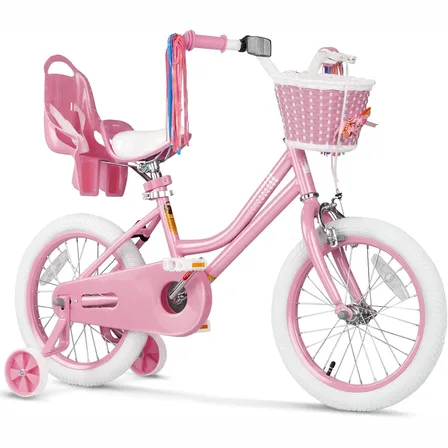
XJD Pink Girls' Bike – Kids 12/14/16 Inch Training Wheel Bicycle
The XJD Pink Girls' Bike is a training-wheel bicycle for girls ages 3 to 8 (ride…$149
$169