

What size bike for 5 feet tall girl
For a girl who is exactly 5 feet tall (60 inches), start by comparing 20-inch and 24-inch bikes, then choose only after an individual fit check. XBikes places 60 inches at the upper end of the 20-inch range and within the 24-inch range, so height alone does not settle the choice.
What size should you try first?
At 5 feet tall, a 24-inch bike is the logical first comparison because the XBikes starting range for that wheel size is 54–64 inches. A 20-inch bike also remains a possibility because its range is 48–60 inches, but the rider is at that range’s upper boundary.
Do not move to a 26-inch bike merely because it seems more grown-up or leaves room for growth. The XBikes standard places that size for youth and adults over 60 inches. At exactly 60 inches, the rider has not exceeded that threshold, and an oversized bicycle can be harder to control.
| Wheel size | XBikes rider-height starting point | Meaning at 5 feet |
|---|---|---|
| 20 Inch | 48–60 in / 122–152 cm | Possible, but at the upper limit |
| 24 Inch | 54–64 in / 137–163 cm | Within the range; compare first |
| 26 Inch | Over 60 in / 153 cm | Not indicated by height at exactly 60 inches |
Measure the rider before comparing bikes
Measure height without shoes, standing straight against a wall. Then measure inseam from the floor to the crotch while the rider stands naturally. Record both measurements rather than relying on age, clothing size or the fact that the bicycle is marketed for girls.
Wheel size is only a starting point. Frame shapes can differ even when the wheel labels match, so inseam and reach must be checked on the actual bicycle. Age may help narrow a search, but measured fit and present riding ability take priority.
Perform the fit check on each candidate
Have the rider try each bicycle rather than ordering a larger one solely for future growth. The American Academy of Pediatrics advises checking stand-over space, control and brake reach and avoiding a bicycle that is oversized for growth.
- Stand-over: With the rider straddling the bicycle, confirm that she can stand securely and is not forced against the frame.
- Starting and stopping: She should be able to mount, begin riding and stop without the bicycle feeling unwieldy.
- Reach: Check that she can hold the handlebar and steer without stretching, locking her arms or losing a comfortable posture.
- Brake control: If the bicycle has hand-operated controls, she must be able to reach and operate them reliably. Confirm the controls present on the exact model rather than assuming a brake type.
- Confidence: Ask her to turn, look ahead and stop in a controlled way. A technically plausible size is not suitable if she cannot control it confidently.
If both sizes fit, compare which one gives better control now. If neither passes every check, do not treat the height chart as permission to compromise; try a different frame or seek help from a qualified bicycle mechanic.
How the supplied 20-inch options are relevant
The catalog includes two training-wheel bicycle ranges in 12-, 14-, 16- and 20-inch versions. For a 5-foot rider, only their 20-inch labels fall within the applicable XBikes height starting point; the smaller labels are not indicated by her measured height. These products are useful 20-inch comparison points when training wheels suit the rider’s current confidence, but the supplied catalog does not include a 24-inch option for the other likely comparison.
 Girls' Training Wheel Bike by XJD, 12–20 Inch Wheels – Blue
The 20 Inch version is a relevant boundary-size comparison for a 5-foot rider. Its smaller 12, 14 and 16 Inch labels are outside the supplied height starting point for this rider.
 XJD Girls' Bike with Training Wheels, 12/14/16/20 Inch – Purple
This training-wheel range includes a 20 Inch option that may suit a 5-foot rider after an individual fit check. The catalog also lists 12, 14 and 16 Inch versions.
What distinguishes the two catalog choices?
Girls' Training Wheel Bike by XJD, 12–20 Inch Wheels – Blue is listed in the Training Wheel Bikes category and offers 12 Inch, 14 Inch, 16 Inch and 20 Inch SKU labels. For this rider, evaluate the 20 Inch version only after checking stand-over, reach and control.
XJD Girls' Bike with Training Wheels, 12/14/16/20 Inch – Purple is also a Training Wheel Bikes product with the same four supplied size labels. Based on the catalog facts provided, color and exact title distinguish these listings; no further performance or fit difference is established.
Neither listing should be treated as equivalent to a 24-inch bicycle. If the rider has already outgrown a 20-inch fit or does not need training wheels, these supplied products may not be relevant even though 20 inches appears in the height range.
Safety and the next decision
Use a bicycle helmet that fits properly, sits level and has its straps adjusted according to the helmet manufacturer’s instructions, as advised by the U.S. Consumer Product Safety Commission. Follow the exact bicycle manual for assembly, maintenance, compatibility, load limits and torque details not provided here, or use a qualified bicycle mechanic.
For a girl exactly 5 feet tall, try a 24-inch bike first and a 20-inch bike as a boundary-size comparison. Buy only the bicycle on which her inseam, reach, braking and present confidence all produce controlled riding—never a larger size chosen only for growth.
Bikes for your next adventure
-

XJD Kids Bike for Girls – Pink, 12/14/16/20 Inch with Training Wheels
The XJD Kids Bike for Girls in Pink is a training-wheel bike built to carry your…$139
$159 -
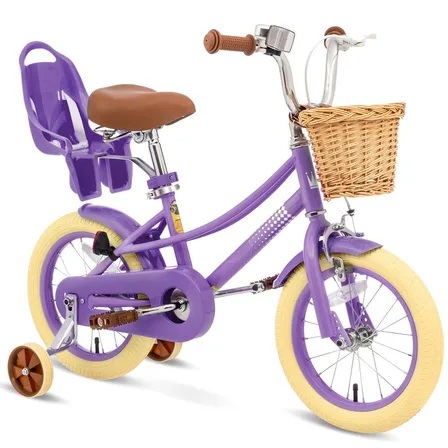
XJD Girls' Bike with Training Wheels, 12/14/16/20 Inch – Purple
The XJD girls' bike with training wheels in Purple is built to grow with your ri…$139
$159 -
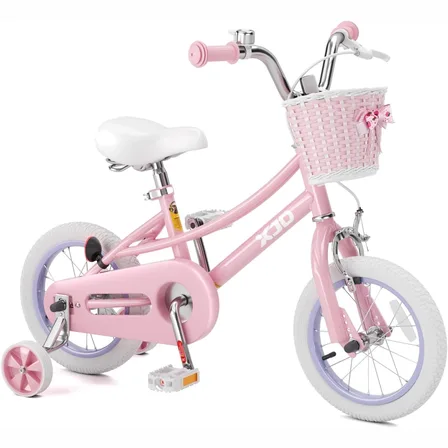
Pink 12/14/16/20" XJD Girls Bike with Training Wheels & Basket
The Pink XJD Girls Bike with Training Wheels & Basket is a first-bike pick f…$65.99
$75.99