

What size bike for a 4 year girl
For most 4-year-old girls, start by comparing a 12-, 14- and 16-inch bike. Measure her height first, then confirm stand-over clearance, reach and control on the actual bicycle.
Choose the starting size from her measured height
Age narrows the search, but it does not determine fit. According to the XBikes starting points, a 12 Inch bike covers ages 3–4 and heights of 34–40 in (86–102 cm). A 14 Inch bike covers ages 3–6 and heights of 37–45 in (94–114 cm). A 16 Inch bike covers ages 4–7 and heights of 40–48 in (102–122 cm).
That overlap matters. A 4-year-old measuring 39 in may fall within both the 12 Inch and 14 Inch ranges, while a child measuring 41 in may fall within both the 14 Inch and 16 Inch ranges. Use the measured height to create a shortlist, then let the individual fit check decide.
| Measured height | Sizes to compare |
|---|---|
| 34–36 in / 86–93 cm | 12 Inch |
| 37–39 in / 94–101 cm | 12 Inch and 14 Inch |
| 40 in / 102 cm | 12 Inch, 14 Inch and 16 Inch |
| 41–45 in / 103–114 cm | 14 Inch and 16 Inch |
| 46–48 in / 115–122 cm | 16 Inch |
These are starting points, not a promise that every frame with the same wheel label will fit identically.
Measure height and inseam before shopping
Have her stand barefoot against a wall with her feet flat and her body upright. Mark the top of her head and measure vertically from the floor. Record the result in inches or centimetres and compare it with the table.
Next, measure inseam. With her shoes off, place a book upright between her legs so its top edge rests firmly where a bicycle saddle would. Measure from the floor to that top edge. No inseam-to-wheel-size formula is supplied here; use the number when checking whether she can stand over the particular frame comfortably.
Measure in the clothing and shoes she will normally wear for riding when performing the final bike check. Thick soles, bulky clothing and different frame shapes can change how secure and comfortable the fit feels.
Perform the fit check on the actual bicycle
Following the HealthyChildren guidance, have the child try the bicycle and do not buy an oversized model merely for future growth. Check these points on each candidate:
- Stand-over: She should be able to straddle the frame and stand securely rather than being forced onto tiptoes or against the frame.
- Starting and stopping: She should be able to get on, begin moving, stop and put a foot down without struggling against the bike's size.
- Reach: While seated, she should reach the handlebar without stretching, locking her elbows or leaning excessively forward.
- Steering: She should turn the handlebar both ways while remaining balanced and in control.
- Brake control: She must be able to reach and operate the bicycle's fitted brake controls reliably. Do not assume that age or wheel size proves this.
- Confidence: If she appears tense, cannot manage the bike independently or loses control during simple manoeuvres, compare a smaller option.
How the supplied girls' bikes help you compare
All three supplied models are categorized as Training Wheel Bikes and offer 12 Inch, 14 Inch and 16 Inch SKU labels, so they provide relevant comparison points across the likely range for a 4-year-old. Select a SKU only after matching her measured height and checking the individual bicycle.
 Purple XJD Girls' Bike with Doll Seat & Basket
Available in 12 Inch, 14 Inch and 16 Inch labels, this training-wheel bike lets parents compare the principal height-based starting sizes discussed for a 4-year-old.
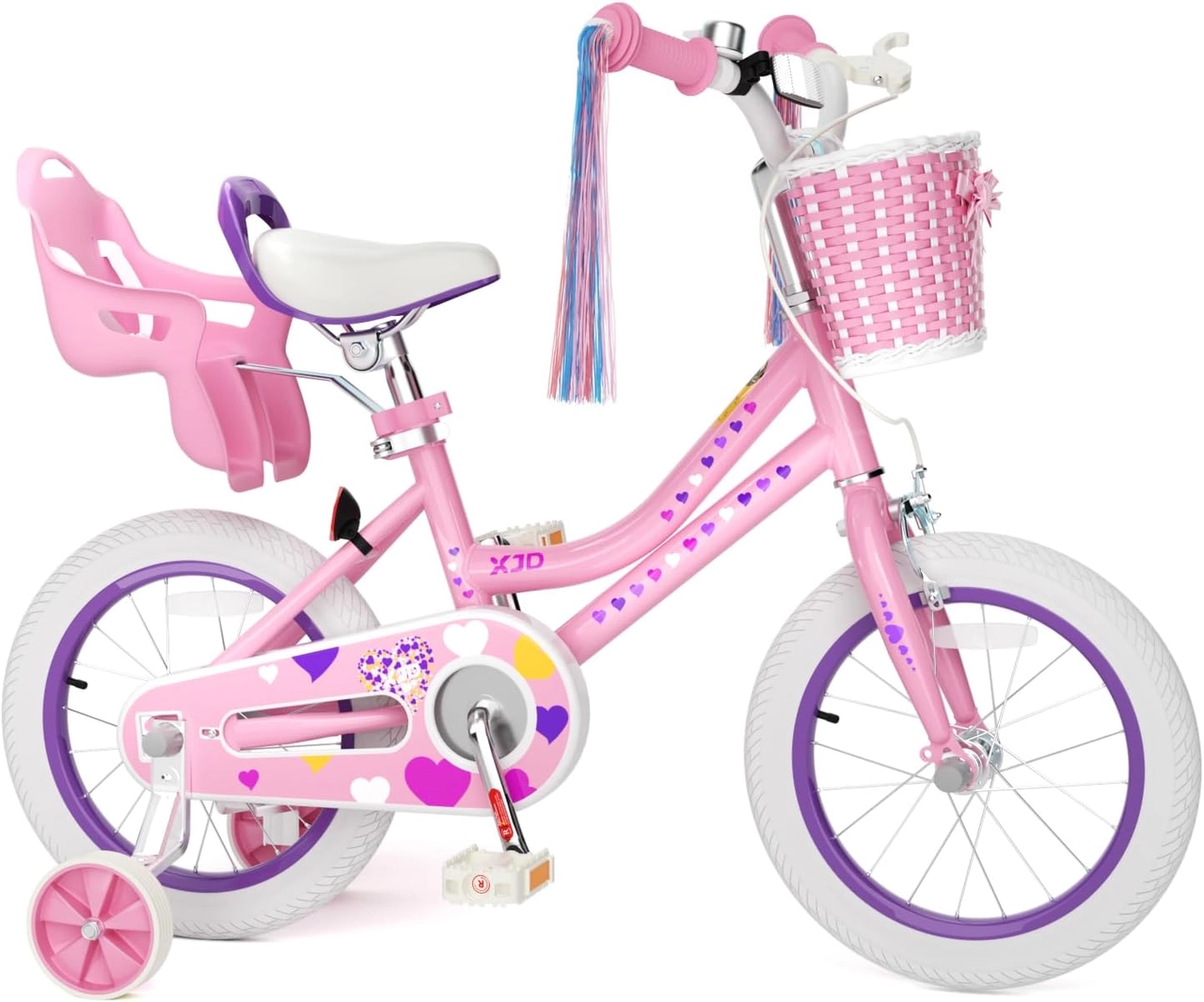 Pink Girls' 12/14/16" Bike by XJD – Basket & Doll Seat
This training-wheel model offers 12 Inch, 14 Inch and 16 Inch labels, making it relevant when measured height places the rider within one or more overlapping size ranges.
 Pink 12/14/16/20" XJD Girls Bike with Training Wheels & Basket
Its 12 Inch, 14 Inch and 16 Inch labels cover the main comparisons for this question. The additional 20 Inch label is relevant only when measured height and an individual fit check support it.
The Purple XJD Girls' Bike with Doll Seat & Basket is offered in 12 Inch, 14 Inch and 16 Inch labels. The Pink Girls' 12/14/16" Bike by XJD – Basket & Doll Seat offers the same three size labels. The Pink 12/14/16/20" XJD Girls Bike with Training Wheels & Basket adds a 20 Inch option, but the XBikes starting point for 20 Inch is ages 7–12 and heights of 48–60 in (122–152 cm), so it is not the age-based starting point for this question. Consider it only if her measured height supports that range and the complete fit check succeeds.
Colour, basket and doll-seat wording can help distinguish the catalog choices, but none proves fit. The shared training-wheel category also does not remove the need to evaluate stand-over, reach, braking and confidence.
Finish the decision safely
Compare the smallest and largest plausible sizes side by side when her height falls in an overlap. Choose the bicycle she can control now, not one she is expected to grow into. Follow the exact product manual or use a qualified bicycle mechanic for assembly, adjustments, maintenance, compatibility, load limits and torque requirements.
Add a properly fitting bicycle helmet. The U.S. Consumer Product Safety Commission advises that it sit level and that its straps be used according to the helmet manufacturer's instructions.
Your next step is simple: measure her standing height and inseam, shortlist 12, 14 or 16 Inch from the supplied ranges, and have her demonstrate comfortable stand-over, reach, braking and control before choosing her 4-year-old girl's bike.
Bikes for your next adventure
-

Pink Girls' 12/14/16" Bike by XJD – Basket & Doll Seat
The XJD Pink Girls' Bike with Basket & Doll Seat is made for riders 71–122 cm ta…$75.99
$99.99 -

XJD Girls Bike for Kids Ages 3-8, 12/14/16 Inch with Training Wheels – Purple
The XJD Girls Bike in Purple is a training-wheel bicycle for kids ages 3 to 8, f…$149
$169 -

Light Purple XJD Toddler Bike Helmet, Adjustable, Size XS (46–51 cm)
This Light Purple XJD toddler bike helmet is made for the smallest riders — the …$20.39