

What size bike for a 43 inch girl
A 43-inch girl should usually start by trying a 16-inch bike. A 14-inch bike may also fit, while an 18-inch bike deserves comparison only after a hands-on fit check.
Why 16 inches is the starting point
At 43 inches tall, or about 109 cm, the rider falls within three XBikes starting ranges: 14-inch bikes cover 37–45 inches, 16-inch bikes cover 40–48 inches, and 18-inch bikes cover 43–52 inches. The 16-inch range places her away from either height boundary, so it is the most practical first size to try.
Those overlaps do not make the sizes interchangeable. Body proportions, skill and bicycle geometry can change the result. A confident rider with longer legs may be ready to compare an 18-inch model; a cautious rider or one with a shorter inseam may have better control on a 14-inch model. Age alone should not decide the size.
Measure height and inseam first
Measure her without shoes, standing straight against a wall. Record her full height from the floor to the top of her head. To measure inseam, place a firm, thin book between her legs so it meets the body as a bicycle saddle would, then measure from the floor to the top edge of the book.
Use the 43-inch height to choose which wheel sizes to try, then use the inseam during the actual fit check. Wheel diameter by itself does not reveal frame stand-over height, saddle adjustment or reach, so do not approve a bike from its size label alone.
Compare the three possible sizes
| Wheel size | XBikes height starting point | Meaning at 43 inches |
|---|---|---|
| 14 Inch | 37–45 in / 94–114 cm | Within range; compare if she needs a smaller, easier-to-control fit. |
| 16 Inch | 40–48 in / 102–122 cm | Within range and the recommended first size to try. |
| 18 Inch | 43–52 in / 109–132 cm | At the minimum boundary; consider only if the individual fit is comfortable and controlled. |
A 12-inch bike is below the supplied 34–40-inch range for a 43-inch rider. A 20-inch bike begins at 48 inches, so it is not an appropriate starting point based on height. Do not buy an oversized bicycle simply to leave growing room; a bicycle that is difficult to mount, steer or stop can undermine control now.
What to check during a test ride
Have her try the exact bicycle while wearing ordinary riding shoes. An adult should steady the bike in a clear, level area. Check these points before making a decision:
- Stand-over: She should be able to straddle the bicycle without the frame preventing a stable stance.
- Starting and stopping: She should get on, begin moving and stop without the bicycle pulling her off balance.
- Reach: She should hold the handlebar and steer without stretching, locking her elbows or leaning excessively.
- Brake control: If the model has hand-operated brake controls, she must reach and operate them comfortably. Check every fitted braking control rather than assuming wheel size guarantees access.
- Confidence: She should look composed while turning and stopping. Hesitation caused by the bike feeling tall, long or heavy to manage is evidence to compare the smaller option.
Repeat the checks with a 14-inch or 18-inch bike when available. Choose the one she can control now, not the largest one she can barely use.
How the supplied girls’ bikes help
The Pink 12/14/16/20" XJD Girls Bike with Training Wheels & Basket and the Light Pink XJD Girls' Bicycle with Basket & Training Wheels each have 12-, 14-, 16- and 20-inch SKU labels. Their 14- and 16-inch versions therefore provide relevant comparison points for a 43-inch rider. Their 20-inch versions fall outside her supplied height range, and neither product offers the possible 18-inch comparison size.
These particular catalog options help answer the title because both let a parent compare the two most relevant listed sizes—14 and 16 inches—within the same training-wheel-bike category. They do not prove fit without a hands-on check.
 Pink 12/14/16/20" XJD Girls Bike with Training Wheels & Basket
Available in 14- and 16-inch labels relevant to a 43-inch rider’s comparison, with training wheels and a basket. Its 20-inch option starts above the supplied height range, and the product has no 18-inch label.
 Light Pink XJD Girls' Bicycle with Basket & Training Wheels
This training-wheel bike with a basket offers 14- and 16-inch labels for hands-on comparison at 43 inches. Its listed 20-inch version is too large by the supplied height starting point, and no 18-inch option is supplied.
Training wheels may suit a rider who still needs that format, but their presence does not justify moving to an oversized bicycle. If she already rides independently, these catalog options may not match her current needs even when the wheel size fits. Follow the exact product manual for assembly, adjustment, compatibility, maintenance and load limits, or ask a qualified bicycle mechanic.
Make the final 43-inch decision
Begin with a 16-inch bike, then compare a 14-inch model if reach, stand-over, braking or confidence is marginal. Compare an 18-inch bike only if she controls it comfortably at the bottom of its stated height range. Reject a 20-inch bike for now based on the supplied height standard. Once the fit is settled, add a properly fitting bicycle helmet that sits level and has straps adjusted according to its manufacturer’s instructions.
Bikes for your next adventure
-
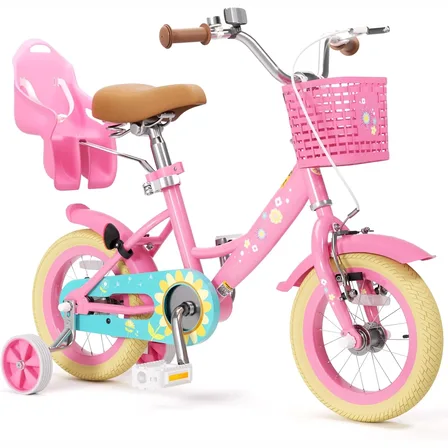
Flower Pink XJD Girls Bike with Doll Seat & Basket
The XJD Flower Pink girls' bike is made for riders 71–122 cm tall (roughly ages …$69.99
-

Pink Girls' 12/14/16" Bike by XJD – Basket & Doll Seat
The XJD Pink Girls' Bike with Basket & Doll Seat is made for riders 71–122 cm ta…$75.99
$99.99 -
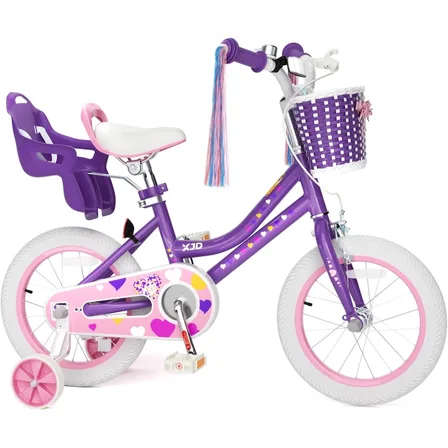
Purple XJD Girls' Bike with Doll Seat & Basket
For girls 71–122 cm tall (about ages 3–7), this XJD girls' bike in Purple pairs …$75.99
$99.99