

What size bike for a 6yr old girl
For most 6-year-old girls, start by trying a 16 Inch bike, then choose by measured height and fit—not age alone. XBikes places 16 Inch wheels at 40–48 in (102–122 cm); a shorter child may fit 14 Inch, while a taller child may need 18 Inch. Buy only when she can stand over, reach, steer and operate the brakes confidently.
Measure her before choosing a wheel size
Measure her height without shoes, standing straight against a wall. Also measure her inseam: place a book firmly between her legs as though it were a bicycle saddle, keep it level, and measure from the floor to the book’s top edge.
Height narrows the likely wheel size. Inseam helps you evaluate stand-over room and saddle position on the actual bicycle. Because frame shapes differ, an inseam measurement does not convert reliably into one universal wheel size; compare it with the bicycle’s fit information and confirm the fit in person.
Compare her height with the XBikes starting points
| Wheel size | XBikes age starting point | Rider height | Relevance at age 6 |
|---|---|---|---|
| 14 Inch | Ages 3–6 | 37–45 in / 94–114 cm | Consider for a shorter 6-year-old who fits and controls it comfortably. |
| 16 Inch | Ages 4–7 | 40–48 in / 102–122 cm | The main size to try first for many 6-year-olds. |
| 18 Inch | Ages 5–9 | 43–52 in / 109–132 cm | May suit a taller rider, subject to an individual fit check. |
| 20 Inch | Ages 7–12 | 48–60 in / 122–152 cm | Consider only if her measured height and control support it. |
The ranges overlap deliberately: wheel size cannot settle the decision by itself. If her height falls in two rows, try both and favor the bicycle she can control now. Do not move up merely because her sixth birthday is near an age boundary.
Perform the fit check on the actual bike
Have her wear normal riding shoes and try the bicycle. Ask her to stand over the frame with both feet on the ground. She should have usable clearance rather than being pressed against the frame. Follow the exact product manual when adjusting the saddle or other components; if assembly or adjustment is uncertain, use a qualified bicycle mechanic.
Next, watch her sit, start, stop and turn in a controlled area. She should reach the handlebar without stretching or locking her arms, steer without fighting the bicycle, and place her hands where she can operate the brakes. Confirm that she can apply the brakes decisively while keeping control. Her present confidence matters: a size that technically matches her height can still be unsuitable if starting or stopping feels intimidating.
Do not buy an oversized bicycle for her to grow into. Extra reach, difficult stand-over and brakes she cannot use comfortably are reasons to choose a smaller fitting option or keep comparing frames.
How the two catalog bikes relate to this question
The supplied choices are training-wheel bicycles with 12 Inch, 14 Inch, 16 Inch and 20 Inch SKU labels. That makes them useful comparison options when her measurements point to one of those sizes. Neither supplied product offers an 18 Inch SKU, so if 18 Inch is the appropriate result, these are nearest-size comparison points—not substitutes for an 18 Inch bicycle.
 Girls' Training Wheel Bike by XJD, 12–20 Inch Wheels – Blue
A training-wheel bike offered in 12 Inch, 14 Inch, 16 Inch and 20 Inch SKU labels. Compare only the size indicated by the rider’s measured height, then verify stand-over, reach, braking and control.
 XJD Girls' Bike with Training Wheels, 12/14/16/20 Inch – Purple
This purple training-wheel model has 12 Inch, 14 Inch, 16 Inch and 20 Inch SKU labels. It provides relevant comparison choices when measurements indicate those sizes, but it does not supply an 18 Inch option.
Girls' Training Wheel Bike by XJD, 12–20 Inch Wheels – Blue is listed in Training Wheel Bikes and offers 12 Inch, 14 Inch, 16 Inch and 20 Inch choices. XJD Girls' Bike with Training Wheels, 12/14/16/20 Inch – Purple is also listed in Training Wheel Bikes with the same four wheel-size labels.
Compare the relevant SKU label, not just the model name or color. The supplied facts do not establish frame dimensions, brake type, weight, load limit or compatibility, so those details cannot decide fit here. Consult the exact product manual or a qualified bicycle mechanic for assembly, maintenance, component compatibility and torque requirements.
Make the final decision
- Record her barefoot height and inseam.
- Use height to shortlist 14 Inch, 16 Inch, 18 Inch or 20 Inch from the table.
- Have her try each shortlisted bicycle rather than treating age as proof of fit.
- Reject any bike that compromises stand-over clearance, reach, steering, brake operation or confident starts and stops.
- Choose the size she controls comfortably today.
Before riding, add a properly fitting bicycle helmet. It should sit level, and its straps should be used according to the helmet manufacturer’s instructions. For a 6-year-old girl, the practical next step is therefore to measure her, try 16 Inch first when she is 40–48 in tall, and compare an overlapping size only when her measurements and real-bike control support it.
Bikes for your next adventure
-
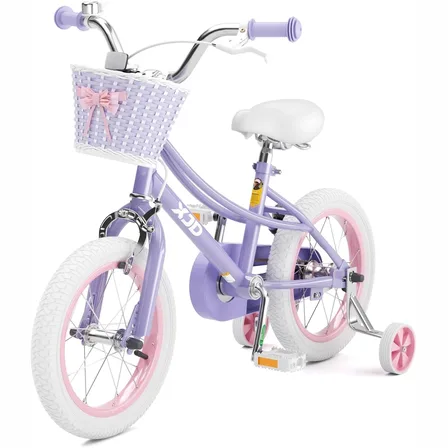
Girls' Training Wheel Bike by XJD with Basket – Purple
If you're shopping for a first bike for a girl roughly 3 to 12 years old (91–152…$75.99
-

Blue XJD Girls Bike with Training Wheels – 12/14/16 Inch
If you're shopping for a first pedal bike for a daughter roughly 3 to 8 years ol…$149
$169 -

Kids Bike Helmet by XJD for Girls – Pink
The XJD Kids Bike Helmet in Pink is a lightweight multi-sport helmet for girls r…$59.99
$99