

What size bike for a 9 yr old girl
Most 9-year-old girls should start with a 20-inch bike, but height and fit decide: measure her height and inseam, then check control in person.
The likely size for a 9-year-old girl
Using XBikes starting points, a 20-inch bicycle generally suits riders ages 7–12 who are 48–60 inches (122–152 cm) tall. That makes it the most likely starting size for a 9-year-old girl—not an automatic answer.
If she is 43–52 inches (109–132 cm), an 18-inch bike may deserve a fit check. If she is already 54–64 inches (137–163 cm), compare a 24-inch bike as well. These ranges overlap because body proportions, reach and confidence differ. Do not move her up simply because her next birthday is approaching.
Measure before comparing bikes
Measure without shoes, with her standing upright against a wall. Record her full height from the floor to the top of her head. For inseam, have her stand with feet slightly apart and measure from the floor to the top of the inside leg. Keep both measurements available while checking the bicycle.
Height identifies a sensible wheel-size range. Inseam helps you judge whether she can stand over the bicycle comfortably. Wheel size alone does not establish frame clearance, reach or riding control, so the final check must be made on the actual bike.
| Wheel size | XBikes age starting point | Rider-height starting point | Meaning at age 9 |
|---|---|---|---|
| 18 Inch | 5–9 | 43–52 in / 109–132 cm | Compare for a shorter rider |
| 20 Inch | 7–12 | 48–60 in / 122–152 cm | Most likely first comparison |
| 24 Inch | 10–14 | 54–64 in / 137–163 cm | Compare for a taller rider only |
What to check during the try-on
Have her try the bicycle rather than selecting solely from an age chart. Check these points before deciding:
- Stand-over: She should be able to straddle the bike without the frame preventing a stable stance.
- Starting and stopping: She should be able to mount, begin riding and stop without struggling against the bike’s size.
- Reach: She should reach the handlebar without stretching, locking her elbows or losing a balanced posture.
- Brake control: She must be able to reach and operate the fitted brake controls reliably with her hands in a normal riding position.
- Steering: Ask her to turn and maneuver at low speed. The bicycle should feel manageable rather than heavy or intimidating to control.
- Confidence: Treat hesitation as useful fit information. A size that matches a chart can still be unsuitable for her present skill level.
If she falls within overlapping height ranges, compare both sizes in person. Favor the bicycle she can control now. An oversized bicycle bought for future growth can make mounting, braking and steering harder.
How the supplied girls’ bike fits this decision
The XJD Kids Bike for Girls – Pink, 12/14/16/20 Inch with Training Wheels is offered in 12 Inch, 14 Inch, 16 Inch and 20 Inch labels. For this question, its 20 Inch option is the relevant starting comparison when the rider measures 48–60 inches (122–152 cm). Its smaller options correspond to younger or shorter XBikes starting ranges and should not be chosen merely because they share the same product title.
This catalog option helps because it provides a 20 Inch girls’ bike to compare against the likely size for a 9-year-old. It does not include an 18 Inch or 24 Inch label, so if her measurements or in-person control point toward either of those sizes, this product is not an equal substitute.

The title identifies it as a training-wheel bike, but that wording does not prove that training wheels suit this particular rider. Base that decision on her current balance and confidence. For assembly, adjustments, compatibility, load limits, maintenance and torque requirements, follow the exact product manual or ask a qualified bicycle mechanic.
Helmet fit belongs in the same check
Use a bicycle helmet that fits her properly. It should sit level and be secured with its straps according to the helmet manufacturer’s instructions. A helmet cannot correct a bicycle that is too large, difficult to stop or beyond her present control, so verify the bike and helmet separately.
What to do next
- Measure her standing height and inseam without shoes.
- Begin with a 20-inch bike if she is 48–60 inches (122–152 cm).
- Compare an 18-inch bike if she is shorter, or a 24-inch bike if she is taller, using the ranges above.
- Have her straddle, reach, steer, start and brake on the actual bicycle.
- Choose only the size she can control confidently today.
For a 9-year-old girl, put the 20-inch size first on the try-on list, then let her measured body and real riding control—not age or room to grow—make the final decision.
Bikes for your next adventure
-

Pink Girls' 12/14/16" Bike by XJD – Basket & Doll Seat
The XJD Pink Girls' Bike with Basket & Doll Seat is made for riders 71–122 cm ta…$75.99
$99.99 -

Blue XJD Girls Bike with Training Wheels – 12/14/16 Inch
If you're shopping for a first pedal bike for a daughter roughly 3 to 8 years ol…$149
$169 -
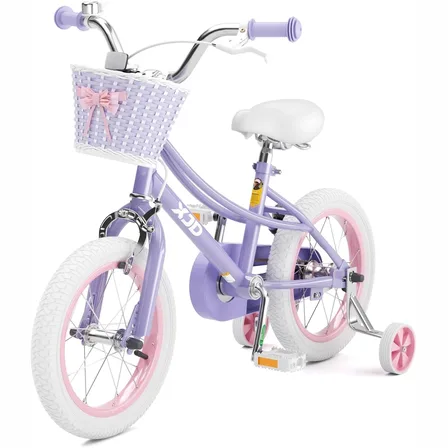
Girls' Training Wheel Bike by XJD with Basket – Purple
If you're shopping for a first bike for a girl roughly 3 to 12 years old (91–152…$75.99