

What size bike for a girl
Choose a girl’s bike by her measured height and fit, not age alone. Start with the wheel-size chart, then check stand-over, reach, brakes and control.
Measure before choosing a wheel size
Measure the rider’s height without shoes, standing straight against a wall. Also measure her inseam from the floor to the crotch while she stands with her feet slightly apart. Height gives you a starting wheel size; inseam helps you judge whether she can stand over the bicycle comfortably.
Age is only a rough guide because children of the same age can differ greatly in height, proportions and confidence. Record both measurements, compare height with the XBikes ranges below, and plan an individual fit check before deciding.
Girls’ bike size chart
| Wheel size | Starting age | Rider height |
|---|---|---|
| 12 Inch | 3–4 | 34–40 in / 86–102 cm |
| 14 Inch | 3–6 | 37–45 in / 94–114 cm |
| 16 Inch | 4–7 | 40–48 in / 102–122 cm |
| 18 Inch | 5–9 | 43–52 in / 109–132 cm |
| 20 Inch | 7–12 | 48–60 in / 122–152 cm |
| 24 Inch | 10–14 | 54–64 in / 137–163 cm |
| 26 Inch | Youth and adults | Over 60 in / 153 cm |
Where ranges overlap, do not automatically select the larger wheel. Compare both sizes in person if possible. Her ability to get on and off, reach the controls and steer confidently matters more than gaining extra growing room.
Check the bike around the rider
Have the child try the actual bicycle. The American Academy of Pediatrics advises against buying an oversized bike simply for growth. Use these checks to decide whether a candidate size works now:
- Stand-over: She should be able to straddle the bicycle rather than being held up by the frame. Use her inseam and an actual try-on to assess clearance.
- Seat position: With the seat adjusted according to the product manual, she should be able to start, stop and support herself with confidence.
- Reach: She should reach the handlebar without stretching, locking her arms or losing a comfortable riding posture.
- Brake control: If the bicycle has hand-operated brake controls, confirm that she can reach and operate them reliably.
- Handling: Ask her to start, steer, turn and stop in a suitable controlled area. A size that makes these actions hesitant or awkward is not a good current fit.
If her measurements fall within more than one row, current confidence can break the tie. A newer or hesitant rider may control one candidate more easily, but only the hands-on checks can confirm that.
How the supplied girls’ bike compares
The Pink 12/14/16/20" XJD Girls Bike with Training Wheels & Basket is relevant because its available SKU labels cover four chart sizes: 12 Inch, 14 Inch, 16 Inch and 20 Inch. That lets you compare the measured rider with several listed starting points while considering a catalog option in the Girls’ Bikes topic and Training Wheel Bikes category.

Match the specific SKU label to the wheel-size row; do not treat the product’s four size labels as interchangeable. This product does not have supplied 18 Inch, 24 Inch or 26 Inch SKU labels. If the fit check points to one of those sizes, the listed product is only a nearby comparison reference and not a substitute for the required size.
Training wheels and a basket are stated product features, but they do not prove that a particular SKU fits. The supplied facts do not specify brake type, weight, materials, load limits, assembly details or compatibility. Consult the exact product manual for those points, and use a qualified bicycle mechanic when assembly or adjustment is uncertain.
Avoid sizing for future growth
A bike that is too large can make mounting, stopping, turning and reaching the brakes harder today. Do not move up merely because the child is near the younger end of another size’s age range or because a larger bicycle may last longer.
Likewise, do not keep a bike that has become cramped simply because its age label still appears suitable. Recheck measured height, stand-over, reach, brake operation and handling. Growth, body proportions and developing skills can change the answer before age alone suggests a change.
Make the final choice
- Measure her standing height and inseam.
- Use measured height to identify the likely wheel-size row or overlapping rows.
- Try the exact bicycle and SKU being considered.
- Confirm stand-over room, comfortable reach, reliable brake access and confident control.
- Reject a larger size if she cannot manage it comfortably now.
Add a properly fitting bicycle helmet for every ride. U.S. Consumer Product Safety Commission guidance says the helmet should sit level and its straps should be used according to the helmet manufacturer’s instructions.
For a girl’s bike, choose the wheel size she can stand over, reach, brake and steer confidently today—even when that means selecting the smaller of two overlapping chart options.
Bikes for your next adventure
-
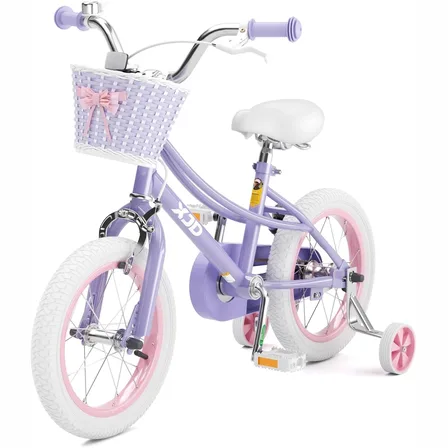
Girls' Training Wheel Bike by XJD with Basket – Purple
If you're shopping for a first bike for a girl roughly 3 to 12 years old (91–152…$75.99
-
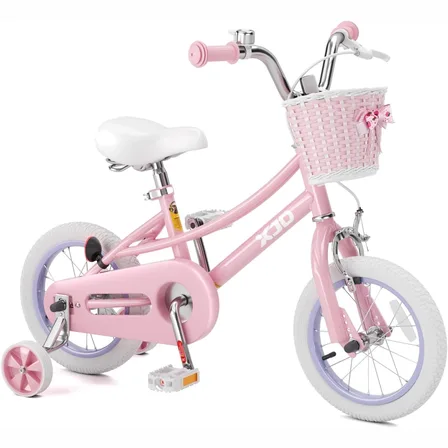
Pink 12/14/16/20" XJD Girls Bike with Training Wheels & Basket
The Pink XJD Girls Bike with Training Wheels & Basket is a first-bike pick f…$65.99
$75.99 -

XJD Kids Bike for Girls – Pink, 12/14/16/20 Inch with Training Wheels
The XJD Kids Bike for Girls in Pink is a training-wheel bike built to carry your…$139
$159