

What size bike for a nine year old girl
For most nine-year-old girls, start with a 20-inch bike, then confirm fit using her measured height, inseam, reach, brake control and confidence.
Choose the starting wheel size
Age narrows the search, but it cannot confirm fit. Under the XBikes starting points, a 20-inch bike covers ages 7–12 and rider heights of 48–60 inches (122–152 cm). That makes it the usual first size to try for a nine-year-old girl.
An 18-inch bike covers ages 5–9 and heights of 43–52 inches (109–132 cm), so it may suit a shorter nine-year-old. A 24-inch bike starts at ages 10–14 and heights of 54–64 inches (137–163 cm), but a tall nine-year-old might be ready to try one. Do not select it merely because she will grow into it.
| Wheel size | XBikes age starting point | Rider height |
|---|---|---|
| 18 Inch | 5–9 | 43–52 in / 109–132 cm |
| 20 Inch | 7–12 | 48–60 in / 122–152 cm |
| 24 Inch | 10–14 | 54–64 in / 137–163 cm |
Measure her before comparing bikes
Measure height without shoes, with her standing straight against a wall. For inseam, have her stand with her feet slightly apart and measure from the floor to the top of the inside leg. Record both measurements rather than relying on clothing size or another child’s bike.
Use height to choose which wheel size to try first. Then compare the inseam with the actual bicycle’s stand-over space and its available saddle adjustment. Wheel size is only a category: frame proportions can differ, so two bikes with the same wheel size may not feel identical.
Check the bike with her on it
Have her try the exact bicycle whenever possible. She should be able to stand over it comfortably, mount and dismount without struggling, and hold the handlebar without stretching or locking her elbows. Seated, she should feel balanced and able to steer deliberately.
Ask her to operate the brakes while maintaining a secure grip. She must be able to reach and control them confidently. Also watch a slow start, straight ride, turn and controlled stop in a traffic-free area. If she cannot manage those actions, a height-chart match is not enough.
- Too large: awkward mounting, excessive reach, poor brake access or hesitant low-speed control.
- Too small: cramped posture or restricted pedalling even after appropriate adjustment.
- Promising fit: comfortable stand-over, natural reach and calm control of steering and brakes.
Where the supplied girls’ bikes fit
The supplied catalog options help by showing 12-, 14- and 16-inch girls’ bikes with training wheels for comparison. However, neither product offers the usual 20-inch starting size for a nine-year-old. They are nearest-size comparison points in this catalog selection, not substitutes for an 18-, 20- or 24-inch bike that fits correctly.
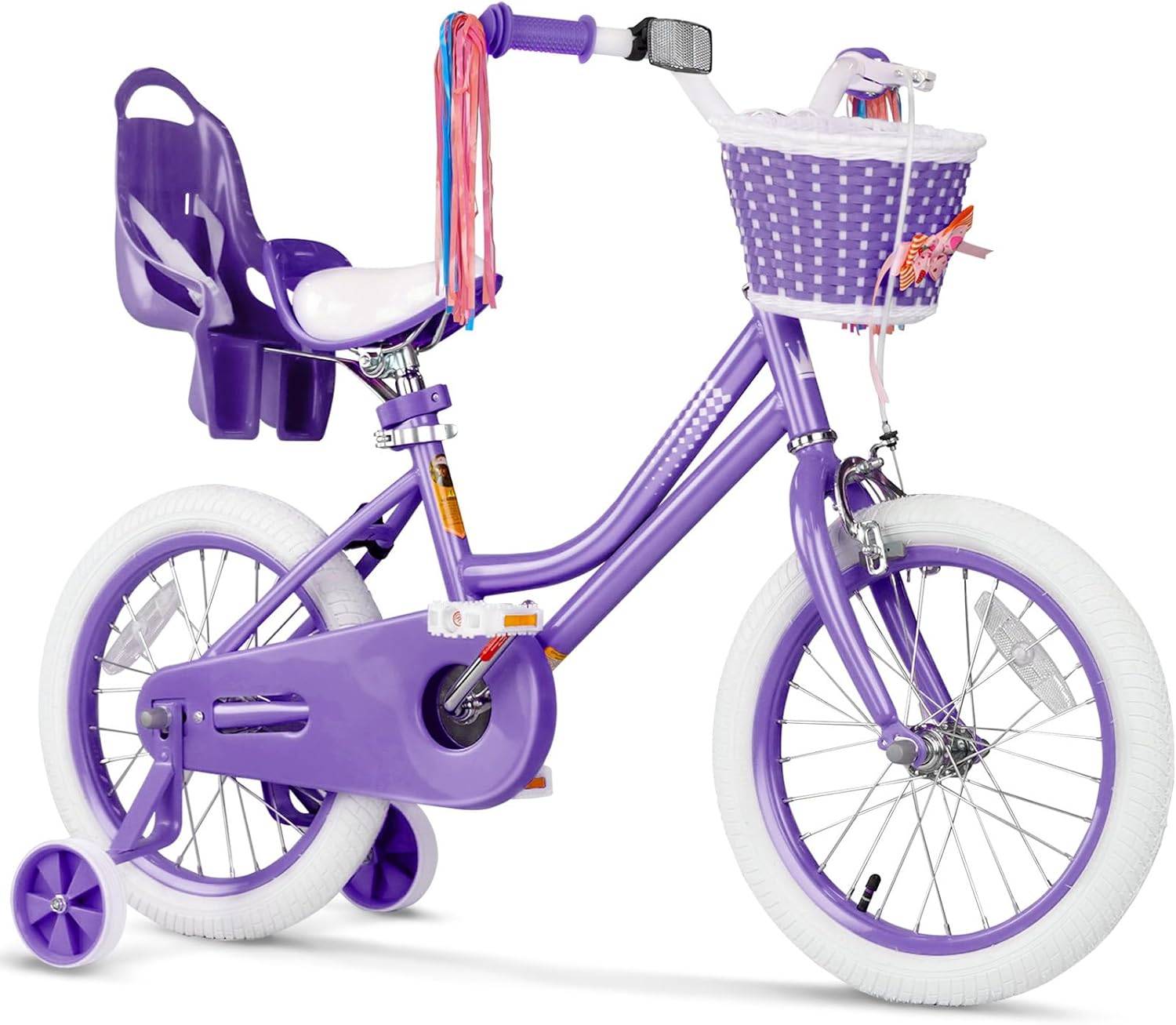 XJD Girls Bike for Kids Ages 3-8, 12/14/16 Inch with Training Wheels – Purple
A 12-, 14- or 16-inch training-wheel bike in purple. Its sizes are smaller than the usual 20-inch starting point for a nine-year-old, so use it only as a comparison if measurements and an individual fit check support it.
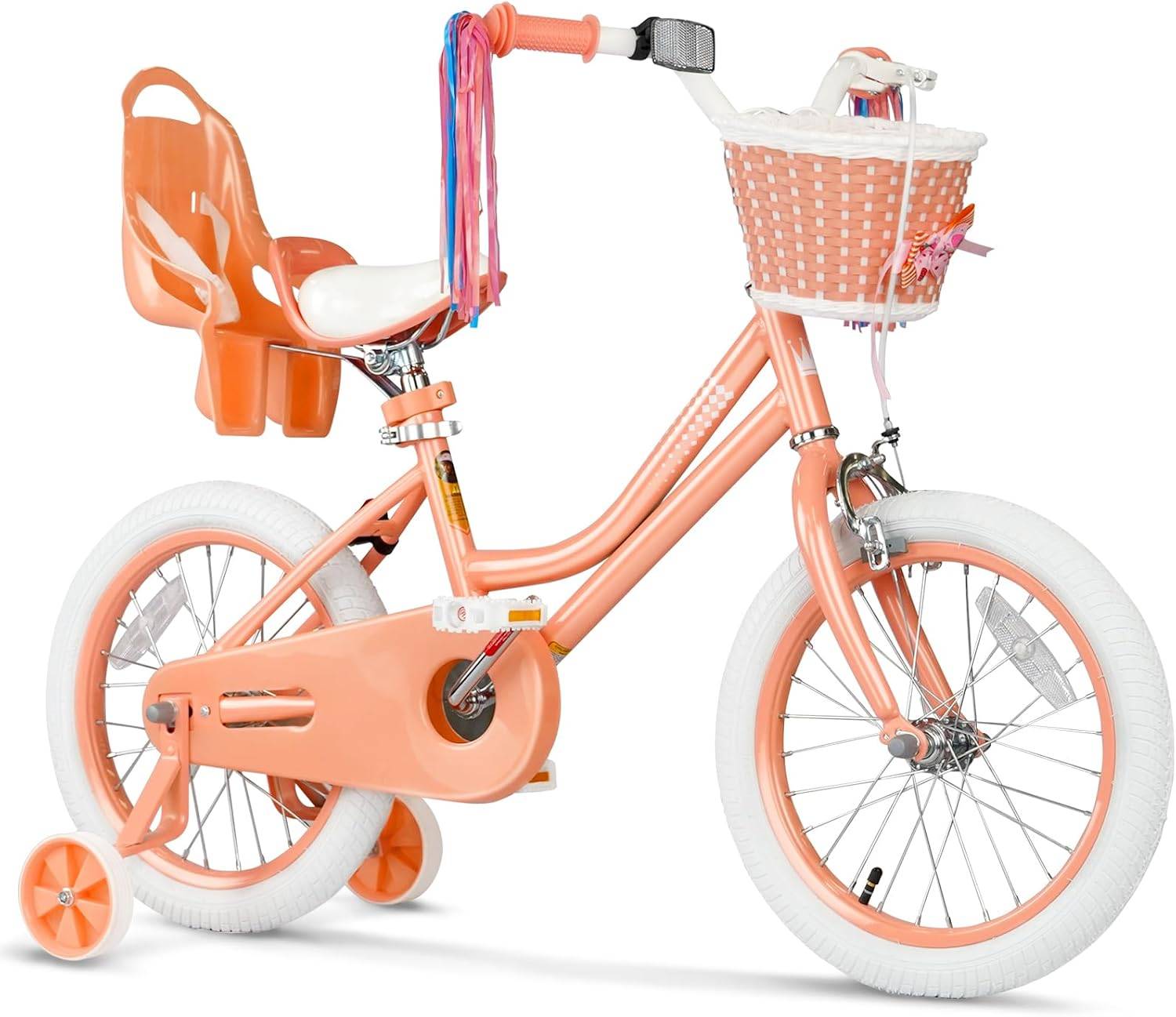 Girls 12/14/16 Inch Kids Bike by XJD with Training Wheels – Peach
A peach training-wheel bike available in 12-, 14- and 16-inch sizes. It is a smaller-size comparison option, not a substitute for a correctly fitted 18-, 20- or 24-inch bicycle.
XJD Girls Bike for Kids Ages 3-8, 12/14/16 Inch with Training Wheels – Purple is offered in 12 Inch, 14 Inch and 16 Inch sizes. Girls 12/14/16 Inch Kids Bike by XJD with Training Wheels – Peach has the same supplied size choices. The age wording in each product title is only a catalog label, not evidence that either bicycle fits a particular child.
Under the XBikes standard, 16-inch bikes are a starting point for ages 4–7 and heights of 40–48 inches (102–122 cm). Therefore, these products are generally relevant only if her measurements lead you to consider a smaller comparison and an individual trial confirms control. Do not choose one solely because it has training wheels or because its title mentions an age range.
Do not size up for future growth
An oversized bike can make starting, stopping and turning harder. If she falls between starting ranges, try the adjacent sizes and select the one she can control now. Current confidence matters: a less confident rider may handle a smaller suitable frame more comfortably, while a confident rider still should not be placed on a bike she cannot stand over or brake effectively.
For assembly, maintenance, adjustments, compatibility, load limits and torque requirements, follow the exact product manual or use a qualified bicycle mechanic. Do not improvise settings that the manufacturer has not specified.
Make the final decision
Before riding, provide a properly fitting bicycle helmet. It should sit level, and its straps should be used according to the helmet manufacturer’s instructions.
For this nine-year-old, measure height and inseam today, begin by trying a 20-inch bike, and compare an 18-inch or 24-inch bike only when her height places her in that range. Buy only after she demonstrates comfortable stand-over, reach, brake operation and controlled riding on the exact bicycle.
Bikes for your next adventure
-

Kids Bike Helmet by XJD for Boys & Girls – Black, Blue, Green, Pink, Purple
The XJD Kids Bike Helmet covers a wide 2-to-8-year age range thanks to two head-…$59.99
-

Kids Bike Helmet by XJD for Girls – Pink
The XJD Kids Bike Helmet in Pink is a lightweight multi-sport helmet for girls r…$59.99
$99 -

XJD Kids Bike for Girls – Pink, 12/14/16/20 Inch with Training Wheels
The XJD Kids Bike for Girls in Pink is a training-wheel bike built to carry your…$139
$159