

What size bike for girl
Choose a girl’s bike by measuring her height and inseam, then check stand-over clearance, reach and brake control in person. Use age only as a starting point, and never size up simply for future growth.
Start with height, not age
Measure the rider without shoes, standing straight against a wall. Record her total height from the floor to the top of her head. Next, measure her inseam from the floor to the crotch while she stands with her feet slightly apart. These two measurements help identify a sensible wheel-size range and reveal whether she can stand over a particular bicycle comfortably.
Wheel size is a useful shopping label, but it does not guarantee fit. Bikes with the same wheel diameter can differ in frame shape and riding position. When two sizes overlap in the chart, compare both on the actual rider instead of automatically choosing the larger one.
Compare her measurements with these starting points
| Wheel size | Starting age | Rider height |
|---|---|---|
| 12 Inch | 3–4 | 34–40 in / 86–102 cm |
| 14 Inch | 3–6 | 37–45 in / 94–114 cm |
| 16 Inch | 4–7 | 40–48 in / 102–122 cm |
| 18 Inch | 5–9 | 43–52 in / 109–132 cm |
| 20 Inch | 7–12 | 48–60 in / 122–152 cm |
| 24 Inch | 10–14 | 54–64 in / 137–163 cm |
| 26 Inch | Youth and adults | Over 60 in / 153 cm |
These XBikes ranges are starting points, not a substitute for checking the individual bicycle. Measured height takes priority over the age column. Inseam, arm reach, hand control and current riding confidence can make the smaller of two overlapping sizes the more manageable choice.
Check the bike around the rider
Have the child try the bicycle before deciding whenever possible. With her standing over the frame, confirm that she has comfortable clearance and is not pressed against the bicycle. Seated in a normal riding position, she should reach the handlebar without stretching, twisting or locking her arms.
Ask her to place her hands on the controls and operate the brakes. She must be able to reach and use them confidently; being able to touch the handlebar alone is not enough. She should also be able to start, steer, stop and get off without the bicycle feeling unwieldy. If she looks tense or loses control because of the bike’s size, do not treat “she will grow into it” as a solution.
How the supplied girls’ bikes compare
The supplied catalog options are useful because they cover several common starting sizes and let you compare models only after measurement. The Light Pink XJD Girls' Bicycle with Basket & Training Wheels is offered in 12 Inch, 14 Inch, 16 Inch and 20 Inch labels. The Blue XJD Girls Bike with Training Wheels – 12/14/16 Inch and the XJD Kids' Training Wheel Bike for Boys & Girls, 12/14/16 Inch – White are each offered in 12 Inch, 14 Inch and 16 Inch labels.
These particular options help answer “what size bike for girl” by providing catalog choices across the 12–16 Inch range, plus one 20 Inch option, which you can compare against her measured height and an individual fit check.
 Light Pink XJD Girls' Bicycle with Basket & Training Wheels
Available in 12 Inch, 14 Inch, 16 Inch and 20 Inch labels, making it relevant across several XBikes height starting points after an individual fit check.
 Blue XJD Girls Bike with Training Wheels – 12/14/16 Inch
Available in 12 Inch, 14 Inch and 16 Inch labels for comparison with the rider’s measured height, inseam, reach, brake control and confidence.
 XJD Kids' Training Wheel Bike for Boys & Girls, 12/14/16 Inch – White
This boys-and-girls catalog option is available in 12 Inch, 14 Inch and 16 Inch labels; select among them only after measuring and checking the individual fit.
Do not infer fit from color, wording or the presence of training wheels. The listed wheel-size label is only the first filter. If her measurements point to 18 Inch, 24 Inch or 26 Inch, none of the supplied products has that exact size; the displayed models are nearest-size comparison points only, not substitutes. A 16 Inch or 20 Inch bike is not equivalent to an 18 Inch bike.
Account for confidence without changing the fit rules
A newer or cautious rider may benefit from the easier control of a correctly fitted smaller option within an overlapping height range. A confident rider still should not be placed on an oversized bicycle. Training wheels do not correct excessive reach, inadequate stand-over clearance or difficulty operating the brakes.
Once a candidate size is identified, verify setup and permitted adjustments using that exact product’s manual. For assembly, maintenance, load limits, compatibility and torque requirements not stated here, follow the manual or ask a qualified bicycle mechanic rather than applying a general number or procedure.
Make the final size decision
- Measure her standing height and inseam without shoes.
- Use the chart to identify one or two candidate wheel sizes.
- Have her stand over and sit on each candidate bicycle.
- Confirm relaxed handlebar reach and reliable access to the brakes.
- Watch her start, steer, stop and dismount under close adult supervision.
Before riding, provide a bicycle helmet that fits properly, sits level and has its straps adjusted according to the helmet manufacturer’s instructions. Recheck fit as the child grows and after significant bicycle adjustments.
The right size is the candidate that matches her measurements and lets her control the bicycle now. If the chart and the real-world fit check disagree, choose according to safe stand-over, comfortable reach, usable brakes and present confidence—not age, appearance or room to grow.
Bikes for your next adventure
-

XJD Kids Bike for Girls – Pink, 12/14/16/20 Inch with Training Wheels
The XJD Kids Bike for Girls in Pink is a training-wheel bike built to carry your…$139
$159 -
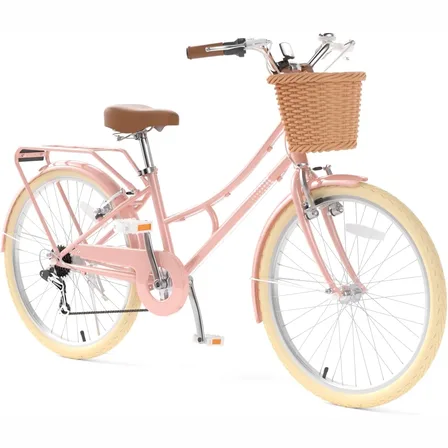
XJD Pink Beach Cruiser for Girls – Rear Rack & V-Brake
The XJD Pink Beach Cruiser for girls is the step-up bike for riders who've outgr…$179.99
$209.99 -
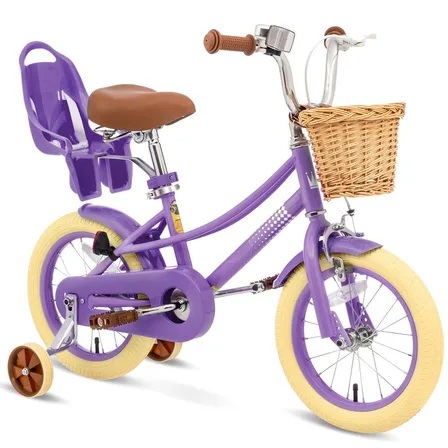
XJD Girls' Bike with Training Wheels, 12/14/16/20 Inch – Purple
The XJD girls' bike with training wheels in Purple is built to grow with your ri…$139
$159