

What size bike should a 6 year old girl ride
Most 6-year-old girls should start by trying a 16-inch bike, but height and fit decide the size. Measure her height and inseam, then confirm stand-over clearance, comfortable reach, brake control and confidence before buying.
Start with height, not age
XBikes lists a 16-inch bike as a starting point for ages 4–7 and heights of 40–48 inches (102–122 cm). That makes 16 inches the most likely first size to try for a 6-year-old girl.
Age overlaps several sizes, however. A shorter rider may fit a 14-inch bike, while a taller rider may need an 18-inch bike. A 20-inch bike generally starts at 48 inches (122 cm) and age 7, so it should not be chosen for a 6-year-old unless her measurements and an individual fit check support it.
| Wheel size | XBikes age starting point | Rider height |
|---|---|---|
| 14 Inch | Ages 3–6 | 37–45 in / 94–114 cm |
| 16 Inch | Ages 4–7 | 40–48 in / 102–122 cm |
| 18 Inch | Ages 5–9 | 43–52 in / 109–132 cm |
| 20 Inch | Ages 7–12 | 48–60 in / 122–152 cm |
These ranges overlap because wheel diameter alone does not determine how a particular bicycle fits. Use the table to select sizes to try, not to make the final decision.
Measure her before comparing bikes
Measure height without shoes, with the child standing straight against a wall. For inseam, have her stand with her feet slightly apart and measure from the floor to the crotch. Record both measurements in inches or centimetres.
Compare her measured height with the XBikes ranges first. Inseam then helps with the physical try-on: she needs usable clearance when standing over the bike, rather than contact with the frame. Because frame shapes and saddle adjustment can differ, do not infer stand-over fit from wheel size alone.
Perform the fit check in person
Have her try the exact bicycle whenever possible. The American Academy of Pediatrics advises against buying an oversized bicycle simply for a child to grow into. While she is seated and standing over it, check that she can:
- stand over the bicycle with comfortable clearance;
- reach the handlebars without stretching or becoming cramped;
- steer while remaining balanced and in control;
- reach and operate the brakes confidently;
- start, stop and put a foot down without panic.
If she cannot control the bike or comfortably reach its controls, reject that fit even when her age and height appear in the listed range. Current confidence matters alongside physical measurements.
Which supplied bikes are relevant?
The catalog options help because both provide adjacent sizes that a typical 6-year-old might compare during a fit check. They are training-wheel bikes, so they are relevant when that is the type the family is considering; their listed sizes still do not prove individual fit.
 Light Pink XJD Girls' Bicycle with Basket & Training Wheels
Available in 12-, 14-, 16- and 20-inch sizes. Its 14- and 16-inch options are relevant comparison points for many 6-year-olds; the 20-inch option requires the rider-height threshold and an individual fit check.
 Blue XJD Girls Bike with Training Wheels – 12/14/16 Inch
Available in 12-, 14- and 16-inch sizes. Its 14- and 16-inch options let parents compare likely sizes for a 6-year-old using measured height, stand-over clearance, reach, brake control and confidence.
Light Pink XJD Girls' Bicycle with Basket & Training Wheels is listed in 12-, 14-, 16- and 20-inch options. Its 14- and 16-inch versions cover the main comparison for a smaller or typically sized 6-year-old. The 20-inch option is relevant only if she is at least 48 inches (122 cm) tall and passes the complete fit check.
Blue XJD Girls Bike with Training Wheels – 12/14/16 Inch is listed in 12-, 14- and 16-inch options. For this question, compare its 14- and 16-inch versions according to measured height and actual control.
Neither supplied product offers an 18-inch size. If her height and fit point to 18 inches, these products are nearest-size comparison points, not substitutes: a 16-inch or 20-inch bike is not equivalent to an 18-inch bike.
Do the final safety and setup checks
Choose a properly fitting bicycle helmet for every ride. U.S. Consumer Product Safety Commission guidance says the helmet should fit properly, sit level and have its straps used according to the manufacturer’s instructions.
Before riding, follow the exact bicycle manual for assembly, adjustment, maintenance, compatibility, load limits and torque requirements. If the instructions are unavailable or any setup is uncertain, use a qualified bicycle mechanic rather than guessing.
Make the size decision
Begin with a 16-inch trial. Move to 14 inches if her measured height and hands-on fit show that 16 inches is too large; consider 18 inches if she is taller and controls 16 inches poorly because it is too small. Consider 20 inches only from 48 inches (122 cm) tall and after a successful fit check. Buy the size she can control now—not one chosen mainly for future growth.
Bikes for your next adventure
-
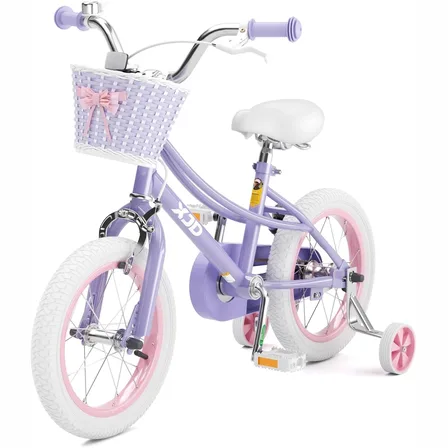
Girls' Training Wheel Bike by XJD with Basket – Purple
If you're shopping for a first bike for a girl roughly 3 to 12 years old (91–152…$75.99
-
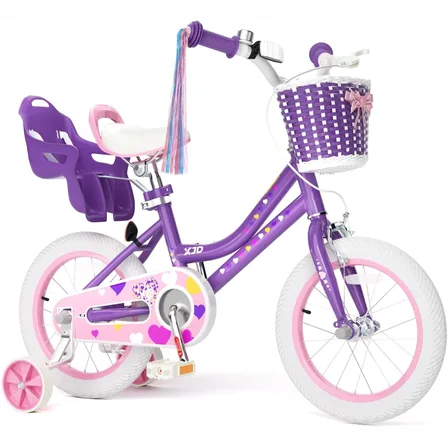
XJD Light Purple Girls Bike with Basket, Training Wheels, 12/14/16/20 Inch
The XJD Girls Bike with Basket in Light Purple is a single-speed training-wheel …$99.99
$119.99 -

Pink 12/14/16/20" XJD Girls Bike with Training Wheels & Basket
The Pink XJD Girls Bike with Training Wheels & Basket is a first-bike pick f…$65.99
$75.99