

What size bike should a 9 year old girl ride
Most 9-year-old girls should start by trying a 20-inch bike if they are 48–60 inches (122–152 cm) tall, but height and individual fit—not age or gender—should decide.
Choose the starting wheel size from her height
Measure her height without shoes, standing straight against a wall. Compare that measurement with the XBikes starting points below. The ranges overlap because two wheel sizes may be plausible; a hands-on fit check determines which one gives her better control.
| Wheel size | XBikes age starting point | Rider height |
|---|---|---|
| 18 Inch | Ages 5–9 | 43–52 in / 109–132 cm |
| 20 Inch | Ages 7–12 | 48–60 in / 122–152 cm |
| 24 Inch | Ages 10–14 | 54–64 in / 137–163 cm |
| 26 Inch | Youth and adults over 60 in / 153 cm | Over 60 in / 153 cm |
For a 9-year-old measuring 48–60 inches, begin with a 20-inch model. If she is under 48 inches, compare an 18-inch bike. If she is at least 54 inches, a 24-inch bike may also merit a fit check despite its older age starting point. Above 60 inches, consider 26-inch options. Never move up solely because her birthday falls near another range.
Measure inseam before visiting or ordering
Height narrows the search, while inseam helps reveal whether she can stand over the bicycle comfortably. With shoes off, have her stand with feet slightly apart. Place a firm, thin book between her legs, gently raise it to simulate a saddle, and measure from the floor to its top edge.
Compare that measurement with the bicycle maker’s stand-over information for the exact model and configuration. No universal inseam-to-wheel-size conversion is used here because frame shapes differ. If the required dimension is absent, consult the exact product manual, seller information, or a qualified bicycle mechanic.
Perform the fit check she actually has to pass
Have her try the assembled bicycle rather than relying on the wheel label. The American Academy of Pediatrics advises against buying an oversized bicycle for a child to grow into. While wearing the shoes she will ride in, check that she can:
- Stand over the frame with comfortable clearance rather than being pressed against it.
- Mount, start, steer and stop without struggling to manage the bicycle’s size.
- Reach the handlebar without stretching, locking her elbows or losing a stable posture.
- Reach and operate the brakes confidently with her hands in their normal riding position.
- Place her feet as intended for the model while remaining composed at a stop.
If she appears cramped on one size but stretched or hesitant on the next, do not assume the larger bike is correct. Compare the exact frames and choose the one she controls now. A qualified bicycle mechanic can help when the result is unclear.
How the supplied girls’ bike relates to this decision
The XJD Kids Bike for Girls – Pink, 12/14/16/20 Inch with Training Wheels is relevant because its available labels include 20 Inch, the usual starting comparison for a 9-year-old within the 48–60-inch height range. Its 12-, 14- and 16-inch choices correspond to shorter-rider starting ranges and should not be selected merely because they share the same product title. This catalog option is categorized as a training-wheel bike, so it may be relevant when that format matches the rider’s present confidence and needs; the supplied facts do not establish whether the training wheels are removable or appropriate for every rider.
These catalog choices help answer the title by providing a 20-inch option to fit-check and smaller labeled variants for comparison, while making clear that the correct selection still depends on the child’s measurements and control.

If her measurements point to 18, 24 or 26 inches, the supplied product does not list that exact wheel size. Its available sizes are therefore comparison points, not equal substitutes. Look for the indicated size elsewhere and conduct the same individual fit check.
Check confidence, controls and final setup
Current riding ability can break a tie within overlapping height ranges. A cautious learner needs a bicycle she can steady, steer and stop without fear; a confident rider still should not be placed on a frame that compromises stand-over clearance, reach or brake operation. “Girls’ bike” styling does not change these fit requirements.
Before riding, follow the exact product manual for assembly, adjustment, maintenance, compatibility and any torque requirements. When instructions or specifications are unavailable, use a qualified bicycle mechanic rather than improvising.
Add a properly fitting bicycle helmet. U.S. Consumer Product Safety Commission guidance says it should sit level and be secured with its straps according to the helmet manufacturer’s instructions. Recheck the fit whenever equipment or adjustments change.
The decision to make today
Measure her height and inseam, then start with a 20-inch trial if she is 48–60 inches tall. Compare 18 inches below that threshold or 24 inches from 54 inches upward, and select only the bicycle on which this particular 9-year-old can stand over, reach, steer and brake confidently now.
Bikes for your next adventure
-
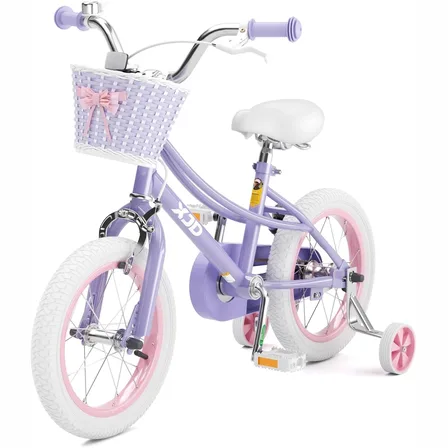
Girls' Training Wheel Bike by XJD with Basket – Purple
If you're shopping for a first bike for a girl roughly 3 to 12 years old (91–152…$75.99
-
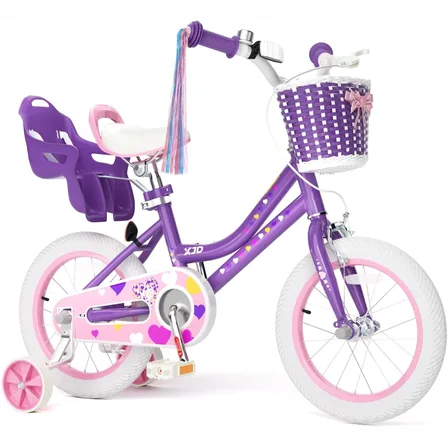
XJD Light Purple Girls Bike with Basket, Training Wheels, 12/14/16/20 Inch
The XJD Girls Bike with Basket in Light Purple is a single-speed training-wheel …$99.99
$119.99 -

Pink 12/14/16/20" XJD Girls Bike with Training Wheels & Basket
The Pink XJD Girls Bike with Training Wheels & Basket is a first-bike pick f…$65.99
$75.99