

What size bikes for young girl
Choose a bike for a young girl by measuring her height first, then matching it to a wheel-size range and confirming stand-over, reach and brake control in person.
Start with her measured height
Bike size is determined by the individual rider, not by gender and not reliably by age alone. Measure her standing height without shoes, with her back straight against a wall. Also measure her inseam from the floor to the crotch while she stands naturally.
Use height to identify a starting wheel size. Then use the inseam to check whether she can stand over the bicycle comfortably. Because frame shapes and adjustment ranges can differ, a wheel-size label cannot complete the fit decision by itself.
Compare her measurement with these starting points
| Wheel size | Starting age | Rider height |
|---|---|---|
| 12 Inch | 3–4 | 34–40 in / 86–102 cm |
| 14 Inch | 3–6 | 37–45 in / 94–114 cm |
| 16 Inch | 4–7 | 40–48 in / 102–122 cm |
| 18 Inch | 5–9 | 43–52 in / 109–132 cm |
| 20 Inch | 7–12 | 48–60 in / 122–152 cm |
| 24 Inch | 10–14 | 54–64 in / 137–163 cm |
| 26 Inch | Youth and adults | Over 60 in / 153 cm |
These ranges overlap because children of the same age can have different proportions and abilities. When her height appears in two rows, compare both sizes in person if possible. Do not automatically select the larger one for extra growing room.
Confirm the fit on the actual bicycle
Have her try the bicycle rather than deciding from the chart alone. The American Academy of Pediatrics advises against buying an oversized bicycle merely for growth. A bike that is too large can make starting, stopping and steering harder.
During the fit check, look for four things:
- Stand-over: She can straddle the frame comfortably rather than being forced onto her toes by the bicycle.
- Reach: She can hold the handlebars without stretching, locking her arms or leaning excessively.
- Brake control: She can reach and operate the fitted brakes confidently with her hands in a normal riding position.
- Overall control: She can start, steer, stop and get off without the bicycle overwhelming her.
If she cannot do these things, a height-chart match is not enough. Compare another frame or wheel size. Her current confidence matters alongside her measurements, especially if she is still learning.
How the available girls’ bike helps with comparison
The XJD Girls' Bike with Training Wheels, 12/14/16/20 Inch – Purple is relevant because its available size labels cover four chart steps: 12 Inch, 14 Inch, 16 Inch and 20 Inch. That makes it useful for comparing the listed options against her measured height and current need for a training-wheel bike. It does not include an 18 Inch, 24 Inch or 26 Inch label, so it is not a substitute when an individual fit check points to one of those sizes.

Select the matching size label only after confirming the actual bicycle’s stand-over, reach and brake control. The title and purple color identify the catalog option, but neither establishes fit. For assembly, adjustment limits, compatibility, maintenance, load limits or torque requirements, follow the exact product manual or ask a qualified bicycle mechanic.
Make the final size decision
- Record her height and inseam without shoes.
- Find every wheel-size range containing her measured height.
- Have her try the candidate size or sizes with the seat adjusted within the bicycle’s documented limits.
- Check stand-over, handlebar reach, brake operation and her ability to control the bicycle.
- Reject a size that is awkward now, even if she may grow into it later.
Complete the setup with a properly fitting bicycle helmet. U.S. Consumer Product Safety Commission guidance says the helmet should sit level and its straps should be used according to the manufacturer’s instructions.
For this young rider, choose the smallest candidate that provides a proper individual fit and confident control today—not a larger bike selected only from her age or anticipated growth.
Bikes for your next adventure
-

Kids Bike Helmet by XJD for Girls – Pink
The XJD Kids Bike Helmet in Pink is a lightweight multi-sport helmet for girls r…$59.99
$99 -

Light Purple XJD Toddler Bike Helmet, Adjustable, Size XS (46–51 cm)
This Light Purple XJD toddler bike helmet is made for the smallest riders — the …$20.39
-
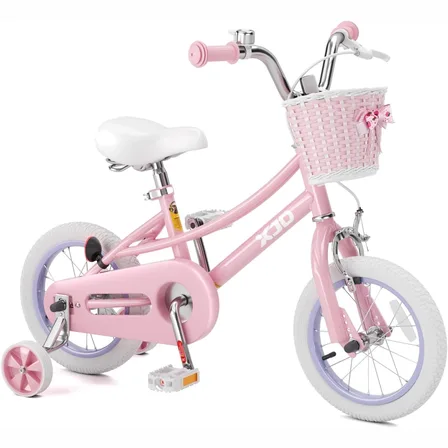
Pink 12/14/16/20" XJD Girls Bike with Training Wheels & Basket
The Pink XJD Girls Bike with Training Wheels & Basket is a first-bike pick f…$65.99
$75.99