

What size girls bike
Choose a girls’ bike by matching her measured height to the wheel-size range, then confirm inseam clearance, reach, brake control and confidence on the actual bike.
Measure the rider before choosing
Have the child wear the shoes she will normally ride in. Measure her standing height against a wall, then measure her inseam from the floor to the crotch. Height gives you a practical wheel-size starting point; inseam helps you judge whether she can stand over and manage the bicycle comfortably.
Use age only as a rough cross-check. Children of the same age can differ considerably in height, proportions, coordination and confidence. A girls’ bike is not sized differently simply because of its colour or styling: the rider’s measurements and control determine the fit.
Compare her height with the wheel-size chart
| Wheel size | Starting age | Rider height |
|---|---|---|
| 12 Inch | 3–4 | 34–40 in / 86–102 cm |
| 14 Inch | 3–6 | 37–45 in / 94–114 cm |
| 16 Inch | 4–7 | 40–48 in / 102–122 cm |
| 18 Inch | 5–9 | 43–52 in / 109–132 cm |
| 20 Inch | 7–12 | 48–60 in / 122–152 cm |
| 24 Inch | 10–14 | 54–64 in / 137–163 cm |
| 26 Inch | Youth and adults | Over 60 in / 153 cm |
These ranges overlap because height alone cannot settle every fit decision. If her height falls into two rows, compare both sizes in person instead of automatically choosing the larger wheel. Her current ability and body proportions should decide.
Do the fit check on the actual bike
Have her try the bicycle rather than relying only on its stated wheel size. She should be able to stand over it with usable clearance and hold the handlebar without an uncomfortable stretch. From a normal riding position, check that she can steer, start and stop while remaining balanced.
- Stand-over: She can straddle the bicycle securely rather than being forced onto tiptoes or against the frame.
- Reach: She can hold the grips and turn the handlebar without locking her elbows or leaning excessively.
- Brake control: She can reach and operate the bicycle’s controls confidently with her hands in their normal position.
- Confidence: She can mount, balance, steer and stop without appearing overwhelmed by the bike’s height or length.
If any of these checks fail, try a different size or setup. Follow the exact product manual for permitted adjustments, assembly, maintenance, load limits and compatibility. If anything is unclear, use a qualified bicycle mechanic.
Do not size up just for growth
An oversized bike can make starting, stopping, steering and reaching the brakes harder. Extra growing room is not useful if the child cannot control the bicycle now. Choose the size that fits her present measurements and ability, then reassess as she grows.
Likewise, do not keep a bike merely because its age label seems correct. Move to another size when her posture, stand-over clearance, reach or control indicates that the current bicycle no longer fits.
How the available girls’ bike compares
The XJD Girls BMX Bike 12/14/16 Inch with Training Wheels – Pink Blue is relevant when her measured height and individual fit point toward a 12 Inch, 14 Inch or 16 Inch option. Those are the available SKU labels for this Kids’ BMX Bikes model, so it lets you compare three adjacent starting sizes without treating them as interchangeable.
These particular catalog options help answer “what size girls bike” because they cover the smaller 12 Inch, 14 Inch and 16 Inch ranges in the chart and allow the measurement-led choice to be narrowed before the hands-on fit check.
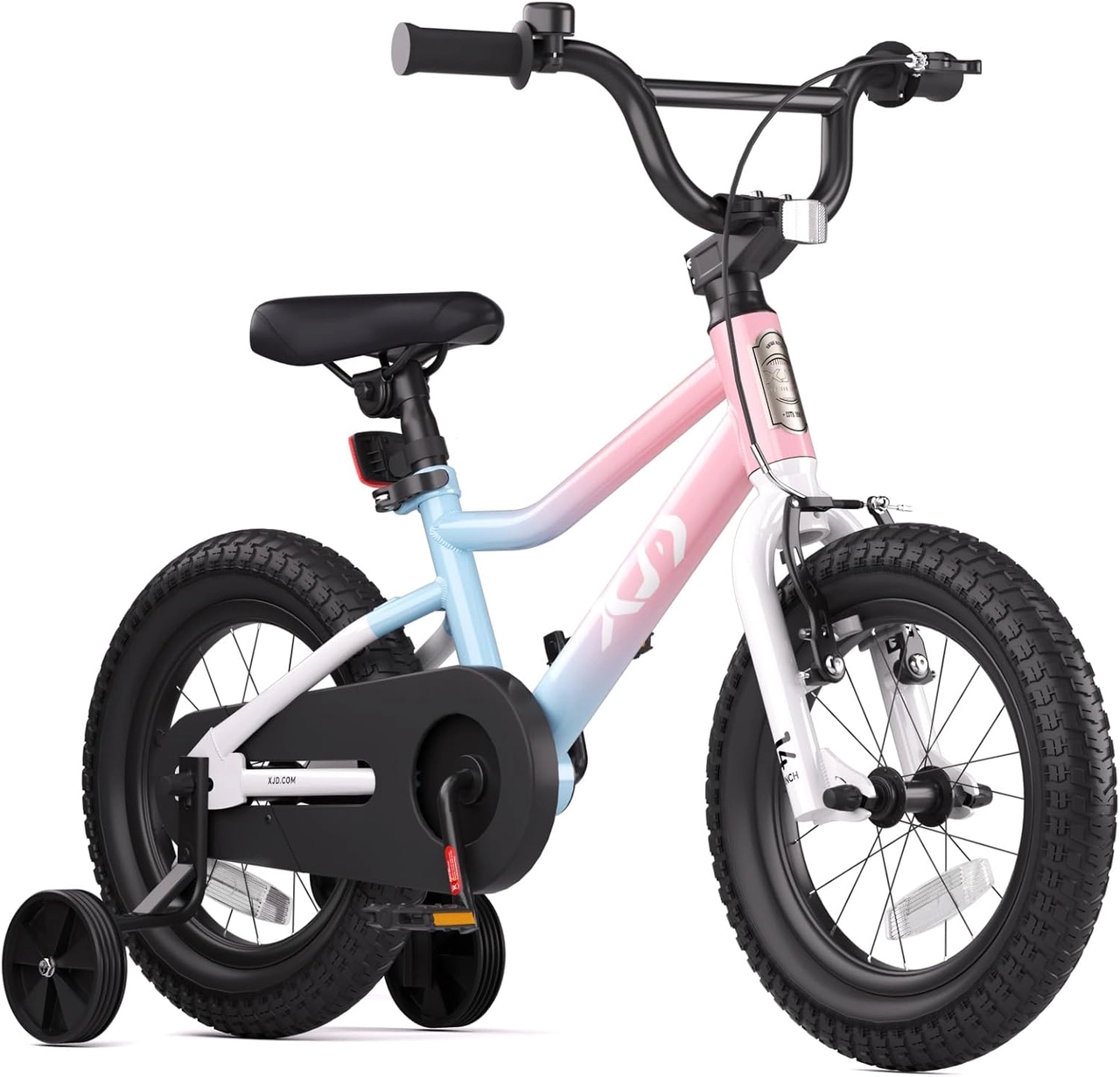
This product is not the relevant catalog match when the fit check points to 18 Inch, 20 Inch, 24 Inch or 26 Inch. A listed 12 Inch, 14 Inch or 16 Inch version is not a substitute for the larger wheel size her measurements and control require.
Complete the decision safely
- Measure her height and inseam.
- Use the chart to identify one or two candidate wheel sizes.
- Have her try each candidate and compare stand-over, reach, brake control and confidence.
- Reject any bike she cannot control comfortably now, even if it offers room to grow.
- Select a properly fitting bicycle helmet for every ride.
The helmet should fit properly, sit level and have its straps used according to the helmet manufacturer’s instructions. A helmet does not correct a poorly fitting bicycle, so verify both separately.
Your final girls’ bike size is the chart starting point that also passes her real-world fit check today; if those results conflict, keep comparing sizes rather than buying by age or future growth.
Bikes for your next adventure
-

Blue XJD Girls Bike with Training Wheels – 12/14/16 Inch
If you're shopping for a first pedal bike for a daughter roughly 3 to 8 years ol…$149
$169 -
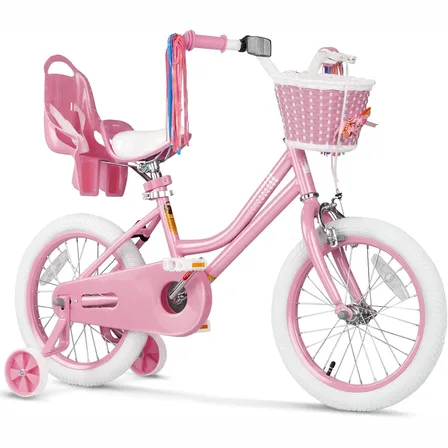
XJD Pink Girls' Bike – Kids 12/14/16 Inch Training Wheel Bicycle
The XJD Pink Girls' Bike is a training-wheel bicycle for girls ages 3 to 8 (ride…$149
$169 -
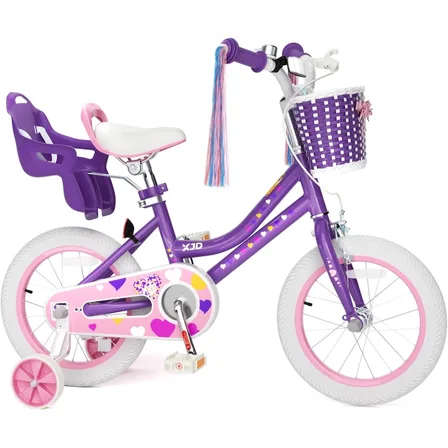
Purple XJD Girls' Bike with Doll Seat & Basket
For girls 71–122 cm tall (about ages 3–7), this XJD girls' bike in Purple pairs …$75.99
$99.99