

What sizes do girls bikes come in
Girls’ bikes commonly come in 12, 14, 16, 18, 20, 24 and 26-inch wheel sizes. Choose by measured fit and control, not gender or age alone.
Girls’ bike sizes at a glance
The size number describes the approximate wheel diameter, not the frame dimensions or the child’s height. “Girls’ bike” usually describes styling or configuration; it does not create a separate sizing system. Use the following XBikes starting points, then check the individual bicycle with the rider.
| Wheel size | Age starting point | Rider height starting point |
|---|---|---|
| 12 Inch | 3–4 | 34–40 in / 86–102 cm |
| 14 Inch | 3–6 | 37–45 in / 94–114 cm |
| 16 Inch | 4–7 | 40–48 in / 102–122 cm |
| 18 Inch | 5–9 | 43–52 in / 109–132 cm |
| 20 Inch | 7–12 | 48–60 in / 122–152 cm |
| 24 Inch | 10–14 | 54–64 in / 137–163 cm |
| 26 Inch | Youth and adults | Over 60 in / 153 cm |
Because several ranges overlap, age cannot settle the choice. A tall four-year-old and a shorter six-year-old may need different sizes despite similar experience. Start with measured height, and never move up merely because a larger bike will last longer.
What to measure before comparing bikes
Measure the child’s standing height without shoes, with her back straight against a wall. Then measure inseam from the floor to the crotch while she stands naturally. Record both measurements in inches or centimetres and compare height with the table.
Inseam helps you judge stand-over clearance, but wheel size alone cannot predict that clearance because frame shapes vary. Compare the inseam with the exact bicycle while the child is present. She should be able to straddle it securely rather than balancing on tiptoe or being pressed against the frame.
How to perform the fit check
Have the child try the exact bike with the seat set within the adjustment range permitted by its manual. A useful fit check covers more than whether her feet can reach the ground:
- Stand-over: she can straddle the bicycle securely and get on and off without the frame obstructing her.
- Reach: she can hold the handlebars without stretching, locking her elbows or losing a stable riding position.
- Brake control: if the bicycle has hand controls, she can reach and operate them confidently while maintaining her grip.
- Steering: she can turn the bars, start, stop and manoeuvre without the bicycle feeling unwieldy.
- Confidence: the size matches her current ability rather than a hoped-for skill level.
If she cannot meet any of these checks, try another size or frame. Do not buy an oversized bicycle for growth. For assembly, adjustments, torque, maintenance or compatibility questions, follow the exact product manual or ask a qualified bicycle mechanic.
Where the supplied XBikes options fit
The two catalog options help families compare three common smaller wheel sizes directly: each is offered with 12 Inch, 14 Inch and 16 Inch SKU labels. The Purple XJD Girls' Bike with Doll Seat & Basket and Pink Girls' 12/14/16" Bike by XJD – Basket & Doll Seat are both categorized as Training Wheel Bikes. Their titles identify a basket and doll seat, while the supplied facts do not establish other specifications.
These particular options are relevant when the measured rider falls near the 12, 14 or 16-inch starting ranges and a Training Wheel Bike is being considered. They are not substitutes for an 18, 20, 24 or 26-inch bicycle; for those sizes, use the table and compare an exact correctly sized model.
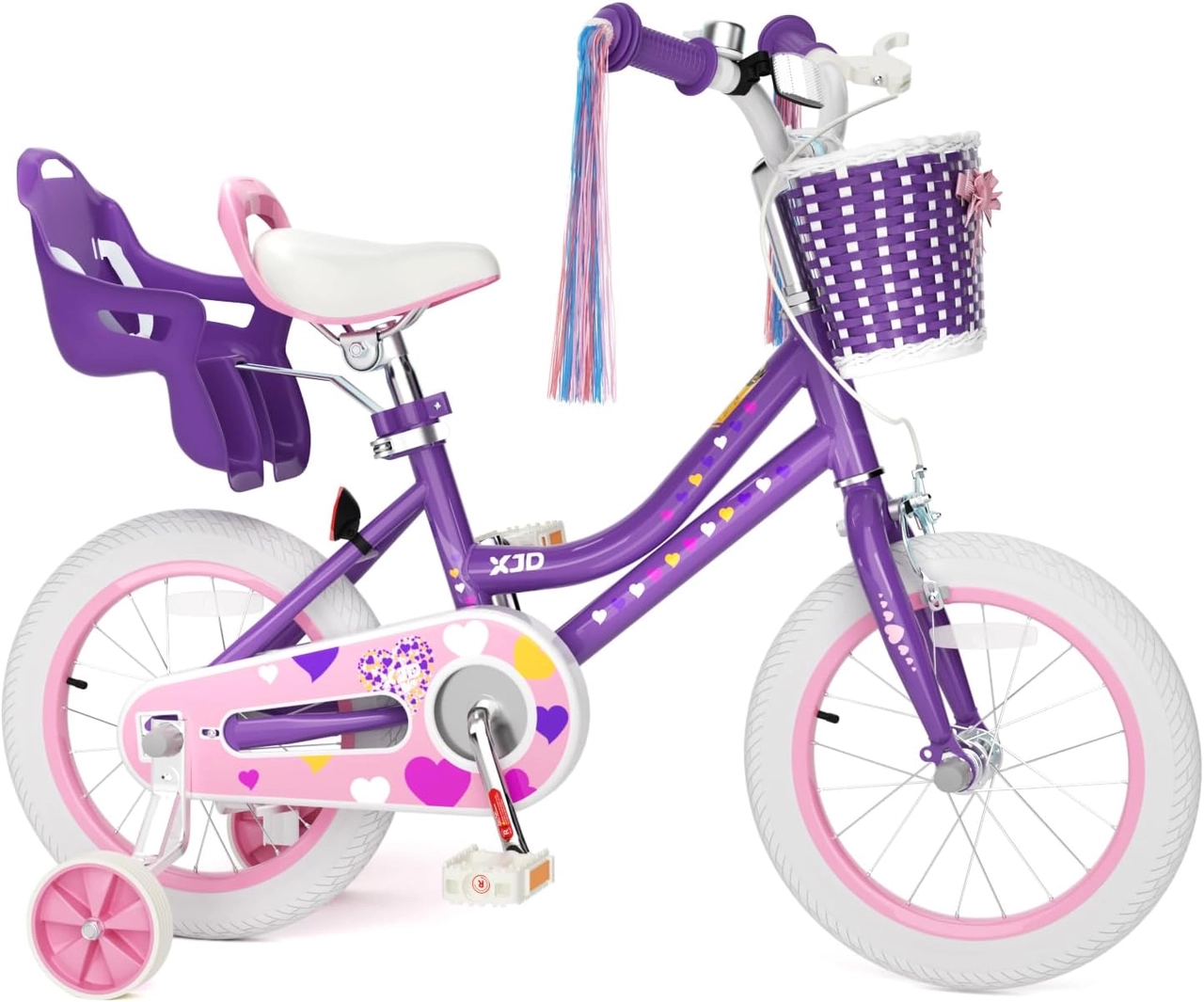 Purple XJD Girls' Bike with Doll Seat & Basket
A Training Wheel Bike offered in 12 Inch, 14 Inch and 16 Inch SKU labels, making it relevant for comparing the three smaller size ranges after measuring the rider and checking fit.
 Pink Girls' 12/14/16" Bike by XJD – Basket & Doll Seat
This Training Wheel Bike has 12 Inch, 14 Inch and 16 Inch SKU labels. It is relevant when those measured height ranges are under consideration, but the exact bicycle still requires an individual fit check.
How to choose within an overlapping range
If the child’s height appears in two rows, compare both sizes in person rather than defaulting upward. Give priority to the bike on which she has secure stand-over clearance, a comfortable reach and reliable control. Her inseam, body proportions and confidence can make the smaller or larger option more appropriate.
A growth margin is only useful when the bicycle fits correctly today. If a 14-inch bike is manageable but a 16-inch bike compromises mounting, steering or braking, choose the current fit. Recheck the fit as the child grows and whenever control begins to look cramped or awkward.
Complete the decision safely
Once the size and exact bike pass the fit check, add a properly fitting bicycle helmet. It should sit level and be secured with its straps according to the helmet manufacturer’s instructions. Recheck the helmet fit rather than assuming an older helmet still fits.
Your next step: measure height and inseam, shortlist the matching wheel-size rows, and have the child try those exact bikes. Select the size she can straddle, reach, steer and brake confidently today—not the biggest girls’ bike she might eventually grow into.
Bikes for your next adventure
-

Blue XJD Girls Bike with Training Wheels – 12/14/16 Inch
If you're shopping for a first pedal bike for a daughter roughly 3 to 8 years ol…$149
$169 -

Black XJD Kids Bike for Boys – 12, 14 & 16 Inch Sizes
For a son between roughly 3 and 8 years old, the XJD Kids Bike in Black covers t…$169
$199 -

XJD Kids Bike for Girls – Pink, 12/14/16/20 Inch with Training Wheels
The XJD Kids Bike for Girls in Pink is a training-wheel bike built to carry your…$139
$159