

What type of bikes do girls ride joke
Girls ride the same types of bikes as anyone else—the real punchline is: the bike that fits. Choose by measured fit, control and confidence, not gender.
What the joke actually gets right
“What type of bikes do girls ride?” sounds like a setup for a gender-based answer, but there is no special bicycle type that every girl needs. A girl might ride a training-wheel bike or another suitable style depending on her current ability. Color and styling can be personal preferences; they do not establish fit.
For a parent, the useful answer is to measure the rider, identify a starting wheel size, and then have her try the bicycle. Age is only a rough starting point. Do not select a larger bicycle merely because she may grow into it.
Measure before comparing bikes
Measure the child’s standing height without shoes. Also measure inseam from the floor to the crotch while she stands naturally. Use height to find a starting size below, then use the in-person fit check to make the decision.
| Wheel size | Starting age | Rider height |
|---|---|---|
| 12 Inch | 3–4 | 34–40 in / 86–102 cm |
| 14 Inch | 3–6 | 37–45 in / 94–114 cm |
| 16 Inch | 4–7 | 40–48 in / 102–122 cm |
| 18 Inch | 5–9 | 43–52 in / 109–132 cm |
| 20 Inch | 7–12 | 48–60 in / 122–152 cm |
| 24 Inch | 10–14 | 54–64 in / 137–163 cm |
| 26 Inch | Youth and adults | Over 60 in / 153 cm |
These ranges overlap deliberately: they narrow the search but cannot confirm a fit. Where two sizes overlap, compare both with the rider present rather than automatically choosing the larger one.
How to check the fit in person
Have the child try the bicycle in the clothes and shoes she normally expects to wear. A useful fit check covers more than whether she can sit on the saddle.
- Stand-over: Check that she can straddle the bicycle with appropriate clearance and without being forced onto tiptoes.
- Reach: She should reach the handlebar without an awkward stretch or cramped posture.
- Brake control: If the bicycle has hand-operated brakes, confirm that she can reach and operate them confidently.
- Steering and balance: Ask her to start, steer, stop and put a foot down while remaining composed.
- Confidence: Treat hesitation or loss of control as fit evidence, even when the age or height chart appears suitable.
This follows the practical principle emphasized by pediatric guidance: let the child try the bike, assess stand-over and controls, and avoid buying an oversized model for future growth.
Where the supplied girls’ bike is relevant
The catalog option, XJD Girls Bike for Kids Ages 3-8, 12/14/16 Inch with Training Wheels – Purple, is relevant when the rider needs a training-wheel bike and her measured height points toward its available 12 Inch, 14 Inch or 16 Inch label. Those three options make it possible to compare adjacent starting sizes instead of treating “girls’ bike” as one fixed size.
The following catalog display helps compare those particular 12, 14 and 16 Inch options after measuring the rider.
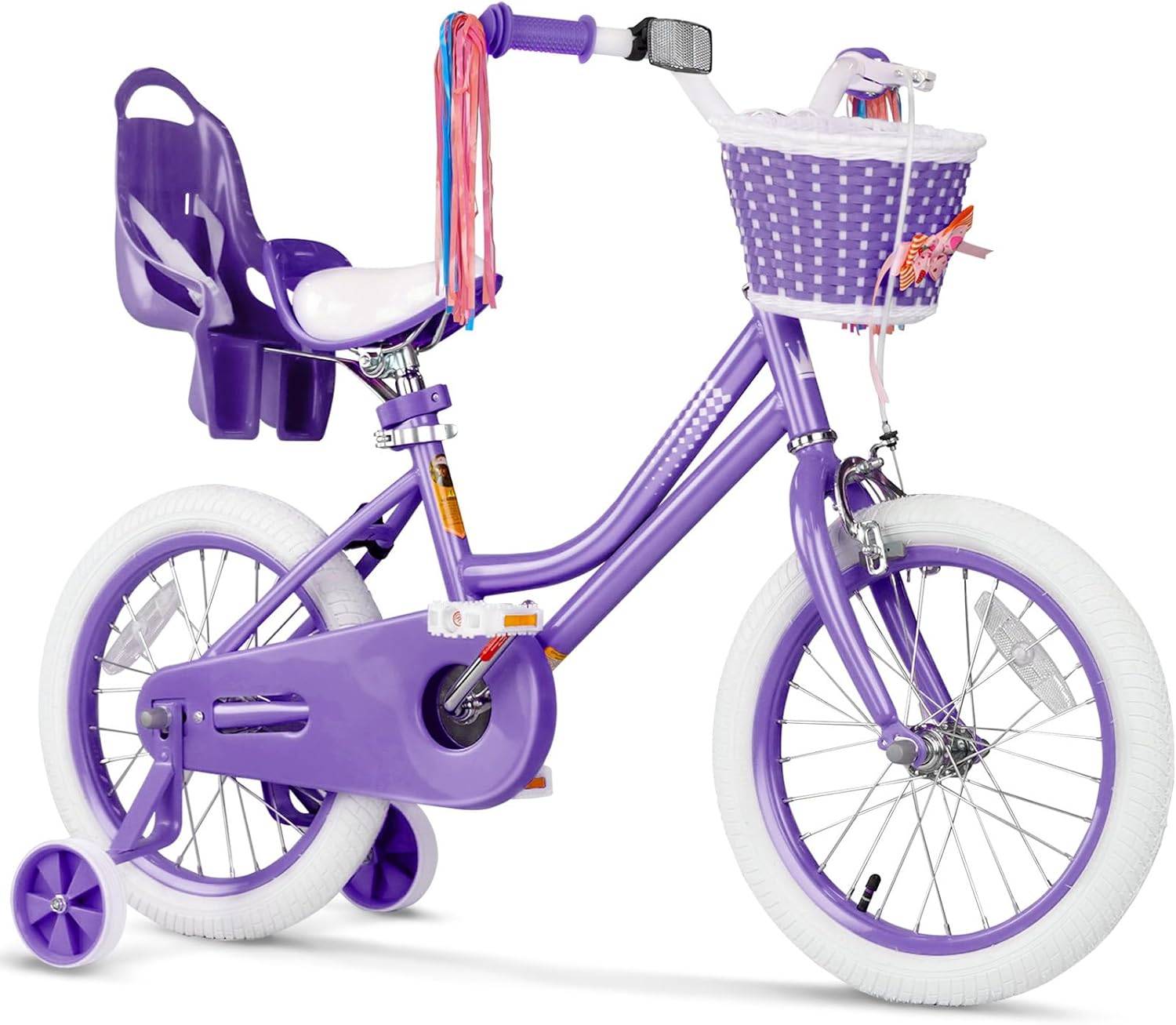
The “Ages 3-8” wording is part of the exact catalog title, not proof that the bicycle fits every child in that span. Use the XBikes size ranges above and verify the individual rider’s inseam, reach, control and confidence. If measurements instead point to 18, 20, 24 or 26 Inch, this product is not a same-size substitute.
Training wheels are a readiness choice
The supplied product belongs to the Training Wheel Bikes category. That makes it pertinent when training wheels match the child’s present confidence and learning needs. It is less relevant when the rider does not need that format or when none of its available wheel sizes fits.
Do not infer assembly details, adjustment procedures, load limits, component compatibility or torque settings from the title. Follow the exact product manual for those points, or ask a qualified bicycle mechanic to inspect and adjust the bicycle.
Helmet and final decision
Use a bicycle helmet that fits the child properly. It should sit level, with its straps adjusted according to the helmet manufacturer’s instructions. Recheck the fit whenever the helmet is put on.
So the title-specific answer is simple: girls ride bikes that fit their bodies and abilities. Measure height and inseam now, compare the matching wheel sizes, and let the rider demonstrate stand-over, reach, braking and control. Choose the purple 12/14/16 Inch training-wheel option only if its format and an individually checked size match her—not merely because the catalog calls it a girls’ bike.
Bikes for your next adventure
-

Blue XJD Girls Bike with Training Wheels – 12/14/16 Inch
If you're shopping for a first pedal bike for a daughter roughly 3 to 8 years ol…$149
$169 -

XJD Girls BMX Bike 12/14/16 Inch with Training Wheels – Pink Blue
The XJD Girls BMX Bike in Pink/Blue is built as a first pedal bike for kids roug…$99.99
$119.99 -

XJD Pink Beach Cruiser for Girls – Rear Rack & V-Brake
The XJD Pink Beach Cruiser for girls is the step-up bike for riders who've outgr…$179.99
$209.99