

Why are girl bikes different from boy bikes
Girl bikes and boy bikes are usually different because of styling, color and sometimes frame shape—not because children need different bikes by sex.
What actually differs
Manufacturers may market the same basic wheel size with different colors, graphics, names or accessories. Some “girl” models use a lower or more sloping top tube, while some “boy” models use a straighter or higher top tube. These are design traditions, not reliable rules about who can ride each bicycle.
A lower top tube can make mounting and dismounting easier for any child. A higher top tube is not automatically stronger, faster or more suitable for a boy. The useful question is whether the individual rider can stand over, mount, steer and stop the bike comfortably.
Touchpoints can differ too, including the apparent position or shape of the saddle and handlebar. Do not assume those details fit because of a gender label. Compare the child's body position and access to the controls.
Measure the rider before comparing labels
Measure the child's height without shoes, then measure inseam from the floor to the crotch. Height gives a wheel-size starting point; inseam helps you judge stand-over clearance and whether the child can put feet down confidently. Age is only a rough reference.
Use these XBikes starting points, then require an individual fit check:
| Wheel size | Starting age | Rider height |
|---|---|---|
| 12 Inch | 3–4 | 34–40 in / 86–102 cm |
| 14 Inch | 3–6 | 37–45 in / 94–114 cm |
| 16 Inch | 4–7 | 40–48 in / 102–122 cm |
| 18 Inch | 5–9 | 43–52 in / 109–132 cm |
| 20 Inch | 7–12 | 48–60 in / 122–152 cm |
| 24 Inch | 10–14 | 54–64 in / 137–163 cm |
| 26 Inch | Youth and adults | Over 60 in / 153 cm |
If height and age suggest different rows, prioritize measured height and the actual fit. Never move up merely to provide room for growth. An oversized bicycle can make starting, stopping and steering harder.
Compare fit on the actual bicycle
Have the child try each candidate, regardless of whether its catalog styling says girls, boys or both. Check the following:
- Stand-over: The child should be able to straddle the bicycle without the frame obstructing a secure stance.
- Reach: The handlebar should be reachable without an exaggerated stretch, locked elbows or a hunched position.
- Brake control: If the bicycle has hand controls, the child must be able to reach and operate them confidently.
- Starting and stopping: The rider should be able to get moving, stop and put a foot down without panic.
- Steering: The child should turn the handlebar and look ahead while remaining balanced and in control.
Current confidence matters. Two children of the same height may be comfortable on different frame shapes or setups. The better choice is the one the rider controls more easily, not the one whose styling matches a gender category.
How the supplied XBikes option is relevant
The catalog option helps demonstrate that a children's bicycle can be explicitly presented for both boys and girls while offering several wheel-size choices. Its value here is as a fit comparison across the supplied sizes, not as proof that every child within a broad label will fit.

XJD Kids' Training Wheel Bike for Boys & Girls, 12/14/16 Inch – White is categorized as a Training Wheel Bike and has 12 Inch, 14 Inch and 16 Inch SKU labels. Compare the child's measured height with the corresponding XBikes starting point, then test stand-over, reach, brake control and confidence on the exact selected size.
This product is relevant when the rider's measurements and ability place them around those three size ranges and a training-wheel bicycle is being considered. It is not relevant as a substitute when the child needs an 18 Inch, 20 Inch, 24 Inch or 26 Inch bicycle; those are different sizes. Confirm assembly, adjustments, compatibility, load limits and maintenance in the exact product manual or with a qualified bicycle mechanic.
Safety is not gender-specific
A bicycle helmet should fit properly, sit level and have its straps used according to the helmet manufacturer's instructions. A “girl” or “boy” label does not change helmet fit, bicycle control or the need to supervise a child according to their ability and riding environment.
Also recheck fit as the child grows. Difficulty reaching controls, cramped knees, an excessive stretch or loss of confidence signals that the setup or size needs attention; it does not mean the child should switch gender categories.
Make the decision
Ignore the gender label first. Measure height and inseam, identify the wheel-size starting point, and have the child compare actual bicycles for stand-over, reach, braking and confident control. Choose the frame and styling the child likes only after those checks. The real difference that matters is fit—not whether the catalog calls the bicycle a girl bike or a boy bike.
Bikes for your next adventure
-
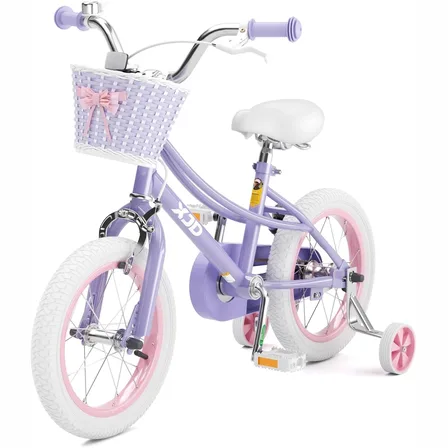
Girls' Training Wheel Bike by XJD with Basket – Purple
If you're shopping for a first bike for a girl roughly 3 to 12 years old (91–152…$75.99
-
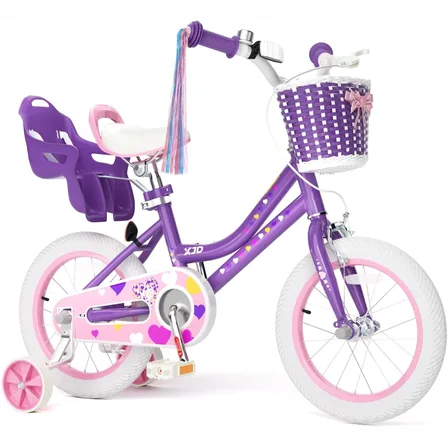
XJD Light Purple Girls Bike with Basket, Training Wheels, 12/14/16/20 Inch
The XJD Girls Bike with Basket in Light Purple is a single-speed training-wheel …$99.99
$119.99 -
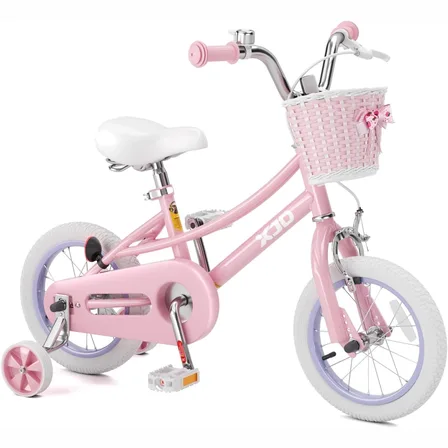
Pink 12/14/16/20" XJD Girls Bike with Training Wheels & Basket
The Pink XJD Girls Bike with Training Wheels & Basket is a first-bike pick f…$65.99
$75.99