

Why do girls bikes not have a bar
Girls’ bikes often appear not to have a bar because their top tube is lowered or sloped, making it easier to step through the frame. This is a frame style, not a rule about who can ride the bike.
What happened to the “bar”?
The bar people usually mean is the top tube, the frame member that runs between the area below the handlebars and the seat area. On some bicycles it is high and nearly horizontal. On others it slopes downward or is positioned low enough to create a step-through opening.
That lower shape was historically associated with clothing such as skirts and dresses because it allowed easier mounting. Today, a low or sloping top tube can be useful to any child who finds it easier or more confidence-inspiring to step through rather than swing a leg over a high tube. A “girls’ bike” label therefore does not establish which frame will fit a particular rider.
Does a lower bar change the fit check?
No. The visible frame shape is only one part of fit. Have the child try the actual bicycle rather than choosing from a gender label, wheel size or age alone. Do not buy an oversized bicycle merely to leave room for growth.
Check these points with the rider wearing normal riding shoes:
- Measured height: Compare the child’s current height with the wheel-size starting points below.
- Inseam and stand-over: Confirm that the child can stand over the frame comfortably; the precise clearance requirement should come from the bicycle’s manual.
- Reach: The child should not have to stretch or twist to hold the handlebars and steer.
- Brake control: If the bicycle has hand controls, verify that the child can reach and operate them as described in the exact product manual.
- Confidence: Watch whether the rider can mount, stop, steer and get a foot down without panic or awkward movement.
Compare wheel size with the rider’s measurements
Wheel size does not tell you whether a frame has a high, sloping or step-through top tube. It is only a starting point for narrowing the bicycles the child should try.
| Wheel size | Starting age | Rider height |
|---|---|---|
| 12 Inch | 3–4 | 34–40 in / 86–102 cm |
| 14 Inch | 3–6 | 37–45 in / 94–114 cm |
| 16 Inch | 4–7 | 40–48 in / 102–122 cm |
| 18 Inch | 5–9 | 43–52 in / 109–132 cm |
| 20 Inch | 7–12 | 48–60 in / 122–152 cm |
| 24 Inch | 10–14 | 54–64 in / 137–163 cm |
| 26 Inch | Youth and adults | Over 60 in / 153 cm |
Where ranges overlap, compare the actual bicycles rather than automatically choosing the larger wheel. Give more weight to measured height, inseam, reach, brake control and present confidence than to age.
How the supplied catalog option is relevant
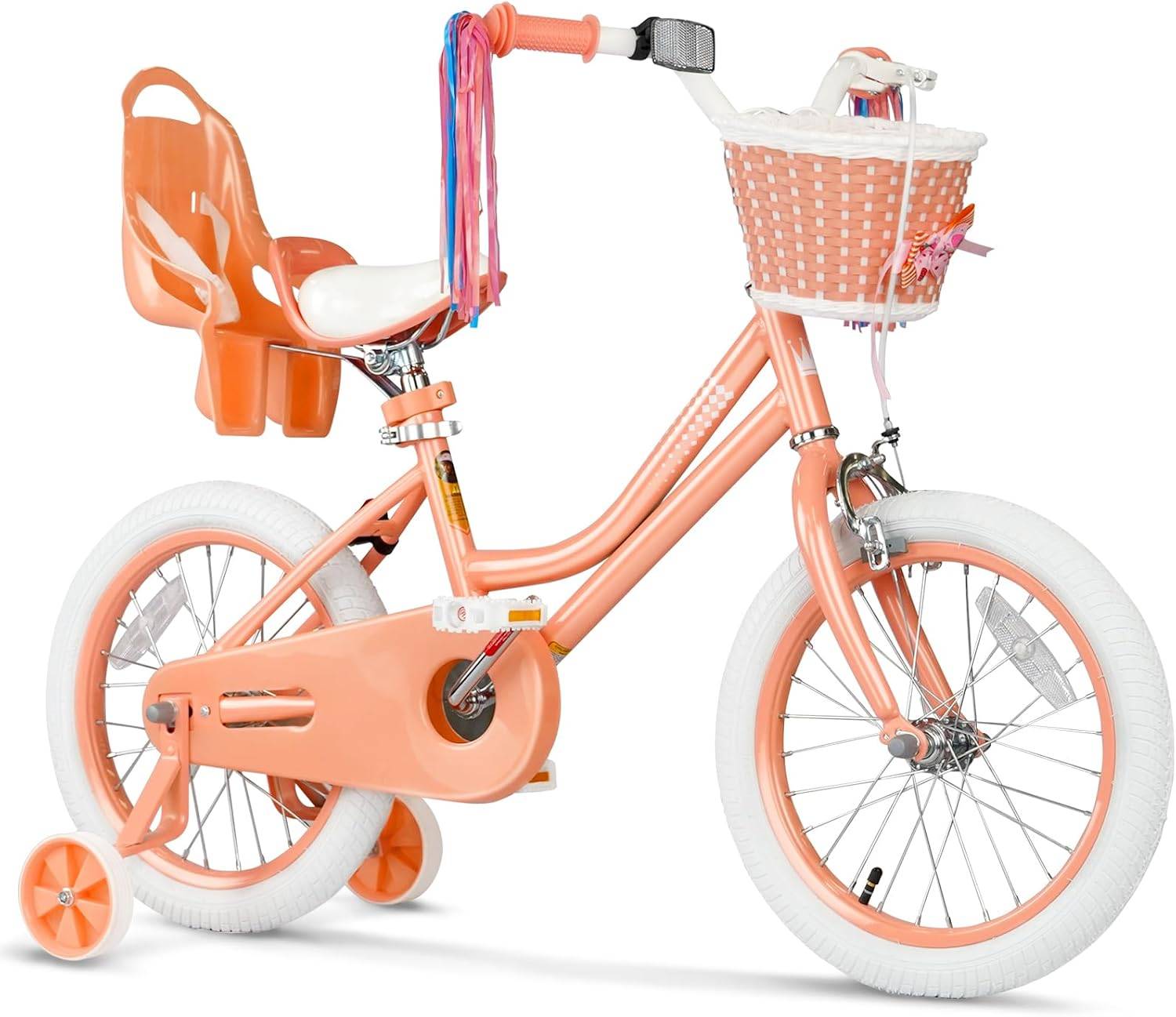
The Girls 12/14/16 Inch Kids Bike by XJD with Training Wheels – Peach is listed as a training-wheel bicycle with 12 Inch, 14 Inch and 16 Inch SKU labels. Those choices provide useful size comparison points for riders within the corresponding height ranges. The supplied catalog information does not specify its top-tube shape, so its title alone cannot confirm whether it has a high bar, sloping bar or step-through frame.
These particular catalog options help answer the question by letting a parent compare three adjacent wheel-size starting points while considering a training-wheel bicycle. They are relevant only if the child’s measurements and individual fit check support one of those sizes.
What to compare on the actual bicycle
First, measure the child’s standing height and inseam. Use height to identify one or more likely wheel sizes, then have the child stand over and sit on each candidate. Compare how easily the child gets on, reaches the controls, turns the handlebars and places a foot down.
A low top tube may make mounting simpler, but it cannot compensate for excessive reach, inaccessible controls or an unsuitable overall size. Likewise, a higher top tube is not automatically wrong if the child has comfortable stand-over room and confident control.
For assembly, adjustment, maintenance, load limits, compatibility and torque, follow the exact bicycle manual or use a qualified bicycle mechanic. Do not guess at procedures or settings.
Make the final decision
Choose by fit and control, not by whether the catalog calls the bicycle a girls’ model. Confirm the wheel-size range from measured height, check inseam and stand-over, then observe reach, braking and confidence on the actual bicycle. Finish by fitting a bicycle helmet so it sits level and its straps are used according to the helmet manufacturer’s instructions. If the child cannot mount and control the bicycle comfortably, try a different frame shape or size rather than waiting for the child to grow into it.
Bikes for your next adventure
-

Kids Bike Helmet by XJD for Boys & Girls – Black, Blue, Green, Pink, Purple
The XJD Kids Bike Helmet covers a wide 2-to-8-year age range thanks to two head-…$59.99
-

Kids Bike Helmet by XJD for Girls – Pink
The XJD Kids Bike Helmet in Pink is a lightweight multi-sport helmet for girls r…$59.99
$99 -

XJD Kids Bike for Girls – Pink, 12/14/16/20 Inch with Training Wheels
The XJD Kids Bike for Girls in Pink is a training-wheel bike built to carry your…$139
$159