

How big a bike for 4 year old
For most 4-year-olds, start by comparing 12-, 14-, and 16-inch bikes. Measure the child first: height, inseam, reach, brake control, and confidence decide the fit—not age alone.
Which wheel size should you check?
XBikes uses these wheel-size starting points:
| Wheel size | Age starting point | Rider height |
|---|---|---|
| 12 Inch | 3–4 | 34–40 in / 86–102 cm |
| 14 Inch | 3–6 | 37–45 in / 94–114 cm |
| 16 Inch | 4–7 | 40–48 in / 102–122 cm |
These ranges overlap, so there is no single correct size for every 4-year-old. A child measuring 39 inches, for example, falls within the 12- and 14-inch height ranges; the better choice depends on how each complete bicycle fits and feels. At 40 inches, all three starting ranges meet, making an individual try-on especially important.
Do not move up to a 20-inch bike merely because it may last longer. The XBikes starting point for 20 Inch is ages 7–12 and heights 48–60 in / 122–152 cm, well beyond many 4-year-olds.
Measure before comparing bikes
Measure the child’s standing height without guessing from clothing size or age. For inseam, have the child stand upright and measure from the floor to the crotch. Use the footwear they will normally wear while riding.
Record both measurements in inches or centimetres. Compare standing height with the XBikes ranges above, then use inseam during the physical fit check. Wheel size is only a label; frame shape, saddle position, and handlebar position can change how two bicycles with the same wheel size feel.
Do a hands-on fit check
Have the child try the exact bicycle. The American Academy of Pediatrics advises against buying an oversized bike for growth and recommends checking stand-over, control, and brake reach.
- Stand-over: With the child standing over the frame, confirm there is clear space and no uncomfortable contact.
- Starting and stopping: Check that the child can get into position, stop, and put a foot down without panic or a large sideways lean.
- Reach: Hands should reach the handlebar without the child stretching, locking the elbows, or losing an upright, controlled posture.
- Brakes: The child must be able to reach and operate the bicycle’s actual controls reliably. Do not assume a suitable wheel size guarantees suitable brake reach.
- Steering: Ask the child to turn the handlebar both ways while remaining balanced and comfortable.
If the child looks cramped on one size but stretched or hesitant on the next, compare another model rather than forcing the larger choice. Current confidence matters alongside dimensions.
How the supplied XBikes options help
The two supplied catalog options are useful because each offers 12 Inch, 14 Inch, and 16 Inch labels—the three sizes most relevant to this question—as well as a 20 Inch label for older or taller riders. Both are categorized as Training Wheel Bikes, so they are relevant when a parent specifically wants that format. Their size labels remain comparison starting points, not proof of fit.
 Pink 12/14/16/20" XJD Girls Bike with Training Wheels & Basket
A Training Wheel Bike offered in 12 Inch, 14 Inch, 16 Inch, and 20 Inch labels. Its three smaller sizes provide relevant comparison points for a measured 4-year-old, subject to an individual fit check.
 Light Pink XJD Girls' Bicycle with Basket & Training Wheels
A Training Wheel Bike with 12 Inch, 14 Inch, 16 Inch, and 20 Inch options. Compare the appropriate smaller size using the child’s measured height, inseam, reach, brake control, and confidence.
Pink 12/14/16/20" XJD Girls Bike with Training Wheels & Basket and Light Pink XJD Girls' Bicycle with Basket & Training Wheels have the same supplied wheel-size choices: 12 Inch, 14 Inch, 16 Inch, and 20 Inch. On the available facts, neither can be declared a better fit. Compare the appropriately sized versions by having the child try the exact bicycle.
These options are not automatically relevant if you do not want a training-wheel bike. They are also unsuitable as evidence that a 20 Inch size fits a 4-year-old; use the rider-height standard and hands-on checks instead.
Before the first ride
Use a bicycle helmet that fits properly, sits level, and has its straps adjusted according to the helmet manufacturer’s instructions, as advised by the U.S. Consumer Product Safety Commission. Recheck the child’s ability to stop, steer, and place a foot down in a controlled practice area.
For assembly, maintenance, load limits, compatibility, and torque settings, follow the exact bicycle’s manual or ask a qualified bicycle mechanic. Do not transfer instructions or settings from another size or model.
Make the size decision
Start with 12 Inch for a child 34–40 in / 86–102 cm, 14 Inch for 37–45 in / 94–114 cm, or 16 Inch for 40–48 in / 102–122 cm. Where ranges overlap, choose only after the child demonstrates comfortable stand-over, natural reach, reliable brake control, easy foot placement, and confident steering. If the larger bike compromises any of those checks, select the smaller suitable bike now rather than buying room to grow.
Bikes for your next adventure
-

26-Inch XJD Beach Cruiser Bike for Girls – Purple, V-Brake
This XJD 26-inch purple beach cruiser is sized for big kids and teens — suggeste…$218.49
$229.99 -

Light Pink XJD Girls' Bicycle with Basket & Training Wheels
The Light Pink XJD Girls' Bicycle with Basket & Training Wheels is a retro-style…$109.99
$129.99 -
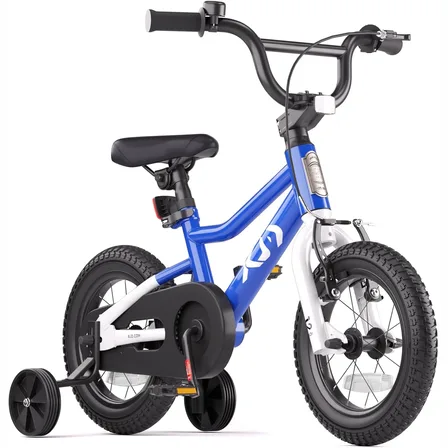
XJD Boys & Girls BMX Bike with Training Wheels, 12/14/16" – Blue
The XJD Boys & Girls BMX Bike in Blue is a first pedal bike for kids roughly age…$99.99
$119.99