

Can a 4 year old learn to ride a bike
Yes—a 4-year-old can learn to ride a bike when the bike fits, the child can control it, and practice stays short, calm and closely supervised.
Check readiness before choosing a bike
Age four is a reasonable starting point, but age alone cannot confirm readiness. Look for a child who wants to try, can follow simple stop-and-go directions, and is comfortable sitting on the bicycle. Confidence may develop gradually; reluctance is a reason to pause, not to push.
Measure the child’s height without shoes. Also measure inseam from the floor to the crotch while the child stands naturally. These measurements narrow the options, but the final decision must come from trying the actual bicycle.
During that trial, check that the child can stand over the bike, reach the handlebar without stretching, steer while looking ahead, and operate the brakes with control. Do not buy an oversized bicycle merely to allow room for growth.
Compare the likely wheel sizes
For a 4-year-old, XBikes’ starting points commonly place 12-, 14- and 16-inch wheels in the comparison. Height overlap is intentional: wheel size is only a starting point, while inseam, reach, brake control and confidence determine the practical fit.
| Wheel size | Starting age | Rider height | How to use the range |
|---|---|---|---|
| 12 Inch | 3–4 | 34–40 in / 86–102 cm | Compare when the child falls in this height range and needs an easily controlled fit. |
| 14 Inch | 3–6 | 37–45 in / 94–114 cm | Compare with both adjacent sizes where height ranges overlap. |
| 16 Inch | 4–7 | 40–48 in / 102–122 cm | Consider only if the measured child can comfortably stand over, reach and control it. |
A taller four-year-old is not automatically ready for a 16-inch bicycle, and a smaller rider does not need to move beyond a 12-inch bicycle because of a birthday. If two sizes appear possible, have the child try both and favor confident control over extra growing room.
Where the supplied bikes fit the decision
The supplied catalog options are relevant because all three are training-wheel bikes and offer multiple wheel-size labels spanning likely comparisons for many four-year-olds. They help narrow a 12-, 14- or 16-inch choice, but their catalog labels do not replace an individual fit check.
 Pink 12/14/16/20" XJD Girls Bike with Training Wheels & Basket
A training-wheel bike offered in 12, 14, 16 and 20 Inch labels. Its first three sizes provide relevant comparison points for many four-year-olds; select only after measuring and checking control.
 Light Pink XJD Girls' Bicycle with Basket & Training Wheels
This training-wheel bicycle comes in 12, 14, 16 and 20 Inch labels. Compare the size matching the child’s height, then confirm stand-over, reach, braking and confidence on the actual bike.
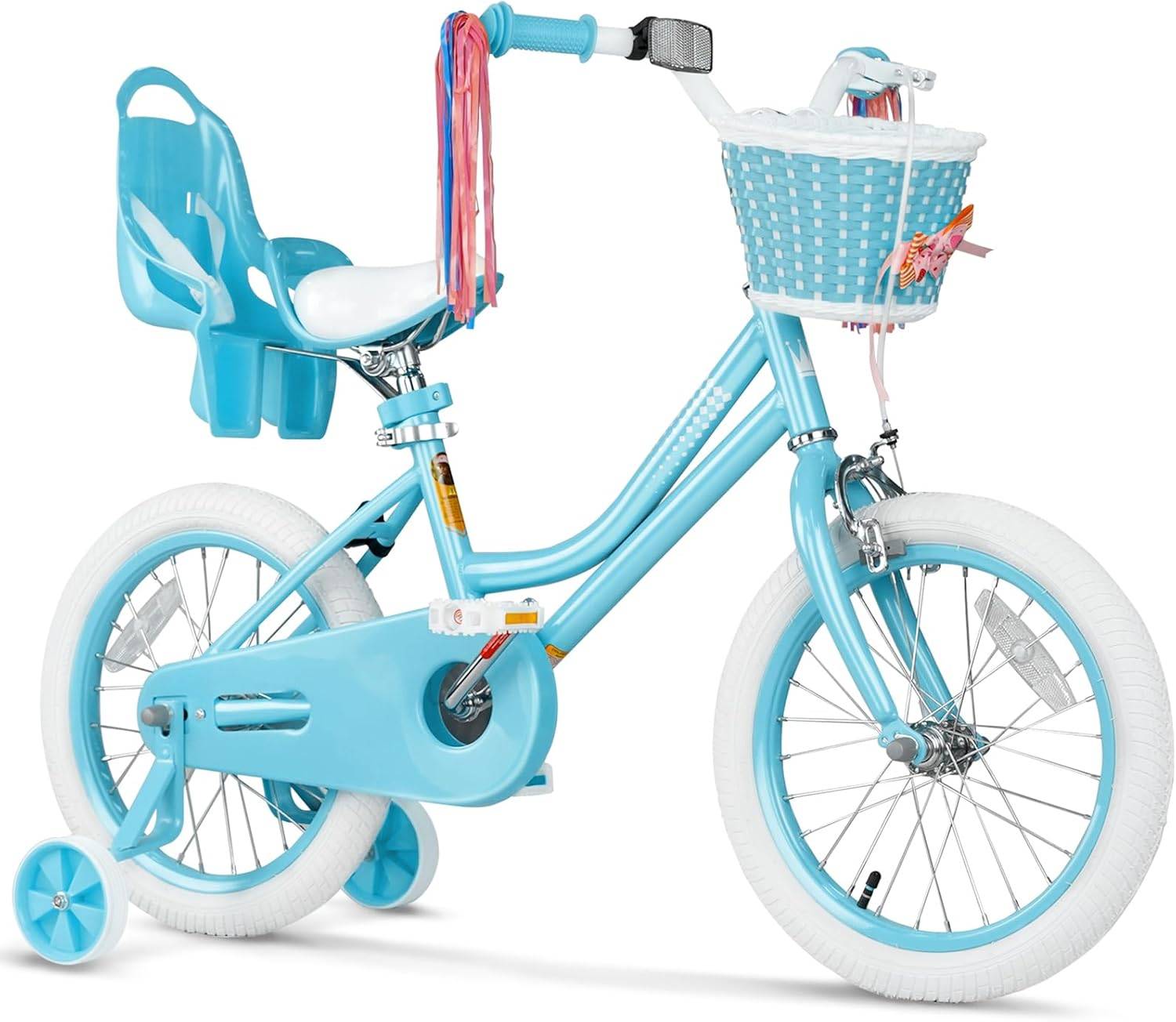 Blue XJD Girls Bike with Training Wheels – 12/14/16 Inch
Available in 12, 14 and 16 Inch labels with training wheels. These sizes span the XBikes starting ranges most relevant to a four-year-old, but an individual fit check remains essential.
Pink 12/14/16/20" XJD Girls Bike with Training Wheels & Basket is offered in 12 Inch, 14 Inch, 16 Inch and 20 Inch labels. For this question, compare only the size supported by the child’s measurements and trial; the 20 Inch starting range is ages 7–12 and 48–60 in / 122–152 cm, so it is generally outside a four-year-old comparison.
Light Pink XJD Girls' Bicycle with Basket & Training Wheels also has 12 Inch, 14 Inch, 16 Inch and 20 Inch labels. Its relevance is the same range of size choices, not proof that every listed size fits a four-year-old.
Blue XJD Girls Bike with Training Wheels – 12/14/16 Inch is available in 12 Inch, 14 Inch and 16 Inch labels. Those are the three most relevant XBikes starting points to compare for this age, subject to the child’s measured height and hands-on control.
Teach in small, controllable steps
- Choose a flat, open riding area away from traffic and obstacles.
- Begin with mounting, sitting, looking ahead and getting off calmly.
- Practice starting, steering and stopping separately before combining them.
- Keep early sessions brief and finish before fatigue or frustration affects control.
- Stay close enough to assist, while allowing the child to do the balancing and steering.
Training wheels can provide support while the child learns pedaling and steering, but they do not prove that the bicycle fits. Recheck reach, stand-over clearance and brake operation on the assembled bike. Follow the exact product manual for assembly, adjustment, maintenance, compatibility and load limits; use a qualified bicycle mechanic when anything is unclear.
Helmet fit and the final decision
Use a properly fitting bicycle helmet every time. It should sit level on the head, with its straps adjusted according to the helmet manufacturer’s instructions. Replace guesswork with a fit check for both helmet and bicycle before the first practice session.
The next step is simple: measure height and inseam, shortlist the matching 12-, 14- or 16-inch options, then let the child try the actual bike. If the child cannot stand over it, reach comfortably, steer and brake with control, choose a better-fitting size or wait before teaching them to ride.
Bikes for your next adventure
-
Purple XJD Girls' Bike with Doll Seat & Basket
For girls 71–122 cm tall (about ages 3–7), this XJD girls' bike in Purple pairs …$75.99
$99.99 -
XJD Light Purple Girls Bike with Basket, Training Wheels, 12/14/16/20 Inch
The XJD Girls Bike with Basket in Light Purple is a single-speed training-wheel …$99.99
$119.99 -

Black XJD Kids Bike for Boys – 12, 14 & 16 Inch Sizes
For a son between roughly 3 and 8 years old, the XJD Kids Bike in Black covers t…$169
$199