

What size of bike for a 4 year old
Most 4-year-olds should start by trying a 12-inch, 14-inch or 16-inch bike, chosen by measured height and an individual fit check—not age alone.
Choose the first wheel size by height
Measure the child without shoes, standing straight against a wall. Compare that height with the XBikes starting points below. Where ranges overlap, do not automatically choose the larger wheel: the child must still be able to stand over, reach, steer and brake comfortably.
| Wheel size | XBikes age starting point | Rider-height starting point |
|---|---|---|
| 12 Inch | Ages 3–4 | 34–40 in / 86–102 cm |
| 14 Inch | Ages 3–6 | 37–45 in / 94–114 cm |
| 16 Inch | Ages 4–7 | 40–48 in / 102–122 cm |
In practical terms, a 4-year-old measuring below 40 inches may begin with a 12- or 14-inch comparison. At 40 inches or taller, 14- and 16-inch models may both enter the comparison. These overlaps are invitations to test fit, not evidence that the sizes are interchangeable.
Measure inseam as well as total height
Height narrows the choices, but inseam helps reveal whether the child can manage the bike when stopped. With the child still barefoot or in thin socks, place a firm, level book between the legs and raise it gently to simulate a saddle. Measure vertically from the floor to the top edge of the book.
Do not convert that measurement into a wheel size using an unsupported formula. Instead, take it to the actual bicycle and check stand-over clearance according to the model’s manual. The child should not be forced onto tiptoes or pressed against the frame when standing over it. If the fit is uncertain, use a qualified bicycle mechanic.
Perform the fit check on the actual bike
The American Academy of Pediatrics advises having a child try the bicycle and avoiding an oversized model bought merely for growth. On each candidate, check the following:
- Stand-over: The child can stop and stand over the bicycle without the frame obstructing a stable stance.
- Reach: Seated normally, the child reaches the handlebar without stretching, locking the elbows or leaning excessively.
- Brake control: The child can reach and operate the fitted controls reliably. Confirm the exact brake operation in the product manual.
- Steering: The child can turn the handlebar both ways while remaining balanced and in control.
- Confidence: Starting, stopping and handling the bike do not cause fear or visible loss of control.
If two wheel sizes match the height chart, prefer the one the child can control now. A larger size that compromises stopping, reach or braking is not an appropriate fit simply because there is room to grow.
How the supplied XBikes options compare
The three catalog options are relevant because each offers 12-, 14- and 16-inch SKU labels, covering the XBikes starting ranges most likely to be compared for a 4-year-old. They help you compare candidate wheel labels after measuring, but the catalog labels do not replace an in-person fit check.
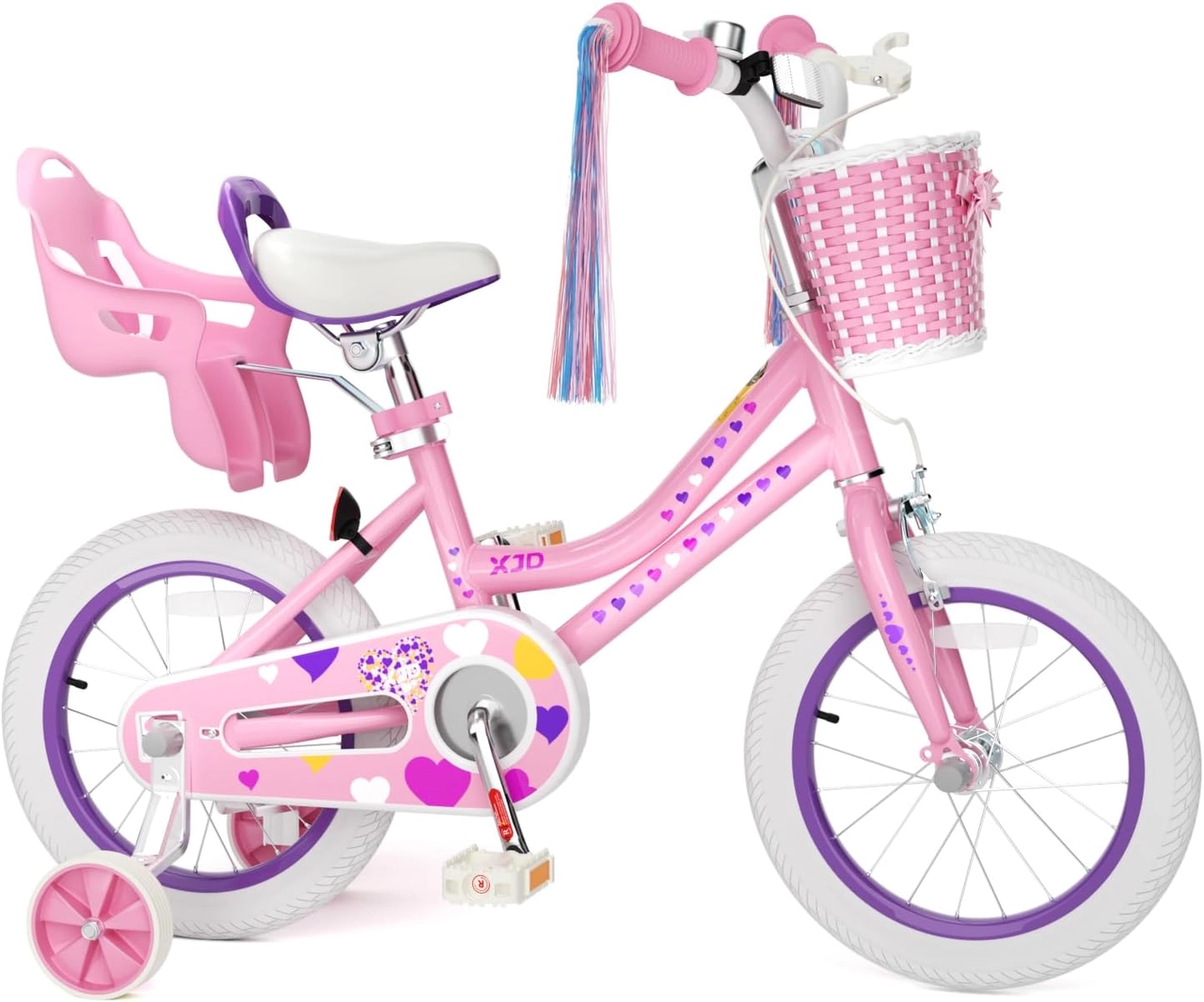 Pink Girls' 12/14/16" Bike by XJD – Basket & Doll Seat
Offers 12 Inch, 14 Inch and 16 Inch SKU labels, all useful comparison points for a 4-year-old after measuring height and completing an individual fit check.
 Pink 12/14/16/20" XJD Girls Bike with Training Wheels & Basket
Its 12 Inch, 14 Inch and 16 Inch choices are relevant fit candidates; the available 20 Inch label starts above the usual XBikes age and height range for a 4-year-old.
 Black XJD Kids Bike for Boys – 12, 14 & 16 Inch Sizes
Provides 12 Inch, 14 Inch and 16 Inch labels for comparing against the child’s measured height, inseam, reach, brake control and confidence.
Pink Girls' 12/14/16" Bike by XJD – Basket & Doll Seat is listed in Training Wheel Bikes with 12 Inch, 14 Inch and 16 Inch choices. Its title identifies a basket and doll seat; no further accessory, fit or compatibility details are supplied.
Pink 12/14/16/20" XJD Girls Bike with Training Wheels & Basket is also listed in Training Wheel Bikes. Its 12 Inch, 14 Inch and 16 Inch labels are relevant to this comparison. Although a 20 Inch SKU is available, the XBikes starting point for 20 Inch is ages 7–12 and 48–60 inches / 122–152 cm, so it is not the normal starting point for a 4-year-old.
Black XJD Kids Bike for Boys – 12, 14 & 16 Inch Sizes is listed in Training Wheel Bikes and provides the same three wheel-size labels central to this decision. Wording such as “girls” or “boys” in these catalog titles is not evidence of fit; use measurements and control instead.
Check setup and helmet fit before riding
After selecting a size, follow the exact product manual for assembly, adjustments, maintenance, compatibility, load limits and torque. None of those specifications is supplied here, so do not guess. Ask a qualified bicycle mechanic to inspect anything unclear.
A bicycle helmet is part of the pre-ride check. The U.S. Consumer Product Safety Commission advises that it fit properly, sit level and have its straps used according to the helmet manufacturer’s instructions.
Make the decision
Measure height and inseam, shortlist 12, 14 or 16 Inch from the chart, then have the child try the exact bike. Choose only the size on which this 4-year-old can stand over, reach, steer and operate the brakes confidently today.
Bikes for your next adventure
-

Pink Girls' 12/14/16" Bike by XJD – Basket & Doll Seat
The XJD Pink Girls' Bike with Basket & Doll Seat is made for riders 71–122 cm ta…$75.99
$99.99 -

XJD Girls Bike for Kids Ages 3-8, 12/14/16 Inch with Training Wheels – Purple
The XJD Girls Bike in Purple is a training-wheel bicycle for kids ages 3 to 8, f…$149
$169 -

Black XJD Toddler Bike Helmet, Adjustable – Kids' Protective Helmet
The XJD Toddler Bike Helmet in black is an adjustable protective helmet for kids…$20.39