

How big of bike for 4 year old
For most 4-year-olds, start by comparing a 12-inch, 14-inch and 16-inch bike. Measure the child first: height, inseam, reach and control matter more than age.
Which wheel size should you check?
At age four, a child may fall within more than one XBikes starting range. A 12-inch bike covers ages 3–4 and heights of 34–40 inches (86–102 cm). A 14-inch bike covers ages 3–6 and heights of 37–45 inches (94–114 cm). A 16-inch bike starts at age 4 and covers heights of 40–48 inches (102–122 cm).
| Wheel size | XBikes age starting point | Rider height |
|---|---|---|
| 12 Inch | 3–4 | 34–40 in / 86–102 cm |
| 14 Inch | 3–6 | 37–45 in / 94–114 cm |
| 16 Inch | 4–7 | 40–48 in / 102–122 cm |
These ranges overlap, so age cannot decide the size by itself. A four-year-old near 38 inches tall may compare 12-inch and 14-inch models, while one at 41 inches may compare 14-inch and 16-inch models. The correct choice is the one the child can physically control now.
Measure before choosing
Measure the child’s height without shoes, standing straight against a wall. Then measure inseam from the floor to the crotch while the child stands with feet slightly apart. Use those measurements to identify likely wheel sizes, but do not treat wheel diameter as a complete fit specification.
Frame shape, saddle adjustment and handlebar position can differ among bicycles with the same wheel label. Have the child try the exact bike whenever possible. Follow the exact product manual for adjustment limits and assembly instructions, or ask a qualified bicycle mechanic if the fit or setup is uncertain.
Perform a hands-on fit check
Once you have a likely size, check the child on the assembled bicycle:
- Stand-over: The child should be able to straddle the bicycle without the frame preventing a stable stance.
- Reach: The child should reach the handlebars without stretching, locking the elbows or losing a comfortable upright position.
- Brake control: If the bicycle has hand controls, confirm the child can reach and operate them. Check the exact model rather than assuming all small bikes use the same controls.
- Starting and stopping: The child should be able to get moving, steer, slow down and stop without the bicycle overwhelming them.
- Confidence: Watch for relaxed control rather than mere ability to sit on the saddle.
Do not move up to an oversized bicycle simply to allow room for growth. A bike that may fit later can make mounting, steering and stopping harder today.
How the supplied bikes help with comparison
The supplied catalog options are relevant because each offers multiple wheel-size labels spanning the likely 12-inch, 14-inch and 16-inch comparison for a four-year-old, and each is categorized as a training-wheel bike. They let you compare likely sizes, but the catalog labels do not replace the child’s measurements or a hands-on fit check.
 XJD Girls' Bike with Training Wheels, 12/14/16/20 Inch – Purple
Offers 12-inch, 14-inch and 16-inch sizes relevant to the age-four comparison, plus a 20-inch option outside the usual starting range for this question. It is categorized as a training-wheel bike.
 XJD Kids Bike for Girls – Pink, 12/14/16/20 Inch with Training Wheels
Its listed 12-inch, 14-inch and 16-inch options cover the sizes most worth comparing for a four-year-old. The additional 20-inch label should be judged against measured height, not selected for growth.
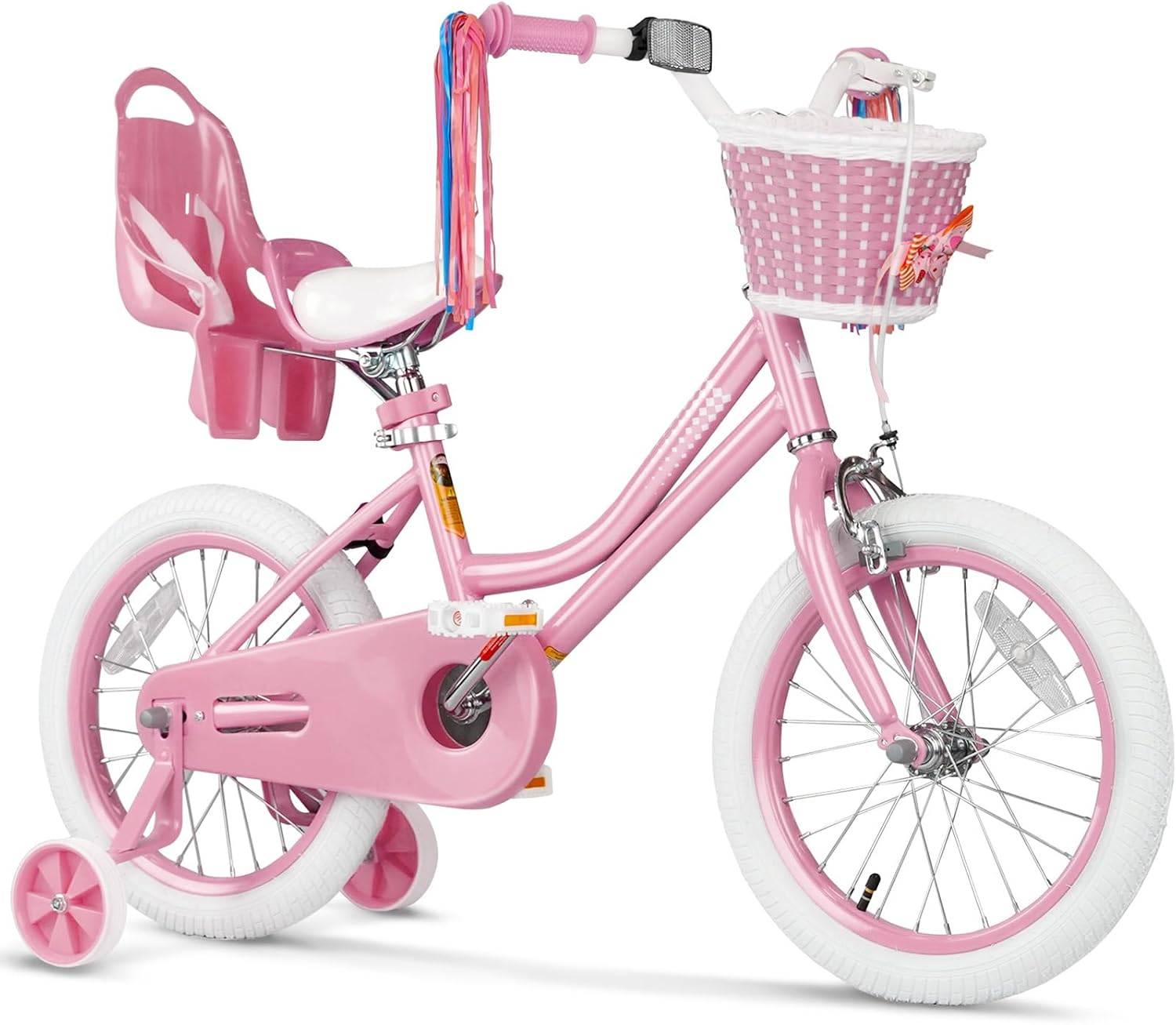 XJD Pink Girls' Bike – Kids 12/14/16 Inch Training Wheel Bicycle
Lists 12-inch, 14-inch and 16-inch options, matching the three likely comparison sizes for an age-four rider. As a training-wheel bike, it is relevant only when that setup suits the child’s current needs.
XJD Girls' Bike with Training Wheels, 12/14/16/20 Inch – Purple and XJD Kids Bike for Girls – Pink, 12/14/16/20 Inch with Training Wheels each list 12-inch, 14-inch, 16-inch and 20-inch options. For this question, focus on the first three sizes; the XBikes starting point for 20-inch bikes is ages 7–12 and heights of 48–60 inches (122–152 cm), so it is not an age-four default.
XJD Pink Girls' Bike – Kids 12/14/16 Inch Training Wheel Bicycle lists 12-inch, 14-inch and 16-inch options. Those are the three wheel sizes most directly worth comparing against the supplied age-four ranges. Any age wording within a product title is only a catalog label, not proof of individual fit.
Training wheels and current confidence
All three supplied products are training-wheel bikes. That makes them relevant when a parent specifically wants that setup, but training wheels do not determine frame fit. The child must still have suitable stand-over clearance, reach and control on the chosen size.
If the child already rides confidently without training wheels, these products may not match the intended setup even when a listed wheel size matches the child’s height. Use the manual for product-specific compatibility, setup, maintenance and load limits; do not infer those details from the title.
Make the final decision
Measure height and inseam, shortlist 12, 14 or 16 inches from the table, and have the child try the exact bicycle. Choose the size they can straddle, reach, steer and stop confidently now. Finish the setup with a properly fitting bicycle helmet worn level, with its straps secured according to the helmet manufacturer’s instructions.
Bikes for your next adventure
-

26-Inch XJD Beach Cruiser Bike for Girls – Purple, V-Brake
This XJD 26-inch purple beach cruiser is sized for big kids and teens — suggeste…$218.49
$229.99 -

Light Pink XJD Girls' Bicycle with Basket & Training Wheels
The Light Pink XJD Girls' Bicycle with Basket & Training Wheels is a retro-style…$109.99
$129.99 -

XJD Boys & Girls BMX Bike with Training Wheels, 12/14/16" – Blue
The XJD Boys & Girls BMX Bike in Blue is a first pedal bike for kids roughly age…$99.99
$119.99