

How tall of a bike for a 4 year old
For most 4-year-olds, start by comparing a 12-inch, 14-inch or 16-inch bike—but choose by measured height and individual fit, not age alone.
Which wheel size should you check first?
Measure your child’s standing height, then use the XBikes starting points below to narrow the search. The ranges overlap because children of the same age can differ in leg length, reach, coordination and confidence.
| Wheel size | XBikes age starting point | Rider height |
|---|---|---|
| 12 Inch | Ages 3–4 | 34–40 in / 86–102 cm |
| 14 Inch | Ages 3–6 | 37–45 in / 94–114 cm |
| 16 Inch | Ages 4–7 | 40–48 in / 102–122 cm |
A 4-year-old who is 38 inches tall might compare 12-inch and 14-inch models. At 40 inches, all three ranges meet, so a hands-on fit check matters especially. A child above 40 inches will usually begin with 14-inch and 16-inch comparisons. These figures are screening ranges, not a guarantee that every frame with that wheel size will fit.
Measure height and inseam before shopping
For height, have the child stand barefoot against a wall with heels down and posture relaxed. Mark the top of the head and measure from the floor to the mark.
For inseam, have the child stand barefoot with feet slightly apart. Place a firm, thin book between the legs and raise it gently to simulate a bicycle saddle, then measure vertically from the floor to the book’s top edge. Record both measurements in inches or centimeters.
Use standing height to select likely wheel sizes from the table. Keep the inseam measurement for checking stand-over room and saddle positioning on the actual bicycle. Wheel diameter alone does not reveal frame geometry, so there is no reliable way to choose from inseam without comparing it with the specific bike and its manual.
What a correct in-person fit looks like
Have your child try the bicycle rather than ordering a larger one solely to allow growth. Check these points with the bike supported by an adult:
- Stand-over: The child should be able to straddle the frame with feet planted and enough room to avoid contact with the frame.
- Starting and stopping: The child should be able to get on, start, stop and get off without the bike overwhelming them.
- Reach: Seated normally, the child should reach the handlebar without stretching, locking the elbows or losing a stable posture.
- Brake control: If the bicycle has hand-operated brake levers, the child must be able to reach and operate them confidently. Verify every braking control actually fitted to the bike.
- Confidence: Choose the size the child can control now. A technically plausible size is still unsuitable if the rider is frightened or cannot steer predictably.
If two wheel sizes appear possible, compare both in person. Favor the bicycle that permits better control today, rather than assuming the larger wheels will be useful longer.
How the supplied XBikes options help
The two supplied catalog models are training-wheel bikes offered with 12-inch, 14-inch, 16-inch and 20-inch SKU labels. That makes them relevant comparison options across the three likely starting sizes for many 4-year-olds. The Girls' Training Wheel Bike by XJD, 12–20 Inch Wheels – Blue and XJD Girls' Bike with Training Wheels, 12/14/16/20 Inch – Purple differ in catalog title and color wording, but the supplied facts establish the same available size labels for each. They do not establish frame dimensions, brake design, weight, materials or current availability.
 Girls' Training Wheel Bike by XJD, 12–20 Inch Wheels – Blue
Available in 12-, 14- and 16-inch comparison sizes relevant to many 4-year-olds, plus a 20-inch SKU that should be considered only against the supplied height standard and an individual fit check.
 XJD Girls' Bike with Training Wheels, 12/14/16/20 Inch – Purple
This purple training-wheel bike offers 12-, 14-, 16- and 20-inch SKU labels. Compare the child’s measured height with the XBikes ranges, then verify stand-over, reach, brake control and confidence in person.
Do not select the 20-inch version merely because it appears alongside the smaller sizes. The XBikes starting point for 20-inch wheels is ages 7–12 and a rider height of 48–60 inches / 122–152 cm, so it is generally outside the stated starting range for a 4-year-old. Measured fit and control remain decisive for every SKU.
Training wheels do not correct a poor fit
Training wheels can change how a child learns balance, but their presence does not make an oversized frame manageable. The rider still needs appropriate stand-over clearance, handlebar reach and brake control. Before riding, follow the exact product manual for assembly, adjustment, maintenance, compatibility and any limits. If the instructions are missing or any control cannot be set correctly, use a qualified bicycle mechanic.
Make the final choice
- Measure the child’s standing height and inseam.
- Shortlist 12-inch, 14-inch or 16-inch wheels using the XBikes height ranges.
- Have the child try each plausible size and check stand-over room, reach, braking, starting, stopping and steering.
- Reject any bike the child cannot control comfortably now, even if it promises more growing room.
- Fit a bicycle helmet so it sits level and secure, with its straps adjusted according to the helmet manufacturer’s instructions.
For a 4-year-old, the answer is therefore not one automatic wheel size: begin with the height-matched 12-, 14- or 16-inch options, then buy only the bicycle that passes the child’s current fit and control check.
Bikes for your next adventure
-
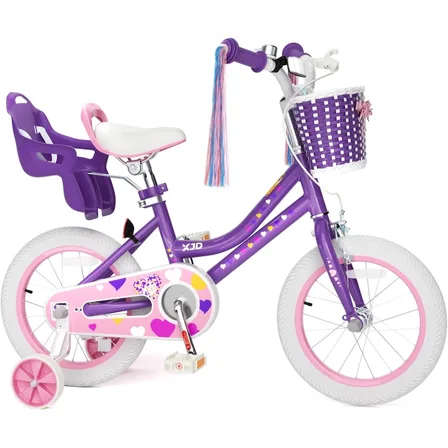
Purple XJD Girls' Bike with Doll Seat & Basket
For girls 71–122 cm tall (about ages 3–7), this XJD girls' bike in Purple pairs …$75.99
$99.99 -

Blue XJD Girls Bike with Training Wheels – 12/14/16 Inch
If you're shopping for a first pedal bike for a daughter roughly 3 to 8 years ol…$149
$169 -
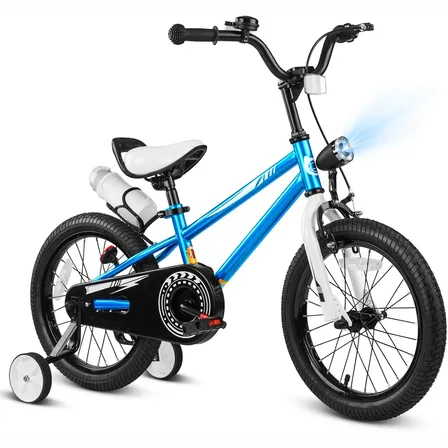
XJD Boys 12/14/16" Training Wheel Bike – Blue
The XJD Boys Bike in Blue is a training wheel bike for riders 71–122 cm tall—rou…$169
$199