

What bike for 4 year old
For most 4-year-olds, start by comparing a 12-inch, 14-inch and 16-inch bike. Measure height first, then confirm stand-over clearance, reach, brake control and confidence on the actual bicycle.
Which wheel size should you try first?
Age four sits across three XBikes starting ranges, so age alone cannot choose the bike. Use your child’s current measured height to narrow the options:
| Wheel size | XBikes age starting point | Rider height starting point |
|---|---|---|
| 12 Inch | Ages 3–4 | 34–40 in / 86–102 cm |
| 14 Inch | Ages 3–6 | 37–45 in / 94–114 cm |
| 16 Inch | Ages 4–7 | 40–48 in / 102–122 cm |
A child near 38 inches, for example, falls within both the 12-inch and 14-inch starting ranges. That overlap means you should compare both sizes in person rather than automatically choosing the larger one. A 16-inch bike becomes a starting candidate at 40 inches / 102 cm, but it is suitable only if the complete fit check also works.
Do not move up to an 18-inch bike merely because your child has turned four. The XBikes starting point for that size is ages 5–9 and 43–52 inches / 109–132 cm. More importantly, buying an oversized bicycle for future growth can make starting, stopping and steering harder.
Measure before comparing bicycles
Measure your child without shoes, standing straight against a wall, and record the height. Then measure the inseam from the floor to the crotch. The supplied wheel-size chart uses height, while the inseam helps you assess stand-over clearance on the actual bicycle.
Bring those measurements when trying a bike, but treat them as screening information rather than a guarantee. Frame shapes and adjustment ranges can differ. Follow these checks:
- Stand-over: Have the child straddle the bicycle with both feet on the ground. There should be usable clearance rather than pressure from the frame.
- Reach: Check that the child can hold the handlebar without stretching, locking the elbows or leaning excessively.
- Brake control: If the bicycle has hand controls, confirm the child can reach and operate them reliably. Do not assume a listed wheel size proves this.
- Starting and stopping: The child should be able to get into position, look ahead, steer and stop without the bicycle overwhelming them.
- Confidence: Choose the size the child can control now, even when a larger size appears to offer more growing room.
How the supplied XBikes options compare
These particular catalog options help answer “what bike for a 4 year old” because each offers at least one of the relevant 12-inch, 14-inch or 16-inch sizes, allowing you to compare candidates after measuring the rider.
 XJD Boys & Girls BMX Bike with Training Wheels, 12/14/16" – Blue
Available in 12 Inch, 14 Inch and 16 Inch labels, this Kids' BMX Bikes option covers all three XBikes starting size ranges commonly relevant at age four, pending an individual fit check.
 Girls' Training Wheel Bike by XJD with Basket – Purple
This Training Wheel Bikes option offers 14 Inch and 16 Inch sizes relevant to some measured 4-year-olds. Its 20 Inch label is outside the supplied age-four starting ranges and requires the stated larger-rider range.
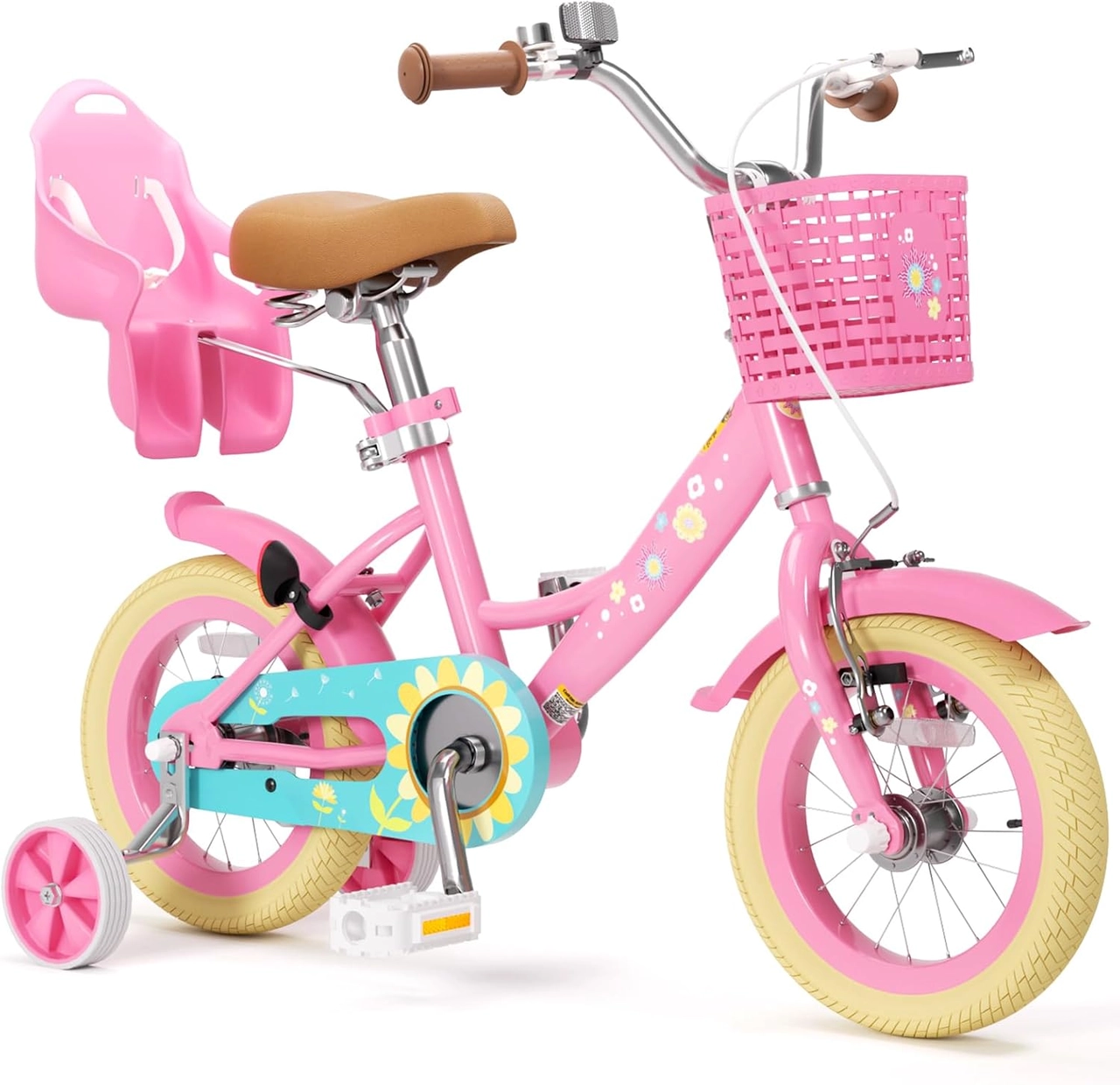 Flower Pink XJD Girls Bike with Doll Seat & Basket
With 12 Inch, 14 Inch and 16 Inch labels, this Training Wheel Bikes model provides three size candidates to compare after measuring height and confirming stand-over, reach, control and confidence.
XJD Boys & Girls BMX Bike with Training Wheels, 12/14/16" – Blue is listed under Kids’ BMX Bikes and has 12 Inch, 14 Inch and 16 Inch SKU labels. That makes it relevant across all three starting ranges commonly encountered at age four, subject to an individual fit check.
Girls' Training Wheel Bike by XJD with Basket – Purple is listed under Training Wheel Bikes and has 14 Inch, 16 Inch and 20 Inch SKU labels. For a 4-year-old, compare only the 14-inch or 16-inch versions when the child’s height supports them. The 20-inch size starts at ages 7–12 and 48–60 inches / 122–152 cm, so age four by itself does not support that choice.
Flower Pink XJD Girls Bike with Doll Seat & Basket is also listed under Training Wheel Bikes and has 12 Inch, 14 Inch and 16 Inch SKU labels. Like the blue XJD option, it lets you investigate all three relevant starting sizes without assuming that every size fits every 4-year-old.
Those catalog labels establish available size choices and product categories only. They do not establish frame clearance, control reach, brake operation, assembly details, load limits or compatibility for your child.
Training wheels do not replace correct fit
All three supplied titles refer to training wheels, but that feature does not make an oversized bicycle appropriate. Your child still needs comfortable stand-over clearance, a manageable reach and dependable control. Current confidence matters too: a hesitant beginner may handle a smaller suitable option more comfortably than the largest size allowed by height.
For assembly, adjustment, maintenance, load limits, compatibility and torque requirements, follow the manual for the exact product and size. If anything is unclear or the bicycle cannot be adjusted correctly, use a qualified bicycle mechanic.
Complete the safety check
Have your child try the bicycle rather than relying on the box label or birthday. Recheck that the feet can reach the ground as intended, the handlebar is comfortably accessible and every fitted control can be used without shifting the hands into an unstable position.
A bicycle helmet must fit properly, sit level and have its straps adjusted according to the helmet manufacturer’s instructions. Replace guesswork with a fresh fit check whenever the child grows or the bicycle or helmet is adjusted.
Your next decision
Measure height and inseam today. Shortlist 12 Inch at 34–40 inches, 14 Inch at 37–45 inches, or 16 Inch at 40–48 inches, then have your 4-year-old try every overlapping candidate. Buy only the size they can comfortably straddle, reach, control and stop now—not the size you hope they will grow into.
Bikes for your next adventure
-

Pink Girls' 12/14/16" Bike by XJD – Basket & Doll Seat
The XJD Pink Girls' Bike with Basket & Doll Seat is made for riders 71–122 cm ta…$75.99
$99.99 -

XJD Girls Bike for Kids Ages 3-8, 12/14/16 Inch with Training Wheels – Purple
The XJD Girls Bike in Purple is a training-wheel bicycle for kids ages 3 to 8, f…$149
$169 -

Light Purple XJD Toddler Bike Helmet, Adjustable, Size XS (46–51 cm)
This Light Purple XJD toddler bike helmet is made for the smallest riders — the …$20.39